Egyptian Gods: Names, Stories, Symbols & Ancient Beliefs
Explore the rich pantheon of ancient Egypt, examining their divine roles, sacred symbols, mythological stories, and how their legacy endures across monumental temples.
The Egyptian Gods formed the cornerstone of a complex, sophisticated religious system that sustained one of history's longest-lasting civilizations. When planning your cultural journey, reviewing our Complete Egypt Trip Cost Guide for 2026 and learning about the Best Time to Visit Egypt will help you prepare effectively. For international travelers wondering about paperwork, checking visa requirements for Egypt is essential before departure.
Who were the Egyptian gods? To the ancient Egyptians, deities were powerful cosmic forces and divine administrators who maintained Ma'at—the fundamental cosmic order of truth, balance, and justice. Understanding these divine beings requires looking beyond simplistic modern labels to examine how religion evolved over three millennia across different nomes, cities, and royal dynasties.

Who Were the Egyptian Gods?
The religious framework of ancient Egypt was not a single, unified dogmatic system established on day one. Instead, the ancient Egyptian gods and goddesses developed over thousands of years through regional cults, political shifts, and theological synthesis. Different cities, such as Heliopolis, Memphis, Thebes, and Hermopolis, maintained their own creation myths and principal deities.
Rather than viewing their pantheon through a strictly monotheistic or polytheistic lens as understood today, ancient Egyptians practiced a fluid form of worship where local gods could be elevated to national prominence when their home cities rose to political power. Priests and scribes continuously reinterpreted divine relationships, resulting in a rich tapestry of overlapping powers, syncretism, and regional variations.
The Most Famous Egyptian Gods and Goddesses
While ancient Egypt recognized hundreds of divine entities, several major figures held central positions in state religion, mythology, and popular devotion. Below is an examination of the most prominent Egyptian god names and their historical significance.
Ra
Ra was the primordial sun god, predominantly centered at Heliopolis. He was visualized as the creator who traversed the sky during the day in a solar barge and navigated the perilous underworld at night. Kings of Egypt claimed descent from him, adopting the title "Son of Ra." Over time, Ra merged with other solar and state deities, most notably Amun, forming Amun-Ra during the New Kingdom.
Osiris
Osiris stands as one of the most enduring figures among ancient Egyptian gods and goddesses. As the lord of the dead and judge of the underworld, Osiris symbolized resurrection, agricultural fertility, and cyclical renewal. According to myth, he was murdered by his jealous brother Set, resurrected through the magic of his wife Isis, and became the eternal ruler of the afterlife.
Isis
Isis was the quintessential mother goddess, associated with magic, healing, motherhood, and royal protection. As the wife of Osiris and mother of Horus, her devotion spanned millennia, eventually spreading throughout the Greco-Roman world. Her temples, particularly at Philae, remained centers of active worship long after other ancient traditions had faded.
Horus
Depicted as a falcon or a falcon-headed man, Horus was intimately tied to divine kingship. As the son of Osiris and Isis, he avenged his father's death by defeating Set in epic mythological battles. The living pharaoh was considered the earthly embodiment of Horus, while his damaged and restored eye—the Eye of Horus—became a powerful amulet of healing, protection, and wholeness.
Anubis
Often mischaracterized in modern media solely as a terrifying entity, Anubis was the jackal-headed deity of embalming, cemeteries, and the protection of the dead. Egyptians observed jackals prowling near desert burial grounds, leading them to associate the animal with guarding tombs. Anubis presided over the weighing of the heart ceremony in the Hall of Two Truths, guiding souls safely into eternity.
Amun
Originally a local god of Thebes whose name meant "The Hidden One," Amun rose during the New Kingdom to become the supreme king of the gods. Centered at the monumental Karnak Temple complex, Amun wielded immense political and economic power. Combined with Ra as Amun-Ra, he received vast tributes that funded much of imperial Egypt's monumental architecture.
Thoth
Thoth was the divine arbiter of wisdom, science, writing, magic, and measurement. Often depicted with the head of an ibis or as a baboon, he served as the scribe of the gods and inventor of hieroglyphs. Thoth recorded the outcomes of the judgment of the dead and maintained cosmic balance through divine decree.
Bastet
Bastet evolved from a fierce warrior lioness in early Egyptian history into the beloved cat-headed goddess of home, fertility, and domestic protection. Cats were revered in her honor, and households across Egypt kept felines to ward off vermin and evil spirits, celebrating grand annual festivals marked by enthusiastic pilgrimage and devotion.
Sekhmet
In contrast to Bastet's domestic nature, Sekhmet was the powerful lioness goddess of warfare, plague, and healing. Known as the "Lady of Slaughter," she was feared for her destructive fury yet revered for her ability to ward off disease. Physicians and priests invoked her power to halt epidemics and protect the pharaoh in battle.
Ptah
Ptah was the supreme creator god of Memphis, revered by craftsmen, architects, and artisans. According to Memphite theology, Ptah did not create the universe through physical labor or combat, but conceived it in his heart and spoke it into existence through his tongue. Sculptors and metalworkers viewed him as their patron deity.
Hathor
Hathor was a multifaceted goddess of motherhood, joy, music, dance, foreign lands, and mining. Often depicted as a cow, or as a woman bearing cow horns and a solar disk, she welcomed deceased souls into the afterlife and embodied feminine grace across temples such as Dendera.
Sobek
Sobek, the crocodile god, personified the dangerous power of the Nile River and agricultural fertility. Worshiped intensely in the Faiyum oasis and at Kom Ombo, live crocodiles were adorned with jewelry, kept in sacred temple pools, and mummified upon death to honor his ferocious protective qualities.
Set
Set represented the desert, storms, foreign lands, chaos, and confusion. While modern storytelling often reduces him simply to a villainous "god of evil," ancient theology was more nuanced. Set protected the sun barge from the serpent Apophis during its nocturnal journey, making his chaotic strength a necessary component of cosmic balance.

Egyptian Gods List
To navigate the vast Egyptian mythology gods landscape, the reference table below outlines major deities, their primary roles, symbolic animals or objects, and main historical associations.
| Egyptian God/Goddess | Main Role | Symbol/Animal | Major Association |
|---|---|---|---|
| Ra | Sun and creation | Solar disk, hawk | Heliopolis, kingship |
| Osiris | Underworld and resurrection | Crook, flail, mummy | Afterlife, agriculture |
| Isis | Motherhood, magic, protection | Throne, wings | Osirian myth, Philae |
| Horus | Kingship and sky | Falcon, Eye of Horus | Living pharaoh, Edfu |
| Anubis | Embalming and mortuary protection | Jackal | Cemeteries, judgment |
| Amun | King of the gods, hidden power | Ram, plumed crown | Thebes, Karnak Temple |
| Thoth | Wisdom, writing, moon | Ibis, baboon | Hermopolis, scribes |
| Bastet | Home, protection, fertility | Cat, sistrum | Bubastis, domestic life |
| Sekhmet | Warfare, healing, destruction | Lioness | Memphis, plague protection |
| Ptah | Master builder, creation | Djed pillar, staff | Memphis, craftsmen |
| Hathor | Joy, music, motherhood | Cow, horns, sun disk | Dendera, love |
| Sobek | Nile waters, fertility | Crocodile | Kom Ombo, Faiyum |
| Set | Desert, storms, chaos | Unknown composite beast | Nubian border, royal combat |
| Nephthys | Mourning, night, protection | Basket and house hieroglyph | Funeral rites, sister of Isis |
| Nut | Sky goddess | Starlit woman arching over earth | Cosmic vault, protection |
| Geb | Earth god | Goose, recumbent man | Vegetation, foundation of earth |
| Ma'at | Truth, justice, cosmic balance | Ostrich feather | Weighing of the heart |
| Khnum | Potter god, inundation | Ram with horizontal horns | First cataract, Elephantine |
| Mut | Mother goddess, queen of gods | Vulture, double crown | Thebes, consort of Amun |
| Wadjet | Lower Egypt protection | Cobra (Uraeus) | Buto, royal crown |
| Nekhbet | Upper Egypt protection | Vulture | Nekheb, royal protection |
| Taweret | Childbirth and pregnant women | Bipedal hippopotamus | Household protection |
| Khepri | Morning sun, rebirth | Scarab beetle | Self-creation, renewal |
| Atum | Primordial creator | Man wearing double crown | Heliopolis Ennead |
| Aten | Solar disk | Sun rays ending in human hands | Amarna period monolatry |
Egyptian Gods and Their Symbols
Visual representation was paramount in ancient Egyptian religion. Egyptian god symbols and animal imagery were not literal zoolatry; rather, animals possessed specific traits that theological thinkers used to articulate divine attributes. For example, the swiftness and soaring height of the falcon mirrored the solar majesty of Horus, while the protective ferocity of a mother lioness personified Sekhmet.
Key iconographic pairings included:
- Ra: The solar disk crowned with a sacred cobra (Uraeus).
- Horus: The falcon and the royal Eye of Horus.
- Anubis: The black jackal alerting guardians of the necropolis.
- Bastet: The domestic cat and the sacred musical rattle (sistrum).
- Sobek: The Nile crocodile resting upon riverbanks.
- Thoth: The ibis bird and the scribe's palette.
- Sekhmet: The raging lioness crowned with the solar disk.
- Hathor: Cow ears, cow horns encasing the sun, or a broad collar necklace.
- Osiris: Wrapped in linen like a mummy, holding the royal crook and flail.
- Isis: Wearing a throne-shaped headdress or spreading protective vulture wings.
Egyptian Gods and Their Powers
Modern descriptions that label a deity simply as the "god of X" often oversimplify complex theological realities. Many gods of ancient Egypt possessed overlapping responsibilities. For instance, several deities were linked to healing, solar movement, or protection during childbirth.
Deities were understood to govern cosmic and earthly domains simultaneously. Ra commanded the physical sun while sustaining political kingship; Osiris governed subterranean geography while regenerating vegetation in the black silt of the Nile valley; Thoth adjudicated divine disputes while granting human scribes mastery over mathematics and language. Powers were dynamic, negotiated through temple ritual, offerings, and royal patronage.
The Most Important Egyptian God: Was There One?
A common inquiry concerns whether ancient Egypt ever settled on a single supreme deity. The answer is nuanced. While the Amarna period under Akhenaten (c. 1353–1336 BCE) witnessed an unprecedented focus on the Aten—the sun disk—as the sole universal creator god, this experiment was an historical exception.
Throughout most of Egyptian history, supremacy shifted with political dynasties. When Thebes dominated, Amun-Ra reigned supreme; during earlier eras, Ra of Heliopolis or Ptah of Memphis held primacy. Rather than rigid monotheism, Egyptian theology practiced syncretism—merging deities (such as Amun-Ra or Ra-Horakhty) to unite regional power bases into national state religion.
Egyptian Gods and Pharaohs
The pharaoh stood at the intersection between the human and divine worlds. Kingship was inherently divine: the living monarch was viewed as the manifestation of Horus, while the deceased king became identified with Osiris.
Temple reliefs across the Nile Valley depicted pharaohs offering incense, wine, and ritual figures to the gods in exchange for military victory, agricultural abundance, and eternal stability. This reciprocal exchange, known as maintaining Ma'at, legitimized royal authority and bound the economic wealth of the state to temple treasuries.

Egyptian Gods and the Afterlife
The journey to the afterlife was governed by specific deities who tested, protected, and judged the deceased. Guided by Anubis, the soul entered the Hall of Two Truths. Here, before a tribunal of forty-two divine judges, the heart of the deceased was weighed upon a golden scale against the ostrich feather of Ma'at, representing truth and cosmic order.
Thoth recorded the verdict, while the fierce devourer Ammit stood ready to consume unworthy souls. Those justified by Osiris passed into the Field of Reeds—an idealized eternal duplicate of the fertile Nile Delta.
The Story of Osiris, Isis, Set and Horus
The most famous narrative cycle in Egyptian mythology explained the cyclical nature of life, death, and royal succession. Osiris ruled Egypt benevolently until his envious brother Set murdered him, trapping his body in a chest and casting it into the Nile.
Isis, fiercely devoted, tracked down the chest and used her potent magic to temporarily resurrect Osiris long enough to conceive their son, Horus. Set subsequently tore Osiris's body into fourteen pieces and scattered them across Egypt. Isis and her sister Nephthys recovered all the pieces, binding them together in history's first mummification.
When Horus reached adulthood, he waged a protracted series of legal and physical battles against Set for the throne of Egypt. Although Horus lost his left eye in the struggle (later restored as the magical Eye of Horus), the divine tribunal ultimately declared Horus the rightful king of the living, while Osiris assumed eternal sovereignty over the underworld.
Egyptian Gods in Ancient Egyptian Temples
Temples were not public houses of worship in the modern congregational sense; they were earthly palaces and fortresses for the gods. Only high priests and the pharaoh entered the sacred inner sanctuary to wash, clothe, and feed the divine cult statue daily.
Major deities were anchored to grand architectural complexes:
- Karnak Temple: Dedicated primarily to Amun, Mut, and Khonsu.
- Luxor Temple: Center for the annual Opet festival celebrating divine kingship and Amun.
- Edfu Temple: The best-preserved sanctuary dedicated to Horus.
- Kom Ombo Temple: Uniquely dual-dedicated to Sobek and Horus the Elder.
- Dendera Temple: Renowned for its exquisite shrines to Hathor and astronomical ceilings.
- Philae Temple: The island sanctuary celebrating Isis.
- Abu Simbel: Rock-cut monuments celebrating Ramses II alongside Amun-Ra, Ra-Horakhty, and Ptah.
Where Can You See Egyptian Gods in Egypt Today?
For international travelers and history enthusiasts, encountering the pantheon firsthand is the highlight of an Egyptian expedition. You can explore these divine representations by booking our curated Egypt Tours or comprehensive Egypt Travel Packages.
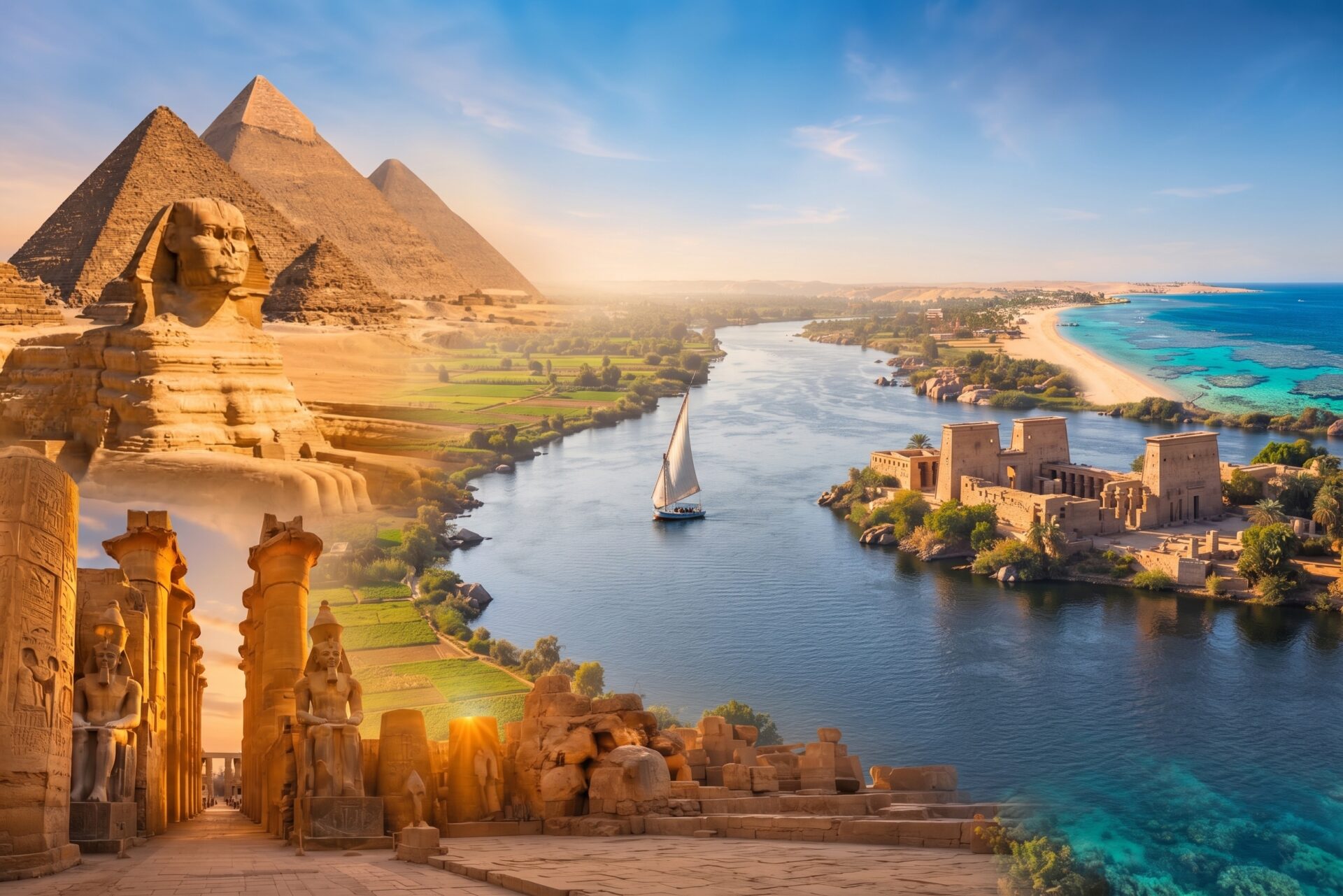
In Cairo and Giza, the Egyptian Museum in Tahrir Square and the Grand Egyptian Museum house thousands of statues, golden sarcophagi, and amulets depicting Anubis, Osiris, Hathor, and Tutankhamun's divine guardian figures. You can also experience these artifacts up close through The Giza Pyramids and GEM Tour. Day trips via our Giza, Saqqara, and Memphis Tour reveal early pyramid texts and depictions of Ptah. To plan your budget, check our Pyramids and Cairo Tour Prices and Cairo and Giza Day Trip Pricing. If you want to experience the city after sunset, book the Cairo by Night Tour, or explore regional history through our Saint Catherine Monastery Tour and The Holy Family's Journey in Egypt guide.
Traveling south to Luxor, the towering pylons of Karnak and Luxor temples immerse visitors in the world of Amun-Ra. Along the Nile, embarking on a 4-Day Nile Cruise or an extensive 8-Day Cairo, Luxor & Aswan Nile Cruise Tour allows travelers to stop at Edfu to explore the magnificent falcon halls of Horus and Kom Ombo to examine crocodile reliefs dedicated to Sobek. You can also combine northern and southern highlights with our Cairo and Alexandria Egypt Tour Packages.
In Aswan and Nubia, the rescued temples of Philae celebrate the enduring cult of Isis, while the colossal facade of Abu Simbel displays monumental rock-cut statues of Ramses II flanked by solar deities. For seamless logistics across all destinations, you can arrange Private Transportations & Travel Services or book a professional Luxury Car Rental with Driver in Egypt.

Egyptian Gods vs Egyptian Goddesses
Female deities held immense power, independence, and respect within the Egyptian pantheon. Goddesses such as Isis, Hathor, Sekhmet, Bastet, Mut, and Ma'at were not subordinate figures; they wielded sovereign authority over magic, war, justice, and creation.
Ma'at personified the cosmic law to which even kings and gods were subject. Isis was revered as cleverer than a million gods combined, commanding magical secrets that even outwitted Ra. The balance between male and female energies was fundamental to maintaining cosmic harmony across Egyptian civilization.
Did Ancient Egyptians Believe in These Gods Literally?
Applying modern categories of religious "belief" to ancient Egypt requires caution. Egyptians did not necessarily think of their gods as static cartoon characters dwelling in the clouds; rather, they understood divinity as manifest in natural phenomena, royal authority, and sacred iconography.
Ritual action, temple maintenance, offerings, and festivals were paramount. The active performance of cult rituals sustained the universe and kept chaos at bay. The sacred texts, temple walls, and amulets functioned as living bridges connecting the human sphere with eternal cosmic truths.
Egyptian Gods FAQ
Who are the Egyptian gods?
The Egyptian gods were divine beings and cosmic forces worshiped in ancient Egypt to maintain cosmic order, fertility, health, and protection across a civilization spanning over three millennia.
Who is the most famous Egyptian god?
Ra, Osiris, Isis, and Horus are among the most famous Egyptian gods, celebrated globally for their central roles in creation myths, royal lineage, and afterlife traditions.
Who are the 5 main Egyptian gods?
While importance varied by era, Ra (sun), Osiris (underworld), Isis (motherhood/magic), Horus (kingship), and Anubis (embalming) are widely recognized as core figures in Egyptian mythology.
Who is the Egyptian god of death?
Ancient Egypt did not have a single "god of death" in the grim reaper sense. Instead, Osiris ruled the underworld and resurrection, while Anubis managed embalming and cemeteries.
Who is the Egyptian sun god?
Ra was the primary sun god, though other solar deities such as Khepri (morning sun), Atum (setting sun), and Aten (the solar disk) were worshiped during various periods.
Who is the Egyptian god of the underworld?
Osiris was the principal lord and judge of the underworld, presiding over the resurrection of the dead and the weighing of the heart.
Who is the Egyptian goddess of love?
Hathor was the primary goddess of love, joy, music, dance, motherhood, and feminine beauty in ancient Egypt.
Who is the Egyptian god with a jackal head?
Anubis, the deity of embalming and guardian of cemeteries, is famously depicted with the head of a black jackal.
Who is the Egyptian god with a falcon head?
Horus, the sky and kingship god, is traditionally depicted as a falcon or a falcon-headed man.
What are the 10 most famous Egyptian gods?
The ten most famous deities include Ra, Osiris, Isis, Horus, Anubis, Amun, Thoth, Bastet, Sekhmet, and Hathor.
Why did Egyptian gods have animal heads?
Animal-headed iconography was symbolic rather than literal. Egyptians used specific animal characteristics—such as the vigilance of a jackal or the soaring flight of a falcon—to visually express complex divine attributes.
What did Egyptian gods represent?
Egyptian gods represented natural forces, cosmic balance (Ma'at), royal legitimacy, moral order, and the cyclical regeneration of life, the Nile, and the sun.
Explore More Egypt Travel Experiences
To continue planning your exploration of ancient heritage, discover our comprehensive guides and Egypt Travel Packages.
Experience the Temples of Ancient Egypt Firsthand
Stand before the monumental sanctuaries of Luxor, Karnak, and Edfu with expert Egyptologists. Browse our handcrafted Egypt Tours to begin your journey.
Explore Egypt Tours