The Ouroboros Symbol: Ancient Egyptian Origins, Meaning & History
The Ouroboros Symbol is one of the most intriguing images in the history of mythology. Usually shown as a serpent biting its own tail, it forms a closed circle with no obvious beginning or end. Today, many people associate the Ouroboros with eternity, renewal, unity, and the repeating cycles of life. Yet the symbol's history is more nuanced than a single modern definition suggests.
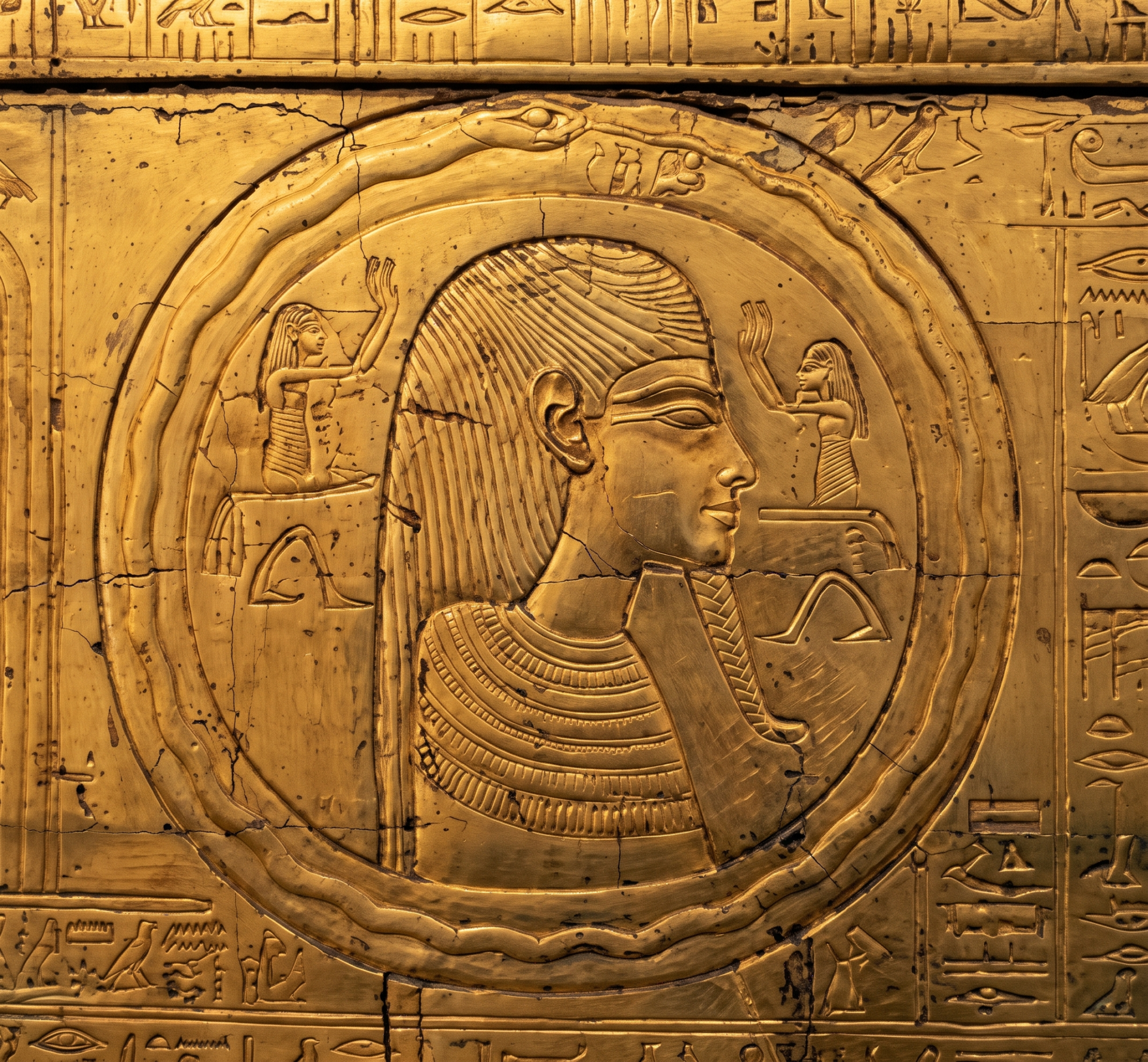
One of the earliest known examples of this tail-biting serpent appears in the royal funerary imagery associated with the second shrine of Pharaoh Tutankhamun, dating to the New Kingdom. In that setting, the serpent belongs to a complex religious composition concerned with the underworld and the relationship between solar and Osirian divinity. Later Greek-speaking, Roman, Gnostic, and alchemical traditions gave the image new interpretations, helping it become a familiar emblem of continuity and transformation.
This guide explores the Ouroboros Symbol in ancient Egypt, the evidence from Tutankhamun's shrine, its relationship to the protective serpent Mehen, and the meanings that developed in later cultures. It also explains how to distinguish historical evidence from popular interpretations, so readers can understand the motif without assuming that every culture used it in exactly the same way.
1. What Is the Ouroboros Symbol?
The Ouroboros Symbol depicts a serpent, snake, or dragon consuming its own tail. The creature's body forms a ring, creating an image that appears self-contained and continuous. The word Ouroboros comes from ancient Greek and is commonly translated as “tail-devourer.” The name describes the visual motif, but it does not prove that every society using the image gave it the same meaning.
In popular culture, the circular serpent is often described as a universal emblem of eternal return. That is one influential interpretation, especially in later philosophy and alchemy. In an ancient Egyptian setting, however, a serpent's meaning depended on its role in the scene, the identity of the figures it surrounded, and the religious text accompanying the image.
Serpents had varied roles in Egyptian thought. Some embodied threats that had to be overcome; others acted as protectors of gods, kings, and the dead. A circular serpent surrounding a divine figure therefore cannot be interpreted from its shape alone. Historians consider the surrounding iconography and inscriptions before drawing conclusions about its meaning.
| Common interpretation | What it suggests | How to treat it historically |
|---|---|---|
| Eternity | A continuous process without a clear endpoint | A prominent later interpretation; not automatically the only meaning of an Egyptian image |
| Renewal | Life or order returning after a period of darkness or change | Useful when discussing Egyptian solar and funerary beliefs, with context |
| Unity | Different parts belonging to one whole | Explicitly important in some later alchemical imagery |
| Protection | A guardian enclosing or defending a figure | Relevant to Egyptian protective-serpent traditions |
| Transformation | Change that forms part of an ongoing process | Common in modern explanations and later esoteric traditions |
2. The Ouroboros Symbol in Ancient Egypt
The early Egyptian history of the Ouroboros Symbol is closely connected with the country's rich traditions of royal funerary art and religious texts. In ancient Egypt, images were not simply decorative. Their placement, accompanying inscriptions, and relationship to particular gods often contributed to a larger statement about kingship, protection, the cosmos, and existence after death.
A well-known early example of a tail-biting serpent appears in imagery associated with Tutankhamun's second gilded shrine. The shrine dates to the fourteenth century BCE and formed part of the elaborate funerary equipment in the king's tomb. The imagery is connected with enigmatic underworld compositions and the theological relationship between the sun god Ra and Osiris, a major god of the dead and regeneration.
John Coleman Darnell's scholarly study, The Enigmatic Netherworld Books of the Solar-Osirian Unity, examines the cryptographic religious compositions associated with Tutankhamun's shrine and other royal tombs. The work provides important context for understanding why the image should be studied as part of a complex theological scene rather than as an isolated sign with a simple one-line definition. See the academic reference at Yale University's publication record.
Serpent imagery in Egypt was not limited to one deity or idea. Mehen could protect the sun god on his journey through the underworld, while Apophis represented a dangerous force opposing the sun's progress. The contrast shows why the same broad animal category could carry different associations depending on context.
For a broader introduction to Egyptian gods and religious figures, readers can continue with our guide to Egyptian civilization, gods, and mythology.
3. Tutankhamun's Shrine and the Serpent Image
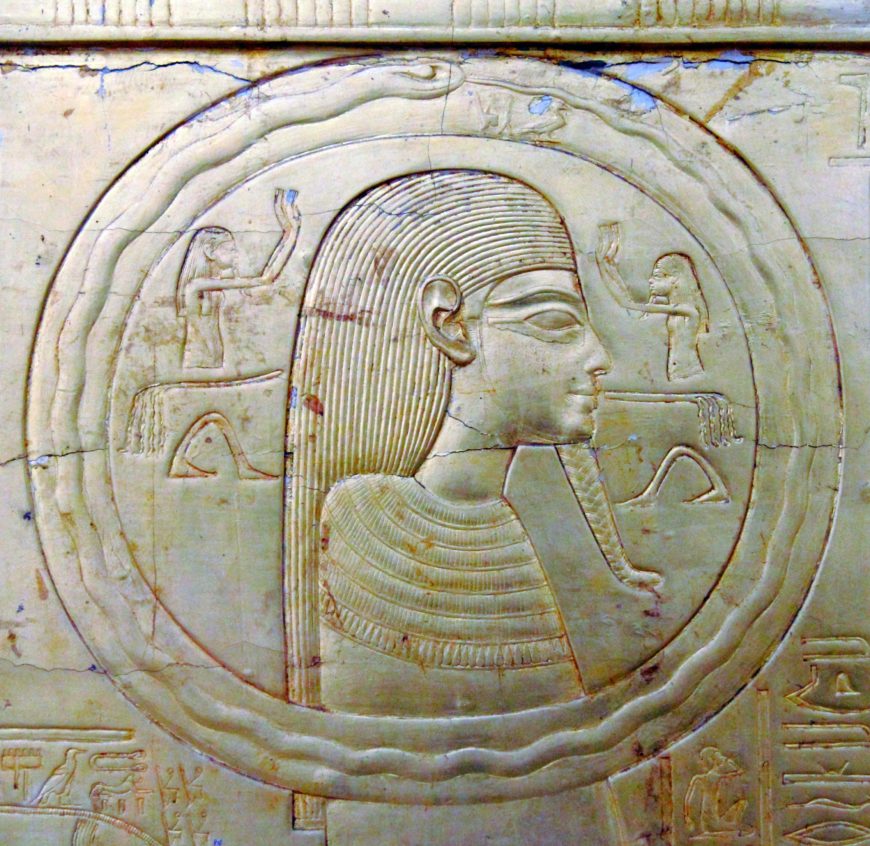
The tomb of Tutankhamun, discovered by Howard Carter in 1922, contained a remarkable collection of funerary objects, including several gilded shrines surrounding the king's sarcophagus. These shrines were decorated with religious scenes and texts that expressed ideas about divine protection and the king's passage into the afterlife.
The circular serpent image is notable because it appears within this wider religious program. In the relevant scene, serpent forms enclose parts of a large mummiform figure, and scholarly interpretation connects the imagery with the solar-Osirian unity. The meaning emerges through the relationship between the serpent, the figures inside the circle, and the accompanying composition.
This context does not make every modern explanation of the Ouroboros historically certain. It does establish that a close visual relative of the familiar tail-biting serpent was used in Egyptian royal funerary art long before the motif became a prominent image in European alchemy. When describing the relief, it is better to say that it belongs to funerary imagery associated with divine renewal than to claim that it proves the symbol always meant mathematical infinity.
The shrine also demonstrates the sophistication of ancient Egyptian religious writing. Some royal compositions used cryptographic signs and unusual arrangements that were not intended to function as ordinary everyday writing. Darnell's work and research on New Kingdom netherworld texts help explain why specialist study is necessary when interpreting them.
Image alt text: Ouroboros Symbol on Tutankhamun's shrine in ancient Egyptian funerary art.
4. Mehen: The Protective Serpent in Egyptian Mythology
Mehen is an important figure for understanding the religious background of the Ouroboros Symbol. His name is often associated with the idea of being coiled. In Egyptian religious imagery, Mehen is a protective serpent connected with Ra during the sun god's nighttime journey through the underworld.
The sun's daily movement gave Egyptian religious thought a powerful model of continuity. At sunset, Ra disappeared from the visible sky and entered the underworld. His nightly journey involved dangers and encounters, and his return at dawn represented the renewal of solar order. A protective serpent surrounding the god was therefore part of a meaningful religious image, not just an ornamental frame.
Mehen should not be treated as exactly synonymous with the Ouroboros. Mehen is a deity with a particular role; Ouroboros is the name used for the motif of a serpent biting its own tail. Some images of Mehen are coiled or encircling without showing the distinct tail-biting arrangement. This difference matters when explaining the symbol's origins accurately.
| Feature | Mehen | Ouroboros motif |
|---|---|---|
| What it is | An Egyptian protective serpent deity | A visual motif of a serpent biting its tail |
| Main association | Protection of Ra during the underworld journey | Meanings vary by period and culture |
| Typical shape | Often coiled around or near a protected figure | Forms a closed ring by connecting mouth and tail |
| Key caution | Not every depiction shows a tail-biting serpent | Not every circular serpent can be assigned one fixed meaning |
Mehen also helps place Egyptian serpent imagery within a broader religious system. Serpents could guard sacred spaces or divine figures, but another serpent, Apophis, symbolized a force that threatened the solar journey. Readers interested in seeing more of Egypt's material culture can explore the Grand Egyptian Museum tour and its focus on the objects and artistic traditions of ancient Egypt.
5. The Ouroboros Symbol Meaning: Renewal, Unity, and Cycles
The phrase Ouroboros Symbol meaning is often answered with a list of concepts: eternity, rebirth, infinity, unity, and the cycle of life. These interpretations are useful starting points, but their historical significance changes across traditions. The table below distinguishes the common associations from the Egyptian context in which related imagery first became important.
Renewal and rebirth
Renewal is a useful concept for discussing Egyptian solar and funerary religion. The sun's return each morning and the possibility of continued existence after death were major themes within Egyptian religious life. A serpent in an underworld composition may contribute to a narrative of protection and transformation, but its precise role should be identified from the surrounding scene and texts.
Continuity and cyclical time
The Ouroboros's closed circle makes it easy to read the image as a continuing cycle. Later writers and artists adopted this visual potential to represent processes that repeat, rather than events that move in a straight line from a fixed beginning to a final end. While solar cycles are central to Egyptian religion, it would be an overstatement to claim that every Egyptian image of a serpent explicitly encoded the same abstract theory of time.
Unity and wholeness
Unity became especially clear in later alchemical imagery, where the Ouroboros could accompany language expressing that “the All is One.” In that setting, the image suggests that distinct parts can belong to a single whole. This is a documented later development and should be distinguished from conclusions based only on the shape of an earlier Egyptian relief.
Protection and boundaries
A serpent that surrounds a figure can visually create a protective boundary. This is especially relevant to Egyptian guardian-serpent traditions such as Mehen. The precise significance of an enclosing serpent depends on the identity of the protected figure and the wider religious composition.
Transformation through opposing forces
Some later interpretations use the Ouroboros to discuss creation and destruction, growth and decline, or endings that become beginnings. These are powerful modern and philosophical readings. They are best presented as interpretations that developed through the symbol's reception rather than as a single definition shared by every ancient culture.
6. Ra, Osiris, and the Cycle of Renewal
The relationship between Ra and Osiris provides an important framework for understanding the funerary context associated with the Egyptian Ouroboros Symbol. Ra was associated with the sun's daily journey, while Osiris was a central deity of the dead and the possibility of renewed existence. Egyptian religious compositions could bring their roles together to express a relationship between solar movement and regeneration in the afterlife.
Rather than treating the two gods as identical, it is more accurate to explain that Egyptian theology could connect them in particular contexts. In royal funerary imagery, this association helped express how the deceased king might participate in divine processes that continued beyond bodily death.
The circular serpent on Tutankhamun's shrine belongs to this dense visual and theological setting. It is a reminder that ancient Egyptian symbols were not always standalone icons with concise dictionary definitions. Their meanings depended on the scene as a whole, the accompanying text, and the religious function of the object.
For travelers who want to connect these stories to real places and collections, our Giza Pyramids and Grand Egyptian Museum tour is a relevant next step for exploring Egyptian monuments and artifacts with historical context. If you want to explore beyond Cairo and allow time for several major sites, you can also review our 10-day Egypt tour.
7. The Ouroboros Symbol in Greek and Roman Traditions
The motif continued beyond Egypt and gained new contexts across the Greek-speaking and Roman worlds. The name Ouroboros is Greek, while one of the best-known early images related to the motif belongs to Egyptian royal funerary art. The difference between the image's surviving history and the word used to describe it illustrates how symbols travel across cultures.
Greek-language magical and esoteric texts helped transmit Egyptian and Egyptian-influenced imagery in the Mediterranean. In later traditions, the tail-biting serpent could be used to express continuity, cosmic unity, or a self-contained process. Its precise meaning varied according to the artifact, text, or philosophical setting in which it appeared.
It is best to avoid a simplistic story in which every society adopted the Ouroboros and preserved a single Egyptian definition unchanged. Instead, the symbol's history shows cultural transmission: communities borrowed recognizable forms and reinterpreted them through their own religious beliefs and intellectual interests.
8. The Ouroboros Symbol in Alchemy and Gnosticism
The Ouroboros in alchemy
Alchemy brought together experimentation, natural philosophy, religious thought, and symbolic imagery. The Ouroboros became influential in this tradition because its closed circle could express a process whose stages belonged to a complete whole. An image known as the Chrysopoeia of Cleopatra shows a serpent forming a circle alongside the Greek phrase commonly read as hen to pan, or “the All is One.” This inscription makes the association with unity especially clear.
Later alchemical interpretations connected the serpent with transformation and the integration of different stages of a process. Some traditions also related it to the philosopher's stone. These associations belong to the later history of the symbol and should not automatically be projected onto the Egyptian shrine image.
The Ouroboros in Gnostic and esoteric thought
Gnosticism describes diverse ancient religious movements rather than one uniform system. Some later esoteric settings interpreted the circular serpent in terms of cosmic unity, spiritual boundaries, or the structure of existence. Not every Gnostic group used the image in the same way, so it is more precise to discuss particular texts and traditions than to assign one meaning to all of Gnosticism.
| Historical setting | Common use of the motif | What not to assume |
|---|---|---|
| Ancient Egyptian funerary art | Serpent imagery within royal and underworld compositions | That every instance means abstract infinity |
| Greek-speaking traditions | Transmission and reinterpretation of the image | That the Greek name proves a Greek visual origin |
| Alchemy | Unity, transformation, and a complete process | That later meanings were already fixed in the New Kingdom |
| Modern art and popular culture | Cycles, identity, continuity, and personal change | That contemporary uses are direct evidence of ancient beliefs |
9. Ouroboros Symbol vs. Other Ancient Egyptian Symbols
The Ouroboros is often discussed alongside the ankh, Eye of Horus, djed pillar, scarab, and uraeus. These symbols should not be confused with one another. Each has its own visual form and a history shaped by different religious, royal, and cultural settings.
| Symbol | Typical visual form | Common association |
|---|---|---|
| Ouroboros | Serpent biting its own tail | Continuity, unity, and renewal in later interpretations |
| Ankh | Cross-like form with a loop at the top | Life and continued existence |
| Eye of Horus | Stylized eye with distinctive markings | Protection, healing, and restoration |
| Djed pillar | Column-like form with horizontal bands | Stability and endurance |
| Scarab | Beetle, sometimes shown with a solar disk | Transformation and solar renewal |
| Uraeus | Upright cobra, often on a royal crown | Royal protection and divine authority |
The comparison highlights what makes the Ouroboros Symbol distinctive: its shape turns the creature into a closed loop. That form lends itself to later ideas of continuity and unity, while other Egyptian signs communicate their associations through different images and mythological backgrounds.
For a wider look at Egypt's archaeological heritage, explore our Giza, Saqqara, and Memphis tour, which introduces travelers to major sites connected with the long history of ancient Egyptian civilization. If you prefer to build in more time for several destinations, compare it with the 12-day Egypt tour package.
10. The Ouroboros Symbol in Modern Culture
Today, the Ouroboros appears in literature, fantasy art, jewelry, tattoos, philosophy, and popular media. Its continued popularity comes from the simple visual idea of a creature forming a circle with its own body. The image can prompt questions about beginnings and endings, the relationship between a part and a whole, or processes that repeatedly renew themselves.
In art, literature, and design
Artists and writers may use the symbol to suggest a recurring history, a self-contained world, an endless conflict, or a transformation that brings an experience back to its starting point. The design can be rendered realistically or reduced to a minimal outline while remaining recognizable.
In tattoos and jewelry
People who choose the Ouroboros for a tattoo or piece of jewelry may associate it with resilience, personal growth, continuity, or the belief that difficult endings can lead to new beginnings. These personal interpretations can be meaningful, but they should not be presented as a universal ancient Egyptian custom.
In philosophy
The Ouroboros can work as a metaphor for systems that generate, consume, or transform their own components. Some interpretations focus on cyclical time, while others emphasize the relationship between apparent opposites. Modern readings are part of the symbol's continuing history—not proof that its meaning remained unchanged for thousands of years.
11. Explore Ancient Egyptian History in Egypt
Egypt offers outstanding opportunities to explore the religious, artistic, and funerary traditions that provide context for symbols such as the Ouroboros. A visit cannot guarantee that every specific artifact will be on display, but museums and archaeological sites help visitors understand the civilization's visual language and beliefs about kingship, gods, and the afterlife.
Cairo and museum collections
Museum collections help visitors compare representations of gods, pharaohs, animals, and funerary objects. Look for collection information and current display details before visiting, because particular objects may be stored, moved, or undergoing conservation. The Grand Egyptian Museum tour is a useful internal resource for planning a visit focused on ancient Egyptian artifacts and royal history.
Giza, Saqqara, and Memphis
The wider Giza and Saqqara area offers context for the long development of Egyptian royal culture, funerary architecture, and artistic traditions. These sites do not all contain the Ouroboros motif specifically, but they help place the image within the broader civilization that produced Egypt's monumental art and religious texts.
Luxor and the Valley of the Kings
Luxor is especially valuable for understanding royal funerary religion. Tombs in the Valley of the Kings contain complex scenes and texts describing the sun's passage through the underworld. Studying these visual narratives with a qualified guide can make the relationship between imagery, divine figures, and afterlife beliefs easier to understand. For an itinerary that combines major historical destinations with a Nile cruise and time on the Red Sea, see the Ultimate 12-day Egypt tour package.
Explore Ancient Egypt with a Guided Tour
Discover Egypt's museums, monumental sites, and royal history with an itinerary shaped around your interests. Explore our Giza Pyramids and Grand Egyptian Museum tour to learn more about Egypt's archaeological heritage.
Explore the Tour12. Conclusion: The Lasting Legacy of the Ouroboros Symbol
The Ouroboros Symbol links early Egyptian imagery with a much longer history of cultural interpretation. Its appearance in funerary imagery associated with Tutankhamun places the circular serpent within a sophisticated religious setting concerned with divine protection, the underworld, and the relationship between Ra and Osiris.
Mehen is an important part of this context because the protective serpent demonstrates that Egyptian snakes could represent guardianship as well as danger. Later Greek-speaking, Roman, alchemical, and esoteric traditions developed additional meanings, including unity, transformation, and eternity. These interpretations helped make the Ouroboros a lasting presence in art and modern culture.
The most useful way to understand the symbol is to separate its early historical context from the ideas attached to it later. Its circle remains visually powerful, but a careful reading of each image depends on its date, setting, accompanying text, and cultural background. For more about the gods and beliefs behind Egyptian imagery, continue to our guide to Egyptian civilization and its gods. Visitors planning a more comprehensive journey can also explore the 15-day Best of Egypt trip, which gives more time to discover the country's historical highlights.
Plan Your Egypt History Experience
Turn your interest in ancient Egyptian civilization into a real journey. Browse our Egypt trips to the Pyramids and explore options for discovering Egypt's historic sites.
View Egypt Trips13. Frequently Asked Questions About the Ouroboros Symbol
1. What is the Ouroboros Symbol?
The Ouroboros Symbol depicts a serpent or dragon biting its own tail to form a circle. Its meanings vary by historical context and include unity, renewal, continuity, and eternity in later interpretations.
2. Is the Ouroboros Symbol Egyptian or Greek?
The motif has early surviving Egyptian evidence, including an example associated with Tutankhamun's second shrine. The word Ouroboros is Greek, and Greek-speaking traditions helped shape its later history.
3. What does the Ouroboros Symbol mean in ancient Egypt?
In its early Egyptian context, the circular serpent appears in royal funerary imagery linked with the underworld and divine renewal. Its precise meaning depends on the surrounding figures, inscriptions, and religious composition.
4. How old is the Ouroboros Symbol?
One of the earliest known examples of the tail-biting serpent motif is associated with Tutankhamun's second shrine, dating to the fourteenth century BCE.
5. What is the connection between the Ouroboros and Tutankhamun?
The circular serpent appears in imagery on the second gilded shrine associated with Tutankhamun's tomb. The shrine's decoration forms part of a complex royal funerary composition.
6. Who is Mehen in Egyptian mythology?
Mehen is a protective serpent deity associated with guarding Ra during the sun god's nightly journey through the underworld.
7. Is Mehen the same as the Ouroboros?
No. Mehen is an Egyptian deity, while Ouroboros is the name for a serpent biting its own tail. Some images are visually related, but the terms are not interchangeable.
8. Does the Ouroboros Symbol represent eternity?
Eternity is one of the motif's best-known later interpretations. The circle suggests continuity, but the meaning of an ancient Egyptian example should be interpreted through its specific context.
9. What does the Ouroboros mean in alchemy?
In alchemical traditions, the Ouroboros became associated with unity, transformation, and a process whose stages belong to a complete whole. Some later interpretations also connected it with the philosopher's stone.
10. What does “Hen to Pan” mean?
The Greek phrase hen to pan is commonly translated as “the All is One” or “one is all.” It appears with an Ouroboros in a well-known alchemical image and emphasizes unity.
11. Is the Ouroboros connected to Ra and Osiris?
An important Egyptian example appears within royal funerary imagery associated with solar-Osirian unity, connecting themes related to Ra's solar journey and Osiris's role in death and renewed existence.
12. Is the Ouroboros the same as the infinity symbol?
No. The Ouroboros is a serpent biting its tail, while the mathematical infinity symbol is a sideways figure eight. Modern interpretations may associate both with endlessness, but they are visually distinct.
13. How is the Ouroboros different from the Eye of Horus?
The Ouroboros is a circular serpent motif. The Eye of Horus is a separate Egyptian symbol commonly associated with protection, healing, and restoration.
14. Why do people choose the Ouroboros for tattoos?
Some people use it to express personal growth, resilience, continuity, or the idea that endings can lead to new beginnings. These are modern interpretations rather than one universal ancient Egyptian meaning.
15. Where can I see ancient Egyptian artifacts?
Museums in Egypt display important collections of ancient Egyptian objects, although specific artifacts and displays can change. Check current museum information before planning a visit.
16. Is the Ouroboros always shown as a snake?
The classic form is a serpent biting its tail, but some later versions depict a dragon or another serpent-like creature. The form varies by artistic tradition.
17. Why is the Ouroboros circular?
The serpent's mouth meets its tail, forming a closed ring. This shape lends itself to later interpretations involving continuity, cycles, and unity.
18. Is the Ouroboros a religious symbol today?
It appears in several contemporary spiritual, philosophical, artistic, and popular contexts. Its meaning depends on the individual or group using it.
19. What is the difference between Egyptian and alchemical meanings of the Ouroboros?
Early Egyptian examples appear within specific funerary and theological compositions. Later alchemical images more explicitly associated the motif with unity and transformation, sometimes using inscriptions to explain the idea.
20. What is the best way to learn about ancient Egyptian symbolism?
Use museum collection records, scholarly Egyptology publications, and reliable guides to archaeological sites. Compare the artwork with its inscriptions and original context instead of relying only on modern symbol lists.
Further Reading and Historical References
- Yale University: The Enigmatic Netherworld Books of the Solar-Osirian Unity
- University of Oxford: Tutankhamun Spatial Archive — Second Sepulchral Shrine
- Smarthistory: Creation Myths and Forms of the Gods in Ancient Egypt
Editorial note: The interpretation of ancient imagery is context-dependent. This article distinguishes early Egyptian funerary imagery from meanings developed in later Greek and alchemical traditions.