
The Great Sphinx of Giza: History, Facts, Mysteries & How to Visit
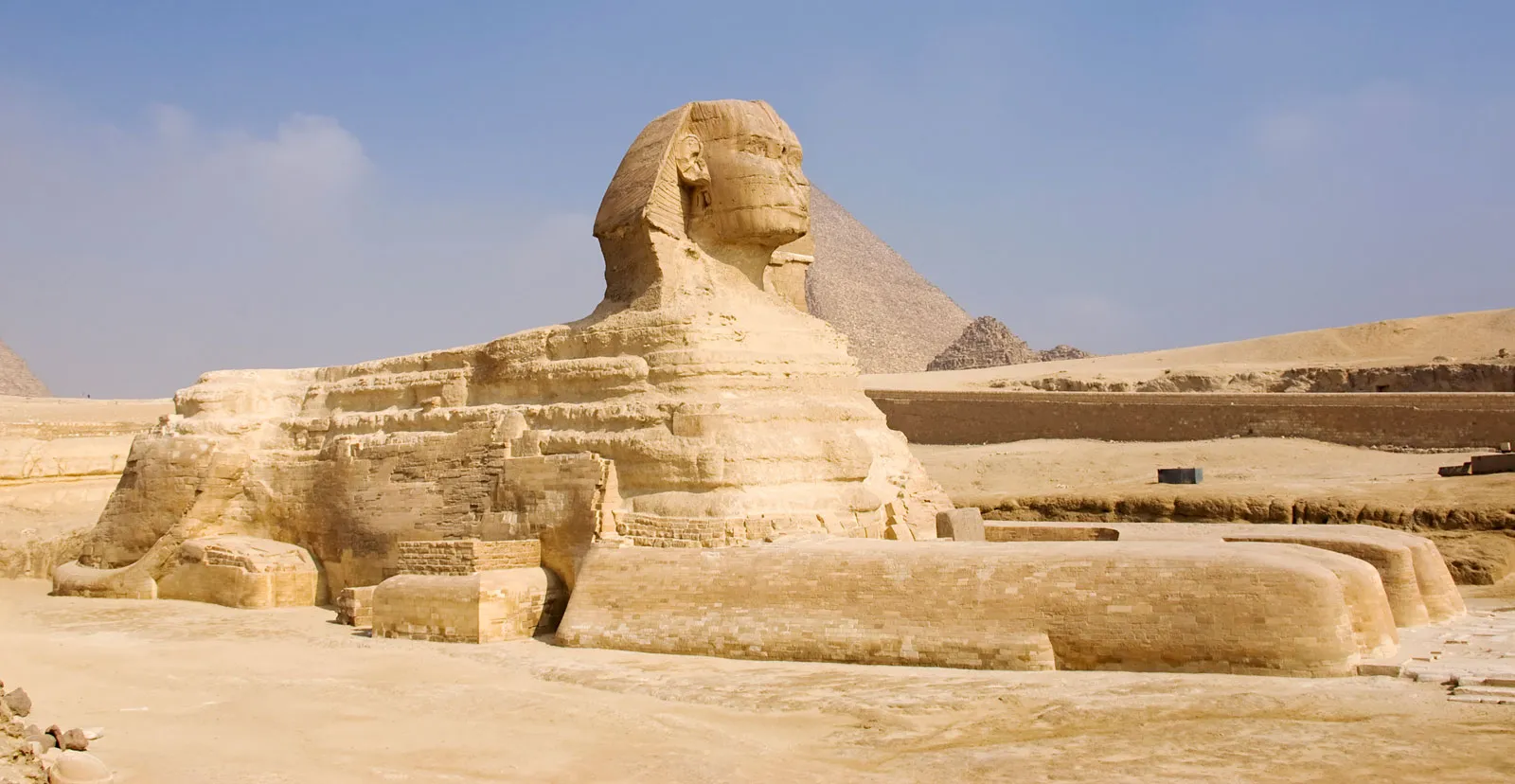
The Great Sphinx of Giza is a colossal monolithic limestone statue combining the recumbent body of a lion with the head of an ancient Egyptian king wearing a royal headdress. Located on the eastern lower terrace of the Giza Plateau on the west bank of the Nile, just outside modern Cairo, it is the oldest known monumental sculpture from ancient Egypt and one of the most recognizable landmarks in human history. Carved directly from the natural bedrock of the plateau rather than assembled from transported stone blocks, the statue stretches approximately 73 meters (240 feet) in length and rises 20 meters (66 feet) from the floor of its quarry enclosure to the top of its head.
Despite standing in plain sight beside the famous pyramids of Khufu, Khafre, and Menkaure for roughly four and a half millennia, the monument presents historians and archaeologists with enduring challenges. No surviving Old Kingdom text records its original name, its exact construction date, or the name of the pharaoh who commissioned it. While contextual archaeology strongly connects the monument to the Fourth Dynasty complex of King Khafre, scholars continue to examine the details of its geological weathering, phased restoration, and evolving religious role. Whether you are researching ancient history or organizing guided Egypt trips to the pyramids, this comprehensive resource separates verified archaeological evidence from later folklore and explains how to experience the Giza Plateau firsthand.
What Is the Great Sphinx of Giza?
The Great Sphinx of Giza is a monumental rock-cut statue sculpted directly into the limestone bedrock of the Giza necropolis. Rather than standing atop a raised pedestal built on flat ground, the Sphinx sits inside a U-shaped quarry pit—known to archaeologists as the Sphinx Sanctuary or Sphinx Ditch—that ancient workmen excavated around a natural limestone outcrop. As Egypt's Ministry of Tourism and Antiquities states in its official monument record: “It was carved directly out of the bedrock during the 4th Dynasty.” By cutting a deep trench into the plateau floor and removing massive blocks of stone for nearby temple walls, Fourth Dynasty quarrymen isolated a long ridge of living rock and shaped it into a couchant lion with the facial features and regalia of a ruling pharaoh.
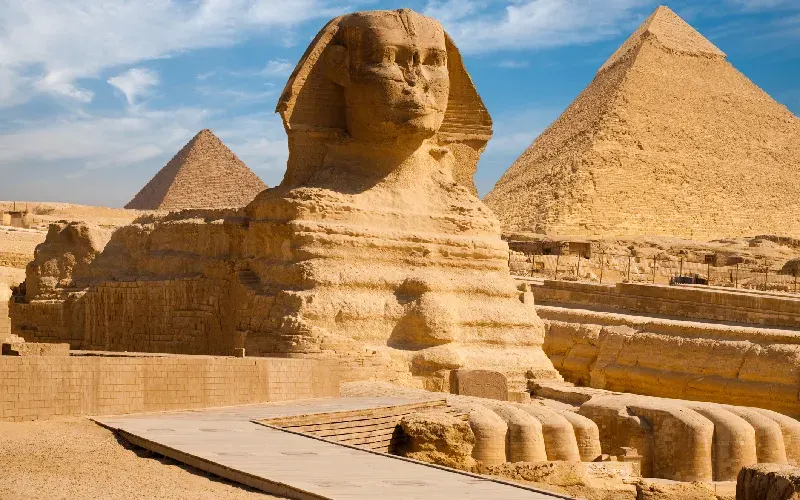
Architecturally and symbolically, the statue does not stand in isolation. It forms an integral part of the royal funerary landscape on the eastern edge of the Giza Plateau. Directly in front of its outstretched paws lies the Old Kingdom Sphinx Temple, while immediately to its south sits the remarkably preserved Valley Temple of King Khafre. A long, monumental stone causeway runs westward from the side of the Valley Temple and the southern flank of the Sphinx Ditch all the way up the slope to Khafre's mortuary temple and pyramid. Travelers who book a comprehensive Giza, Saqqara, and Memphis historical guide can trace how this lower temple complex evolved from earlier royal enclosures at Saqqara into the solar-aligned necropolis of the Fourth Dynasty.
Great Sphinx of Giza — Quick Facts
Before examining the archaeological debates and conservation history of the monument in detail, the following table summarizes its core physical specifications, historical attribution, and the scholarly level of certainty attached to each feature.
| Fact | Information | Notes & Level of Certainty |
|---|---|---|
| Location | Eastern edge of the Giza Plateau, Giza Governorate, Greater Cairo, Egypt | Confirmed geographical setting within the Memphis and its Necropolis UNESCO World Heritage area. |
| Total Length | Approx. 73 meters (240 feet) from paw tip to tail base | Confirmed by modern photogrammetric and archaeological surveys of the bedrock core and masonry casing. |
| Total Height | Approx. 20 meters (66 feet) from the sanctuary floor to the crown of the head | Confirmed physical measurement. |
| Width of Face | Approx. 4.1 meters (13.5 feet) across the cheekbones | Confirmed physical measurement; the nose alone originally measured roughly 1 meter (3.3 feet) wide. |
| Material & Construction | Monolithic natural limestone bedrock (Mokattam Formation) with ancient and modern limestone block casing | Confirmed by geological analysis; the core body was sculpted in situ from three distinct natural limestone strata. |
| Likely Construction Period | Old Kingdom, Fourth Dynasty (approx. mid-26th century BCE) | High archaeological consensus based on quarry stratigraphy, temple architecture, and tool marks; no exact calendar year survives. |
| Leading Royal Attribution | King Khafre (builder of the second pyramid at Giza) | Leading scholarly attribution supported by the contiguous causeway, Valley Temple, and Sphinx Temple; not confirmed by a surviving contemporary inscription. |
| Alternative Royal Proposals | King Khufu or King Djedefre (Fourth Dynasty) | Minority scholarly interpretations based on stylistic comparisons and plateau development; debated among Egyptologists. |
| Orientation | Due East (facing the rising sun and the Nile Valley) | Confirmed alignment corresponding with the east-west axis of the adjacent Sphinx Temple and solar liturgy. |
| Original Old Kingdom Name | Unknown | Confirmed historical gap; no surviving Fourth Dynasty text records what its original builders called the statue. |
| New Kingdom Religious Name | Horemakhet (“Horus in the Horizon”) | Confirmed by numerous Eighteenth and Nineteenth Dynasty stelae and sanctuary inscriptions found around the monument. |
| The Dream Stele | Pink granite royal inscription erected between the paws by Pharaoh Thutmose IV (18th Dynasty, c. 1401–1391 BCE) | Confirmed artifact standing in situ; records an ancient sand-clearing and restoration campaign. |
Who Built the Great Sphinx of Giza?
For travelers standing at the viewing terrace above the Sphinx Sanctuary, the first question is almost always who ordered the statue to be carved. Unlike later New Kingdom temples covered from base to cornice with royal cartouches and dedicatory narratives, the Old Kingdom monuments at Giza are remarkably austere in their surviving surface inscriptions. Neither the bedrock body of the Great Sphinx nor the massive limestone walls of the Sphinx Temple preserve a Fourth Dynasty dedication naming the commissioning pharaoh. Consequently, Egyptologists rely on architectural stratigraphy, quarry geology, and the layout of the surrounding necropolis to determine who built the monument.
The Khafre Theory
The leading attribution among mainstream Egyptologists—and the primary context presented by Egypt's Ministry of Tourism and Antiquities—links the Great Sphinx to King Khafre, the Fourth Dynasty ruler who built the second-largest pyramid at Giza around 2558–2532 BCE. This attribution does not rest on guesswork; it is anchored in physical evidence linking the Sphinx quarry directly to Khafre's building program.
First, the spatial planning of the lower Giza complex treats the Sphinx, the Sphinx Temple, Khafre's Valley Temple, and Khafre's causeway as a unified architectural ensemble. The western end of the southern wall of the Sphinx Ditch runs directly along the northern side of Khafre's monumental causeway. Had the causeway been constructed long after the Sphinx, or vice versa without coordination, their drainage channels, foundation cuts, and enclosure walls would show clear signs of disruption. Instead, archaeological mapping demonstrates that the builders laid out the Valley Temple, the Sphinx Temple, and the Sphinx quarry as adjacent components of the same lower funerary complex.
Second, geological micro-analysis of the massive core blocks used to build both Khafre's Valley Temple and the Sphinx Temple reveals that these multi-ton megaliths were quarried directly from the U-shaped trench excavated around the body of the Sphinx. As workmen cut down into the limestone plateau to extract heavy masonry for Khafre's lower temples, they left the central bedrock outcrop standing and sculpted it into the royal lion. Furthermore, Old Kingdom royal statuary discovered across Giza—much of which travelers can examine by booking a Grand Egyptian Museum tour right beside the plateau—provides an authentic Fourth Dynasty reference point for royal portraiture and headcloth carving techniques.
Even with this strong contextual framework, careful historians note its boundary: architectural association proves that the Sphinx Ditch and Khafre's Valley Temple belonged to the same overarching Fourth Dynasty construction horizon, but the absence of a surviving contemporary dedicatory inscription leaves room for ongoing scholarly discussion about the exact sequence of work.
Could It Represent Khufu or Djedefre?
While Khafre remains the primary candidate, a minority of respected Egyptologists have proposed alternative Fourth Dynasty attributions—most notably Khafre's father, King Khufu (builder of the Great Pyramid), or Khafre's older brother and predecessor, King Djedefre.
The hypothesis attributing the Sphinx to Khufu, developed by the late German Egyptologist Rainer Stadelmann, argues that Khufu originally quarried the eastern plateau during the construction of the Great Pyramid and that Khafre later routed his causeway slightly southward to avoid an already existing Sphinx. Stadelmann also pointed to stylistic features of the Sphinx's face—such as the broad, square jaw, the absence of a relief-carved headband across the brow, and the specific pleating pattern of the nemes headdress—arguing that they resemble early Fourth Dynasty conventions closer to Khufu's reign.
Another scholarly proposal, advanced by Vassil Dobrev, suggests that King Djedefre—whose own pyramid was built northward at Abu Rawash—may have commissioned the Sphinx in the image of his deified father, Khufu, as part of a solar cult homage at Giza. Both the Khufu and Djedefre proposals remain completely within the accepted Fourth Dynasty archaeological timeline, differing from the Khafre consensus by only one or two royal generations. Visitors who combine plateau exploration with museum collections on the Giza Pyramids and GEM tour can compare the facial proportions of Fourth Dynasty rulers side by side to see why the majority of field archaeologists continue to view Khafre as the best-supported candidate.
How Old Is the Great Sphinx?
Based on the archaeological, architectural, and geological evidence from the Giza Plateau, the Great Sphinx of Giza is approximately 4,500 years old, dating to Egypt's Fourth Dynasty during the Old Kingdom (roughly 2613–2494 BCE, with the reigns of Khufu, Djedefre, and Khafre falling in the 26th century BCE). Because ancient Egyptian chronology for the Old Kingdom relies on royal king lists, astronomical alignments, and radiocarbon dating of organic mortar inclusions from the surrounding pyramid complexes, historians express Fourth Dynasty dates as an approximate scholarly range rather than a single immutable year.
Understanding how archaeologists establish this Fourth Dynasty timeframe helps explain why claims placing the Sphinx at 10,000 or 12,000 BCE are rejected by mainstream Egyptology. When archaeologists excavate a rock-cut monument, they do not try to carbon-date the natural limestone itself—which formed from marine sediments millions of years ago during the Eocene epoch. Instead, they date the human activity that shaped the stone. At the Sphinx Sanctuary, pottery shards, copper-chisel marks, pounder stones, quarry levels, and the foundational architecture of the Sphinx Temple and Valley Temple all belong squarely to the material culture of the Fourth Dynasty.
Nowhere on the Giza Plateau—or anywhere else in the Nile Valley—has any archaeological excavation uncovered urban infrastructure, stone-quarrying tools, social organization, or monumental architecture dating to 10,000 BCE capable of excavating multi-ton limestone blocks and carving a 73-meter royal statue wearing a dynastic nemes headdress. Travelers exploring the plateau on guided Cairo and Giza day tours can still see the unfinished Old Kingdom quarry trenches and tool marks cut directly into the bedrock floor around the pyramids and the Sphinx.
15 Fascinating Facts About the Great Sphinx of Giza
To appreciate the engineering, geology, and turbulent post-pharaonic history of the monument, here are 15 distinct, verifiable facts about the Great Sphinx of Giza:
- It Is a True Monolith Carved from Living Bedrock: Unlike the pyramids behind it, which were assembled from millions of quarried stone blocks stacked course by course, the core body and head of the Great Sphinx were sculpted directly out of the natural limestone bedrock of the Giza Plateau.
- It Is the Oldest Known Monumental Sculpture in Egypt: While small statuettes of lions and rulers existed in the Early Dynastic Period, the Great Sphinx represents the earliest surviving colossal royal sculpture on Earth, measuring roughly 73 meters (240 feet) long and 20 meters (66 feet) tall.
- The Statue Was Created by Digging Down, Not Building Up: Only the head and neck originally projected above the natural slope of the plateau as a limestone knoll (known geologically as a yardang). Ancient workmen had to excavate a deep U-shaped ditch into the surrounding bedrock to carve the massive lion body below ground level.
- Its Stones Built the Temple Directly in Front of It: Rather than discarding the limestone cut away from around the Sphinx's body, Fourth Dynasty masons extracted it in giant rectangular blocks weighing up to 100 tons or more and used them to construct the adjacent Sphinx Temple and Khafre's Valley Temple.
- Three Different Limestone Layers Explain Its Uneven Weathering: Geologists divide the Sphinx's bedrock into three members of the Mokattam Formation. The base belongs to a hard, fossil-rich reefal limestone; the middle body consists of alternating soft, yellow, clay-rich limestone strata that flake easily; and the head was carved from a much harder, dense upper stratum, explaining why the face survived far better than the paws and torso.
- The Head Is Proportionately Smaller Than a Natural Lion's Body: Visitors often notice that the head appears slightly small compared to the elongated 73-meter leonine torso (roughly a 1:7 head-to-body ratio rather than the 1:5 typical of later Egyptian sphinxes). Many geologists and Egyptologists note that natural fissures running through the bedrock body forced the ancient sculptors to lengthen the back to avoid structural cracking, or that the upper rock knoll limited the maximum width of the head.
- It Wears the Royal Nemes Headdress and Uraeus Cobra: The human head is framed by the pleated nemes cloth, an emblem reserved exclusively for pharaohs and deities representing royal authority. Above the brow sits the carved base and socket of the uraeus—the sacred rearing cobra that protected the king—though the upper hood of the cobra broke away in antiquity.
- Its Original Old Kingdom Name Has Never Been Found: No surviving text from the Fourth Dynasty mentions the Sphinx. For roughly a thousand years after its carving, the monument does not appear in known Old or Middle Kingdom written archives, leaving its original title a mystery.
- New Kingdom Egyptians Worshipped It as the Solar God Horemakhet: By the Eighteenth Dynasty (c. 1550–1292 BCE), the statue had become the focus of a vibrant pilgrimage cult. New Kingdom worshippers called it Horemakhet—translated by Egypt's Ministry of Tourism and Antiquities as “Horus in the Horizon”—identifying the monument as a living manifestation of the rising sun god. You can learn more about how Horus, Re, and Atum merged in solar theology in our Egyptian civilization gods guide.
- The Word “Sphinx” Comes from Classical Greece, Possibly via an Egyptian Phrase: The Greeks applied the name Sphinx (after the winged mythological creature of Thebes in Greek legend) to Egyptian human-headed lions. Many philologists suggest the Greek word may also echo the ancient Egyptian phrase shesep-ankh, meaning “living image.”
- The Dream Stele Was Repurposed from an Old Kingdom Stone Threshold: Standing between the front paws, the granite Dream Stele of Pharaoh Thutmose IV (c. 1400 BCE) records how the young prince cleared away desert sand after the Sphinx appeared to him in a dream. Closer archaeological inspection revealed that the granite slab itself was originally a massive lintel or threshold block taken from Khafre's nearby mortuary temple.
- The Ceremonial Beard Was Likely a New Kingdom Addition: The bedrock chin of the Sphinx shows no damage scar where a monolithic beard would have been carved during the Fourth Dynasty. Instead, the braided royal beard—fragments of which were excavated between the paws in 1817—was added using fitted limestone blocks, most likely during New Kingdom restoration work when the statue was venerated as Horemakhet. Visitors interested in royal regalia can also book a GEM Museum Cairo tour to see how pharaonic ceremonial beards and headdresses were sculpted across dynasties.
- Napoleon's Soldiers Did Not Shoot Off the Nose: One of the most persistent travel myths claims French artillery destroyed the Sphinx's nose during Napoleon Bonaparte's 1798 campaign. In reality, Danish explorer Frederic Louis Norden sketched the Sphinx in 1737—more than sixty years before Napoleon set foot in Egypt—and his drawings clearly show the nose already missing.
- Traces of Red, Yellow, and Blue Pigment Still Survive: Although today the Sphinx appears uniform sandy beige, sheltered creases around the face and ears preserve microscopic traces of red ochre pigment, while parts of the nemes headdress and beard fragments retain hints of yellow and blue paint.
- It Spent Most of Its 4,500-Year History Buried Up to Its Neck in Sand: Because the Sphinx sits inside a depressed quarry hollow at the edge of the Western Desert, prevailing winds constantly refill the ditch with blown sand. Without human intervention, the Sphinx Sanctuary fills completely within a few decades; it was only fully and permanently cleared down to its bedrock floor between 1925 and 1936 by French engineer Émile Baraize.
Why Does the Sphinx Have a Lion's Body and a Human Head?
In ancient Egyptian art and royal ideology, hybrid forms were never monstrous accidents; they were visual statements combining complementary powers. The lion was the premier desert predator visible along the fringes of the Nile Valley—an animal renowned for physical strength, solar vigilance, and fierce protection of its territory. By uniting the muscular, recumbent body of a lion with the composed human face of the reigning pharaoh wearing the royal nemes headcloth, Fourth Dynasty sculptors created a visual metaphor for kingship itself: brute natural might governed by royal intelligence and divine order (Ma'at).
Archaeological parallels confirm that this fusion was deeply rooted in early dynastic iconography. Even before the Fourth Dynasty, commemorative palettes (such as the Battlefield Palette and Narmer's ideological heirs) depicted the king subduing chaotic forces in the guise of a lion or bull. From the reign of Djedefre and Khafre onward, the royal sphinx became the standard guardian figure placed along temple avenues, thresholds, and funerary causeways. Unlike the female, winged, riddle-posing Sphinx of later Greek mythology—which throttled travelers outside Thebes—the Egyptian royal sphinx was predominantly male, wingless, benevolent toward the cosmic order, and fiercely protective of the sacred necropolis.
It is also important to distinguish this well-documented Egyptian artistic tradition from modern speculative claims that the lion's body was originally carved thousands of years earlier to mirror the astronomical constellation Leo. In ancient Egyptian sky lore, stellar groupings were mapped differently from the later Babylonian and Greco-Roman zodiac, and no Old Kingdom text or astronomical ceiling links the Giza bedrock monument to a prehistoric age of Leo. Walking the plateau with a dedicated female tour guide in Cairo or a licensed Egyptologist helps bring these authentic Old Kingdom artistic traditions to life on site.
The Ancient Name of the Great Sphinx
Because no Fourth Dynasty inscription survives on the monument, we do not know what Khafre's priests or quarry builders called the Great Sphinx when it was first completed. During the Old Kingdom, the statue appears to have functioned silently within the architectural ritual of the royal funerary complex, possibly conceptualized as a colossal shesep-ankh—a “living image” of the divine king merging with the sun god Re as he rose over the eastern horizon.
Roughly a millennium after the Fourth Dynasty, during the New Kingdom (c. 1550–1070 BCE), the monument's identity underwent a profound transformation that is abundantly documented in stone. As royal princes, military charioteers, and pilgrims visited the Giza Plateau from nearby Memphis and Heliopolis, they recognized the towering head rising above the desert sand as an embodiment of the solar deity himself. In numerous New Kingdom stelae erected around the sanctuary, the statue is named Horemakhet (rendered in Greek centuries later as Harmachis). As documented by Egypt's Ministry of Tourism and Antiquities, this title translates to “Horus in the Horizon.”
During this era, Pharaoh Amenhotep II built a mudbrick and limestone temple dedicated specifically to Horemakhet just northeast of the Sphinx's forepaws, where rulers and commoners left votive limestone plaques carved with ears—praying that the great solar guardian would hear their petitions. Later still, in the Late Period and Greco-Roman era, local Aramaic and Arabic speakers knew the monument by names such as Bel-hit or Abu al-Hol (often translated in popular Arabic folklore as “Father of Dread” or “Father of Awe,” and discussed by etymologists as a possible phonetic preservation of an older Egyptian cult title meaning “Place of Horus”). Travelers who enjoy seeing how ancient pharaonic heritage blends into living Egyptian culture often pair their morning plateau visit with a Cairo by Night tour through the historic heart of the capital.
The Dream Stele of Thutmose IV
Nestled directly between the masonry-clad forepaws of the Great Sphinx stands one of the most important historical inscriptions on the Giza Plateau: the Dream Stele of Thutmose IV. Measuring approximately 3.6 meters (nearly 12 feet) tall and carved from rose granite, this freestanding royal monument dates to the Eighteenth Dynasty (c. 1401–1391 BCE)—meaning that when Thutmose IV placed it before the Sphinx's chest, the Great Sphinx was already more than a thousand years old.
The Dream, the Sand, and the Promise of Kingship
The upper lunette of the stele depicts Thutmose IV appearing twice in symmetrical scenes, offering incense and libations to the Great Sphinx, which rests atop a high temple-like pedestal wearing its royal headdress and ceremonial beard. Beneath this relief, a hieroglyphic text recounts a vivid royal narrative. According to the inscription, when Thutmose was still a young prince—and not necessarily the first in line to succeed his father, Pharaoh Amenhotep II—he went hunting and practicing chariotry across the desert near Memphis and Giza. At midday, exhausted by the heat, the young prince lay down to rest in the shadow of the great statue, which was then buried up to its shoulders in encroaching desert sand.
As Prince Thutmose slept, the sun god Horemakhet-Khepri-Re-Atum spoke to him through the statue as a father speaks to a son. The deity complained that the heavy desert sands of the necropolis were pressing against his body and promised that if Thutmose would clear away the sand and restore the sanctuary, the god would grant him the Double Crown of Upper and Lower Egypt. Historians carefully distinguish the theological framing of this text from independently verified political events: while the dream narrative served as a classic piece of royal legitimation explaining why Thutmose IV ascended the throne ahead of older brothers, the physical fact that he excavated the sand from the Sphinx Sanctuary and encased parts of the eroded lion body in protective limestone blocks is confirmed by the archaeology of the site.
Why the Dream Stele Matters
According to Egypt's Ministry of Tourism and Antiquities, the Dream Stele of Thutmose IV is vital not only for documenting the New Kingdom cult of Horemakhet (“Horus in the Horizon”), but also as a landmark record in the history of archaeological conservation. It proves that even 3,400 years ago, ancient Egyptians viewed the Old Kingdom monuments of Giza as sacred antiquities requiring active maintenance against desert erosion. Moreover, as discussed in Smithsonian Magazine's analysis of Sphinx research, the lowest weathered lines of the stele contain a damaged syllable—Khaf—which early Egyptologists recognized as a reference linking the monument's ancient heritage back to King Khafre. Visitors fascinated by Thutmose IV and the Eighteenth Dynasty can trace his royal legacy from the Giza Plateau all the way to the Valley of the Kings on an 8-day Cairo, Luxor, and Aswan Nile Cruise tour.
Why Is the Great Sphinx Missing Its Nose?
The Great Sphinx is missing its nose because the bridge and nostrils were deliberately pried off with metal chisels or rods during the medieval period, centuries before modern European armies arrived in Egypt. Detailed forensic inspection of the statue's face reveals clear tool marks: one chisel or lever was driven downward from the bridge of the nose above, and another was wedged into the side near the right nostril, snapping the meter-wide limestone projection away from the face.
For generations, popular guidebooks and travelers repeated the tale that Napoleon Bonaparte's soldiers blasted the nose off with cannon fire during the French campaign in Egypt in 1798 (or, in variant retellings, British or Mamluk troops). This story is conclusively disproved by the historical archive. In 1737—sixty-one years before Napoleon landed in Alexandria—the Danish naval captain and artist Frederic Louis Norden traveled to Giza and drew detailed sketches of the Great Sphinx, published in 1755 in his work Voyage d'Égypte et de Nubie. Norden's engravings clearly show the Sphinx's nose already missing.
What actually happened to the nose? As highlighted in historical investigations covered by Smithsonian Magazine, the earliest detailed medieval testimony comes from the fifteenth-century Egyptian historian al-Maqrizi (writing around 1400–1440 CE). Al-Maqrizi recorded that in 1378 CE, a pious Sufi ascetic named Muhammad Sa'im al-Dahr from the khanqah of Sa'id al-Su'ada became outraged when he saw local peasants making offerings to the Sphinx in hopes of increasing their agricultural harvest and halting the desert sands. According to al-Maqrizi's account, Sa'im al-Dahr defaced the statue's nose and ears to prove it was merely stone, after which angry locals retaliated against him, and blowing sand buried local fields.
Careful historians distinguish between physical evidence and written testimony here: the chisel marks on the face are an undeniable archaeological fact proving deliberate human defacement rather than wind erosion alone, while al-Maqrizi's account—along with an earlier tenth-century Arab reference suggesting the face already showed damage—provides the strongest medieval historical context for why iconoclastic defacement occurred long before the modern era. Solo travelers and small groups who join a women-only Cairo tour or private historical walk can examine the exact angle of the facial tool marks from the southern Sphinx terrace.
The Sphinx's Missing Beard and Original Colors
Along with its nose, the Great Sphinx is missing its plaited royal beard (false beard), a key symbol of divine kingship. In 1817, the Italian explorer Captain Giovanni Battista Caviglia led the first modern excavation of the Sphinx's chest and paws. Buried in the sand between the forepaws, Caviglia uncovered several large limestone fragments carved with the distinctive braided pattern of a royal ceremonial beard, together with a fragment of the royal uraeus cobra from the forehead.
Today, the largest surviving pieces of the Sphinx's beard are held in Cairo's antiquities collections, while one smaller fragment—measuring roughly 78 centimeters (30 inches) long and representing about one-thirtieth of the beard's original mass—was presented by Caviglia to the British Museum in London. Archaeological examination of the Sphinx's bedrock chin shows no masonry mortise or broken core stone from the Fourth Dynasty. Instead, the braided beard was supported against the chest by a solid stone strut and attached with masonry blocks, leading most Egyptologists to conclude that the beard was added during the Eighteenth Dynasty when Thutmose IV or Amenhotep II restored the statue as the god Horemakhet.
Visitors are also often surprised to learn that the Great Sphinx was not originally left bare limestone. In ancient Egypt, monumental stone sculptures were routinely plastered with a thin layer of gypsum gesso and painted in vivid mineral pigments. Sheltered beneath the ears and along the cheeks of the Sphinx, conservators have documented surviving traces of red ochre pigment—the traditional color used in Egyptian art to depict male skin and solar vitality. Additionally, patches of yellow and blue pigment were observed by early modern excavators on the alternating stripes of the nemes headdress and on the recovered beard fragments. To see well-preserved examples of painted Old Kingdom limestone statues alongside your plateau visit, consider booking a Giza Pyramids and Grand Egyptian Museum tour.
Excavation and Restoration of the Great Sphinx
Because the Great Sphinx sits inside a quarried basin below the surrounding plateau surface, its conservation history is a 3,500-year struggle against two relentless forces: windblown desert sand and salt-driven limestone flaking. Surprisingly, the periods when the Sphinx was buried up to its neck in sand actually protected the soft middle strata of its body from wind abrasion and atmospheric moisture.
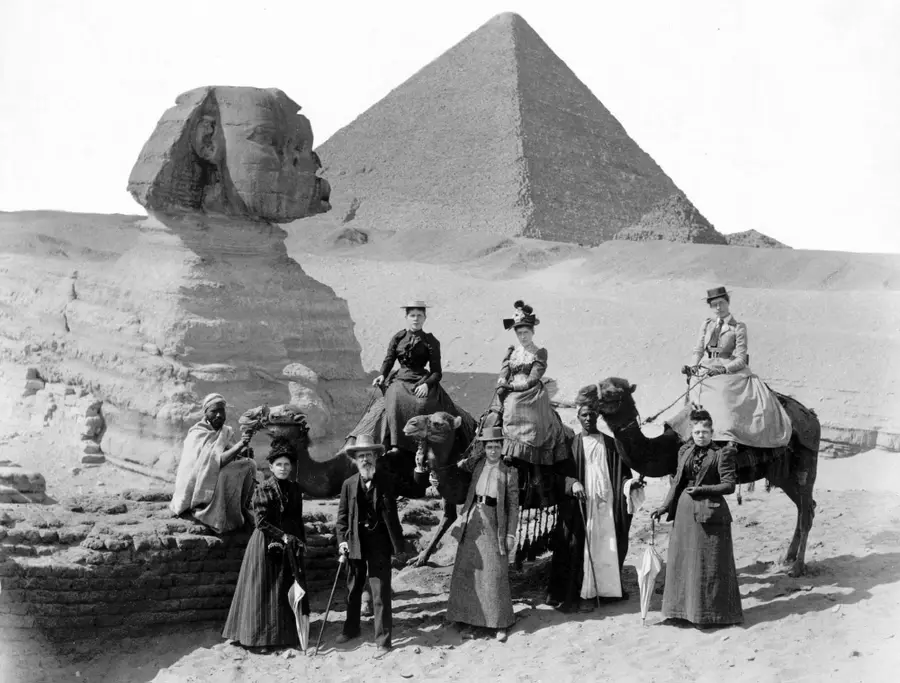
This remarkable nineteenth-century archival photograph—among the oldest surviving camera images ever taken of the Great Sphinx—vividly illustrates how the monument looked to travelers for most of post-pharaonic history. Taken before twentieth-century engineers permanently cleared the surrounding quarry enclosure, the image shows drifted desert sand completely burying the 73-meter lion body, the outstretched paws, the Dream Stele, and the adjacent Old Kingdom temples, leaving only the weathered chest, neck, and royal head emerging above the dunes. Beyond its immense historical value as early photography, this visual record provides firsthand archaeological proof of how rapidly windblown sand refilled the Sphinx Ditch whenever active human maintenance stopped, confirming the exact desert conditions described millennia earlier on the Dream Stele of Thutmose IV. If you want to avoid seasonal spring sandstorms (the Khamsin winds) when photographing the monument today, read our seasonal guide on the best time to visit Egypt.
- New Kingdom Restoration (Eighteenth & Nineteenth Dynasties, c. 1400–1250 BCE): Pharaoh Thutmose IV cleared the sand from the Sphinx Sanctuary, erected the Dream Stele, and installed large limestone casing blocks over already-eroded sections of the paws and flank. Later rulers, including Ramesses II, left additional stelae and maintained the sanctuary walls.
- Saite & Greco-Roman Repairs (c. 664 BCE–200 CE): During the Twenty-Sixth Dynasty and extensively under Ptolemaic and Roman emperors (including Marcus Aurelius and Septimius Severus), engineers cleared the sanctuary floor again, built high mudbrick and stone retaining walls along the edge of the ditch to hold back desert sand, placed a monumental staircase descending into the sanctuary from the east, and clad the paws and tail in small limestone masonry blocks.
- Nineteenth-Century Clearing Attempts (1817–1886): Following Caviglia's 1817 dig at the chest, French Egyptologist Auguste Mariette cleared portions of the complex in the 1850s and uncovered the nearby Valley Temple of Khafre, while Gaston Maspero conducted further sand removal in the 1880s. In each case, desert winds rapidly refilled the trench.
- Complete Excavation by Émile Baraize (1925–1936): Working for the Egyptian Antiquities Service, French engineer Émile Baraize spent eleven years completely excavating the Sphinx Ditch down to the bedrock floor, reinforcing the back of the head and neck cheeks where deep fissures threatened stability, and resetting dislodged ancient casing stones.
- Late Twentieth-Century & Modern Conservation (1980s–Present): In the 1980s, restoration teams mistakenly used Portland cement mortar and incompatible limestone blocks during repairs; the cement trapped subterranean moisture and salts inside the porous bedrock, accelerating flaking. Beginning in the late 1980s and continuing through extensive campaigns led by Egypt's Ministry of Tourism and Antiquities in partnership with international geologists and the Getty Conservation Institute, conservators removed the damaging cement, replaced deteriorated stones with matching high-purity limestone and lime-sand mortar, installed environmental monitoring stations, and introduced modern water-table drainage systems across the lower plateau to stop capillary groundwater from rising into the bedrock.
Great Sphinx Mysteries — Evidence vs. Myths
Few monuments on Earth attract as much popular speculation as the Great Sphinx of Giza. From television specials about lost prehistoric civilizations to claims of vast underground libraries, popular media frequently blurs the line between genuine geological questions and unsupported myth. The comparison table below evaluates the six most common popular claims against peer-reviewed archaeological and geological evidence.
| Popular Claim or Question | What the Available Evidence Supports | What Remains Uncertain |
|---|---|---|
| Is the Great Sphinx older than the Giza Pyramids (e.g., 10,000 BCE)? | Quarried blocks from the Sphinx Ditch directly form the core walls of the adjacent Fourth Dynasty Sphinx Temple and Khafre's Valley Temple. All tool marks, pottery, and architectural stratigraphy date the monument to the Old Kingdom (c. 26th century BCE). | The exact year within the Fourth Dynasty when carving began, and whether the natural uncarved rock knoll (yardang) already drew religious attention before Fourth Dynasty masons sculpted it. |
| The Water-Erosion Hypothesis (Precipitation-Induced Weathering) | Mainstream geologists demonstrate that the deep vertical fissures and undulating horizontal recesses in the Sphinx Ditch result from pre-existing Eocene tectonic joints in the limestone combined with salt exfoliation, morning dew condensation, rising groundwater, wind abrasion, and wet-dry flaking of the soft marl-rich Layer II limestone. | The exact proportion of weathering caused by brief Old Kingdom rainstorms and historical Nile flood seepage versus ongoing atmospheric salt crystallization. |
| Orion and Leo Astronomical Alignment Claims | The Sphinx faces due east toward the rising sun at the equinoxes, matching the east-west solar axis of the Sphinx Temple directly in front of it and Old Kingdom solar theology. | While solar alignment is firmly established by temple architecture, claims that the Sphinx was built in 10,500 BCE to mirror the zodiacal constellation Leo lack any textual or archaeological support in Egyptian astronomy. |
| The Alleged “Hall of Records” from Atlantis | The “Hall of Records” originated in the 1930s from the trance claims of American mystic Edgar Cayce, not from ancient Egyptian texts or archaeological surveys. Decades of excavations and geophysical tests have found zero evidence of an Atlantean archive. | Nothing in the archaeological record supports the existence of an Atlantean library; the concept is purely modern esoteric folklore. |
| Claims of Hidden Chambers and Tunnels | Natural karstic dissolution cavities exist throughout the Eocene limestone of the Giza Plateau, along with a few small, shallow man-made shafts cut into the Sphinx's rump, back, and base by ancient treasure hunters or Roman/nineteenth-century excavators. | Whether small, unexcavated natural limestone fissures detected by seismic or radar equipment beneath the plateau floor contain any minor ancient quarry cuts. |
| Extraterrestrial or Lost High-Technology Construction | The quarries at Giza preserve unfinished trenches, copper-tool marks, dolerite pounder stones, lever sockets, and workers' settlements demonstrating exactly how skilled Egyptian craftsmen carved and moved limestone blocks using Old Kingdom engineering. | Specific workshop sequences and the exact rigging methods used to maneuver the heaviest 100-ton blocks inside the cramped corridors of the Sphinx Temple. |
As this comparison illustrates, identifying a genuine geological feature—such as differential weathering across soft limestone beds or a natural karstic void in porous rock—is entirely different from proving the existence of a lost prehistoric civilization. Scientific archaeology requires converging lines of physical evidence: stratified artifacts, contemporary architecture, and verifiable material culture.
Has a Hidden Chamber Been Found Beneath the Great Sphinx?
No confirmed hidden archaeological chamber containing royal burials, papyrus archives, or secret rooms has ever been discovered beneath the Great Sphinx of Giza. However, to understand why rumors persist, it helps to separate two very different things: small physical shafts that actually exist on the monument's surface, and subsurface geological anomalies detected by remote-sensing instruments.
First, the Sphinx does have three known, physically inspected small openings on or immediately beside its body, none of which lead to secret underground halls:
- The Crown Hole: A shallow circular cavity at the very top of the head (roughly 1.5 meters wide and deep), which originally served as an anchor socket for an additional sculptural crown or headrest ornament during antiquity and was filled in with protective mortar during twentieth-century conservation.
- The Dorsal Shaft: A short, dead-end vertical cut behind the head along the back, excavated in the nineteenth century by early explorers and sealed during Émile Baraize's 1920s restoration.
- The Rump Passage: A narrow crevice at the rear northern haunch of the Sphinx extending a few meters into the bedrock and floor—likely an ancient or medieval treasure-hunter's probe following a natural fissure in the limestone. It terminates in solid rock and contains no chamber or inscriptions.
Second, beginning in the late 1970s and continuing in the 1980s and 1990s, geophysical teams from institutions such as SRI International, Waseda University, and Florida State University conducted ground-penetrating radar (GPR), acoustic, and seismic refraction surveys around the Sphinx Sanctuary. As noted in Smithsonian Magazine's coverage of Sphinx investigations, the limestone bedrock of the Giza Plateau is naturally honeycombed with karstic solution cavities—irregular hollows dissolved into the rock by water millions of years ago. While geophysical scans occasionally register density variations or natural voids under the sanctuary floor, rotary test drillings conducted under the supervision of Egyptian antiquities authorities confirmed that these features are natural geological cavities in the Eocene limestone rather than constructed subterranean rooms. In archaeology, extraordinary claims of secret chambers require direct, independently verifiable physical evidence, not ambiguous radar echoes in porous limestone.
Where Is the Great Sphinx of Giza?
The Great Sphinx of Giza stands at the eastern foot of the Giza Plateau in the Giza Governorate, on the west bank of the Nile River approximately 15 to 20 kilometers (9 to 12.5 miles) southwest of downtown Cairo. Within the layout of the Giza necropolis, the Sphinx occupies a low rocky terrace directly east of the second pyramid (the Pyramid of Khafre) and southeast of the Great Pyramid of Khufu, right beside the secondary eastern entrance gate (commonly called the Sphinx Gate, located across from the Nazlet el-Samman neighborhood). First-time visitors can check our detailed guide on how far the pyramids are from Cairo, including travel time and directions from every major hotel district.
On a broader historical scale, the Giza Plateau is not an isolated site; it is the northern anchor of a vast chain of Old Kingdom royal cemeteries stretching more than 30 kilometers along the desert escarpment overlooking the ancient capital of Memphis. In 1979, this entire archaeological belt was inscribed on the UNESCO World Heritage List as Memphis and its Necropolis – the Pyramid Fields from Giza to Dahshur. Understanding this geographic relationship helps visitors appreciate why the Great Sphinx faces due east: in antiquity, a canal fed by the annual inundation of the Nile brought ceremonial barges right up to a harbor basin in front of Khafre's Valley Temple and the Sphinx Temple, making the towering guardian the first monumental sight greeting royal funeral processions arriving from the river valley.
How to Visit the Great Sphinx of Giza
Visiting the Great Sphinx of Giza requires practical preparation so that logistics do not overshadow the history in front of you. Access to the standard Sphinx viewing terrace is included with the general Giza Plateau admission ticket, which you obtain at either the northern Great Pyramid gate (Fayoum Road entrance) or the eastern Sphinx Gate. To stand directly beside the monument, visitors walk through the atmospheric pink-granite halls of the Valley Temple of Khafre and exit along a paved passage that leads to an elevated viewing platform overlooking the Sphinx's southern flank and profile, with the Pyramid of Khafre rising directly behind it.
When organizing your day, follow a logical route across the plateau:
- Start Early at the Upper Plateau: Arrive as close to the morning opening hour as possible to explore the base of the Great Pyramid of Khufu and the Pyramid of Khafre before midday heat and large tour buses peak.
- Visit the Western Panoramic Viewpoint: Head out to the high desert ridge southwest of the three main pyramids for wide-angle photographs showing Khufu, Khafre, and Menkaure aligned against the desert horizon.
- Descend to the Valley Temple and the Great Sphinx Last: Finish your plateau circuit at the lower eastern terrace. Morning and early-to-midday light illuminates the face and profile of the Sphinx favorably, and ending near the Sphinx Gate makes meeting your driver or walking to nearby lunch spots straightforward.
Before traveling, always confirm current ticket categories, payment rules (Egyptian archaeological sites now operate on card-only electronic ticketing systems at the gates), and seasonal opening hours through official channels. Note that walking down inside the enclosed Sphinx Ditch—directly between the paws in front of the Dream Stele—is closed to regular general-admission ticket holders for conservation reasons and requires special advance permission and high-tier private-access fees issued by the Ministry of Tourism and Antiquities. To estimate your overall sightseeing expenses accurately, review our breakdown of Cairo and Giza pyramids tour prices, consult our guide to planning your 2026 Egypt trip budget, and—if you are flying in from the United States—check whether Americans need a visa for Egypt prior to departure.
Can You Visit the Sphinx and the Giza Pyramids on the Same Tour?
Yes, the Great Sphinx and the three main pyramids of Giza are located within the same fenced archaeological zone and are virtually always visited together on a single excursion. The distance from the base of the Great Pyramid of Khufu down the slope to the Valley Temple and the Great Sphinx is roughly 600 to 800 meters (less than half a mile). While healthy travelers can walk downhill from the pyramids to the Sphinx, navigating the sprawling upper plateau and the high desert viewpoint in the sun is far easier with a dedicated air-conditioned vehicle waiting at each stop.
When comparing Cairo and Giza day-trip costs, make sure your itinerary includes reliable transportation options in Egypt or book a luxury car rental with a driver in Egypt so you can move effortlessly between the upper pyramid checkpoints, the panoramic ridge, and the lower Sphinx Sanctuary.
How Much Time Should You Allow for the Visit?
While there is no official minimum time limit once inside the gates, most visitors find that allowing 3 to 4 hours on the Giza Plateau provides a comfortable, unhurried experience. Of that window, travelers typically spend 45 to 60 minutes exploring the Valley Temple of Khafre and the Great Sphinx viewing terrace—leaving ample time to examine the diorite and granite masonry joints, view the limestone strata and missing nose in detail, and photograph the monument from different angles.
The total duration of your excursion depends heavily on your broader itinerary. If you plan to enter the interior burial chamber of the Great Pyramid of Khufu, ride a camel across the desert ridge, or combine Giza with Saqqara, Memphis, or a major museum in Cairo, you should budget a full 8-hour sightseeing day.
Should You Choose a Private Tour or a Larger Egypt Itinerary?
Choosing between a standalone Cairo/Giza day tour and a multi-day Egypt package comes down to how your international flights and hotel bookings are structured. If you have already booked your Cairo hotel independently or are visiting on a short city break or stopover, a private single-day excursion gives you targeted door-to-door pickup, a dedicated Egyptologist, and complete control over your morning schedule.
Conversely, if you plan to see the Great Sphinx and Giza Pyramids before continuing south to the temples of Luxor and Aswan, sailing on a Nile cruise, or visiting Alexandria and the Red Sea, booking one of our complete Egypt vacation packages or specialized Egypt vacation packages for Americans eliminates the stress of coordinating domestic flights, intercity transfers, and separate guides in every city. Always check individual tour pages to confirm specific ticket, meal, and hotel inclusions before booking.
Explore Cairo and the Giza Pyramids with Egy Travel Lux
Whether you want a focused half-day walk through the Giza necropolis, a full day of Old Kingdom pyramid evolution, or a multi-week journey down the Nile, Egy Travel Lux offers curated sightseeing itineraries led by knowledgeable Egyptologist guides. If you are planning a full vacation across Egypt that begins with the Great Sphinx and Giza Pyramids before venturing to Alexandria, Upper Egypt, or the Red Sea, the table below organizes our top multi-day packages from Search Console by duration and regional focus.
| Destination Focus | Duration | Recommended Egy Travel Lux Itineraries |
|---|---|---|
| Giza, Saqqara & Memphis | Full-Day Excursion | Trace the evolution of royal burials from Djoser's Step Pyramid to Khafre's Valley Temple and the Great Sphinx on our signature Giza, Saqqara, and Memphis guided tour. |
| Cairo & Alexandria | Multi-Day Short Breaks | Combine the Giza Pyramids and Great Sphinx with Greco-Roman and Mediterranean landmarks through our Cairo and Alexandria Egypt tour packages. |
| Cairo, Luxor, Aswan & Nile Cruise | 7 to 8 Days | Pair Giza sightseeing with Upper Egypt temples via our Cairo and Nile Cruise package, our popular 7-day Egypt tour and Nile Cruise, or our 8-day Cairo, Luxor, and Aswan Nile Cruise tour. |
| Grand Egypt Expeditions | 10 to 12 Days | Connect the Giza Plateau with Upper Egypt, Alexandria, and the Red Sea coast on a 10-day Egypt tour or the Ultimate 12-day Cairo, Alexandria, Nile Cruise, and Hurghada package. |
Frequently Asked Questions About the Great Sphinx of Giza
1. What is the Great Sphinx of Giza?
The Great Sphinx of Giza is a colossal monolithic statue carved directly out of the natural limestone bedrock on the Giza Plateau near Cairo, Egypt. Combining the recumbent body of a lion with the head of an ancient Egyptian king wearing a pleated nemes headdress, it is the oldest known monumental royal sculpture from ancient Egypt.
2. Who built the Great Sphinx of Giza?
Although no surviving contemporary Old Kingdom inscription records the builder's name, mainstream Egyptologists attribute the Great Sphinx primarily to Fourth Dynasty Pharaoh Khafre. This attribution is supported by the archaeological integration of the Sphinx Ditch with Khafre's adjacent Valley Temple, the Sphinx Temple, and the causeway leading up to his pyramid, though a few scholars have proposed Khufu or Djedefre as alternative Fourth Dynasty candidates.
3. How old is the Great Sphinx?
Based on archaeological stratigraphy, quarry tool marks, and the surrounding funerary temples, the Great Sphinx dates to Egypt's Fourth Dynasty during the Old Kingdom (roughly the mid-26th century BCE), making it approximately 4,500 years old. Popular claims that it dates back to 10,000 BCE are not supported by archaeological evidence.
4. How tall and long is the Great Sphinx?
The Great Sphinx measures approximately 73 meters (240 feet) in total length from the tips of its outstretched front paws to the base of its tail, and rises about 20 meters (66 feet) from the floor of the Sphinx Sanctuary to the top of its head. Its face alone measures roughly 4.1 meters (13.5 feet) wide across the cheekbones.
5. What does the Great Sphinx symbolize?
In ancient Egyptian royal ideology, the Great Sphinx symbolized the union of supreme physical power and royal wisdom, acting as a sacred solar guardian over the Giza necropolis. By the New Kingdom, it was also revered directly as a manifestation of the sun god rising on the eastern horizon.
6. Why does the Sphinx have a human head and a lion's body?
Ancient Egyptian sculptors combined the lion—the fiercest predator of the desert margin and an emblem of solar vigilance—with the human head of the reigning pharaoh wearing the royal nemes headcloth. This composite form visually expressed that the king possessed the unmatched strength of a lion guided by human intelligence and divine authority.
7. Why is the Great Sphinx missing its nose?
Forensic examination of the face shows chisel and pry-bar marks near the bridge and nostril, demonstrating that the nose was deliberately broken off by human hands during the medieval period. Fifteenth-century Egyptian historian al-Maqrizi attributed the damage to a fourteenth-century Sufi figure named Muhammad Sa'im al-Dahr around 1378 CE, though earlier medieval accounts also mention facial damage.
8. Did Napoleon's soldiers destroy the Sphinx's nose?
No. The widespread rumor blaming Napoleon Bonaparte's artillery during the 1798 French campaign is disproved by historical drawings made in 1737 by Danish explorer Frederic Louis Norden, which clearly depict the Great Sphinx without its nose more than sixty years before Napoleon arrived in Egypt.
9. What is the Dream Stele of Thutmose IV?
The Dream Stele is a 3.6-meter-tall pink granite slab erected between the front paws of the Great Sphinx by Eighteenth Dynasty Pharaoh Thutmose IV (c. 1400 BCE). Its hieroglyphic inscription recounts how the young prince fell asleep in the shade of the sand-buried Sphinx and dreamed that the solar god Horemakhet promised him the Egyptian throne if he cleared the sand away and restored the sanctuary.
10. What was the original name of the Great Sphinx?
The original Fourth Dynasty name of the Great Sphinx is unknown because no Old Kingdom text mentioning the statue has survived. During the New Kingdom, about a thousand years later, Egyptians worshipped the monument under the name Horemakhet (“Horus in the Horizon”), while the word “Sphinx” was introduced later by Greek travelers.
11. Was the Great Sphinx originally painted?
Yes, surviving traces of mineral pigment indicate that at least parts of the Great Sphinx were painted in antiquity. Conservators and early excavators have documented red ochre pigment on sheltered areas of the face and ears, along with traces of yellow and blue paint on the royal nemes headdress and ceremonial beard fragments.
12. Has a hidden chamber been discovered beneath the Sphinx?
No confirmed hidden archaeological chamber, burial room, or archive has ever been found beneath the Great Sphinx. While geophysical surveys have detected natural karstic cavities and solution voids typical of the porous Eocene limestone of the Giza Plateau, test drillings and physical inspections have never revealed an artificial underground room or “Hall of Records.”
13. Is the Great Sphinx older than the pyramids?
No established archaeological evidence indicates that the Great Sphinx is older than the Giza pyramid age. Rather, the Great Pyramid of Khufu was built first, and the megalithic limestone blocks quarried from the trench around the Sphinx's body were used directly to build the adjacent Fourth Dynasty Sphinx Temple and Khafre's Valley Temple.
14. Can visitors get close to the Great Sphinx?
Yes, standard Giza Plateau admission allows visitors to walk through the Valley Temple of Khafre onto an elevated viewing terrace immediately beside the southern flank of the Sphinx. Accessing the lower quarry floor directly between the paws requires a special private-access permit arranged in advance through Egypt's Ministry of Tourism and Antiquities.
15. Can you visit the Great Sphinx and Giza Pyramids on the same tour?
Yes, the Great Sphinx stands inside the same Giza Plateau archaeological complex as the Pyramids of Khufu, Khafre, and Menkaure, less than a kilometer down the slope from the Great Pyramid. Every standard half-day or full-day Giza sightseeing tour includes both the three pyramids and the Great Sphinx.
Discover the Great Sphinx for Yourself
After four and a half millennia of desert winds, shifting sands, royal restorations, and modern conservation, the Great Sphinx of Giza remains an extraordinary testament to Old Kingdom stone-carving and ancient Egyptian solar beliefs. Reading about the bedrock strata of the Sphinx Ditch, the rose-granite columns of Khafre's Valley Temple, and the Dream Stele of Thutmose IV prepares you to look past popular myths—but nothing replaces standing on the eastern terrace of the Giza Plateau and seeing the monument in its true architectural setting beside the pyramids.