The Serapeum of Saqqara: History, Sacred Apis Bulls & 2026 Visitor Guide | Egy Travel Lux
The Serapeum of Saqqara: History, Sacred Bulls, and Underground Tombs
What Is the Serapeum of Saqqara?
The Serapeum of Saqqara is a monumental subterranean burial complex hewn directly into the limestone bedrock of the Saqqara necropolis, approximately 30 kilometers south of Cairo, Egypt. For more than 1,350 years — from the reign of Pharaoh Amenhotep III in the Eighteenth Dynasty (c. 1390–1352 BCE) until the end of the Ptolemaic Period (30 BCE) — these underground galleries served as the state cemetery for the sacred Apis bulls, which were venerated in the nearby capital city of Memphis as the living earthly manifestation of the creator god Ptah. Today, the accessible portion of the catacombs is famous for its nearly 200-meter-long main gallery flanked by deep, vaulted side chambers holding 24 colossal sarcophagi carved from single blocks of granite, greywacke, basalt, and diorite weighing between 60 and 80 metric tons each.
To understand the monument, it helps to clarify its name. Ancient Egyptians did not originally call this site the "Serapeum." In Egyptian texts, the burial complex was known as the resting place of Osiris-Apis (written in hieroglyphs as Wsjr-Ḥp and preserved in Coptic as Userhapi), reflecting the belief that a deceased Apis bull merged with Osiris, Lord of the Underworld. During the Hellenistic period, the Ptolemaic dynasty Hellenized Osiris-Apis into the Graeco-Egyptian god Serapis (Sarapis), and Greek and Roman writers consequently referred to the sanctuary and its catacombs as the Serapeion or Serapeum. Note that the Serapeum of Saqqara is entirely distinct from the later Ptolemaic Serapeum of Alexandria; while Alexandria's temple was a civic sanctuary dedicated to the syncretic god Serapis, Saqqara's Serapeum was the actual subterranean necropolis where mummified Apis bulls were physically interred with royal honors.
Among all the things to do in Cairo and its surrounding desert plateaus, descending into the Serapeum provides a striking contrast to the sunlit pyramids above. Rather than celebrating a single pharaoh's reign, these rock-cut corridors record a continuous religious institution maintained by dozens of successive kings — native Egyptian, Kushite, Persian, and Macedonian Greek alike — each seeking political and spiritual legitimacy by honoring Memphis's sacred bull.
Explore Saqqara and the Serapeum with a Licensed Egyptologist
Since 1983, Egy Travel Lux has designed private, customized archaeological excursions led by licensed Egyptologists. If you want to connect the underground galleries of the Serapeum with the Step Pyramid of Djoser and the ancient capital of Memphis in a single, seamless day, explore our curated Cairo sightseeing options.
View the Giza, Saqqara & Memphis Private TourWhere Is the Serapeum of Saqqara Located?
The Serapeum of Saqqara sits in the northwestern sector of the Saqqara necropolis within Egypt's Giza Governorate, on the elevated western desert escarpment overlooking the Nile Valley. Geographically, the entrance to the subterranean galleries lies approximately 800 meters (half a mile) northwest of the Step Pyramid of Djoser and roughly 30 kilometers (19 miles) south of downtown Cairo. Since 1979, the entire plateau has been inscribed by UNESCO as part of the Memphis and its Necropolis – the Pyramid Fields from Giza to Dahshur World Heritage Site.
For ancient Egyptians, this specific location was chosen for both topographical and sacred reasons:
- Connection to the Capital of Memphis: Directly below the eastern cliffs of the Saqqara plateau, in the fertile floodplain around modern Mit Rahina, stood Memphis (ancient Inbu-Hedj, "The White Walls"), the administrative and religious center of Old Kingdom Egypt and home to the Great Temple of Ptah. The living Apis bull resided in a sacred court adjacent to Ptah's temple in the valley.
- The Processional Transition from Valley to Desert: When the bull died, its funeral cortege climbed from the cultivated Nile floodplain up to the dry limestone plateau of the western desert — the realm of Osiris and the dead — following a paved sacred causeway and a sphinx-lined processional avenue (dromos) that terminated directly at the Serapeum enclosure.
- Orientation Within the Saqqara Visitor Zone: For modern travelers arriving through the main Saqqara ticket gate, the road forks past the Step Pyramid of Djoser complex and continues northwest across open desert toward the New Kingdom tombs and the Serapeum parking area, located immediately adjacent to the tombs of Ti and Ptahhotep.
The History of the Serapeum of Saqqara
Although worship of the Apis bull in the Memphis area is attested on Early Dynastic monuments dating back to the First Dynasty (c. 3000 BCE), archaeological evidence for where the earliest bulls were buried prior to the New Kingdom has not survived. The monumental complex known today as the Serapeum of Saqqara developed over three distinct architectural phases spanning the New Kingdom, the Third Intermediate Period, the Late Period, and the Ptolemaic Kingdom.
Phase 1: The Isolated Tombs (Eighteenth to Early Nineteenth Dynasty, c. 1390–1250 BCE)
The earliest archaeologically verified burial at the Serapeum dates to the reign of Amenhotep III in the Eighteenth Dynasty (c. 1390–1352 BCE). Supervised by the king's eldest son, Crown Prince Thutmose (who served as High Priest of Ptah in Memphis before his premature death), this inaugural tomb established a pattern that lasted for roughly a century and a half. During the reigns of Amenhotep III, Tutankhamun, Horemheb, Seti I, and the early decades of Ramesses II, each deceased Apis bull received its own independent monument: a vertical shaft descending into a subterranean burial chamber cut into the bedrock, surmounted on the desert surface by a small freestanding cult chapel built of mudbrick and faced with carved limestone reliefs. In these early burials, the mummified bull — or specifically treated ritual remains — was placed inside wooden coffins accompanied by canopic jars containing the animal's embalmed internal organs and royal funerary figurines (shabtis).
Phase 2: Prince Khaemwaset and the Lesser Vaults (Nineteenth to Twenty-Sixth Dynasty, c. 1250–644 BCE)
A major architectural turning point occurred in Year 30 of the reign of Ramesses II (c. 1250 BCE) under the direction of his fourth son, Prince Khaemwaset. Serving as High Priest of Ptah in Memphis, Khaemwaset is widely recognized by modern scholars as an early antiquarian ("the first Egyptologist") because he systematically studied, cataloged, and restored dilapidated Old Kingdom pyramids and temples across Giza and Saqqara, leaving restoration inscriptions on monuments such as the Pyramid of Unas.
Rather than digging additional isolated shafts for each new Apis burial, Khaemwaset ordered the excavation of a shared underground gallery — known to archaeologists as the Lesser Vaults (Petits Souterrains). Measuring approximately 68 meters in length, this rock-cut corridor allowed priests to carve individual burial chambers into the side walls as successive bulls died, sealing each chamber with masonry once the funeral was complete and embedding commemorative limestone stelae into the corridor walls. The Lesser Vaults remained the active burial gallery through the Twentieth, Twenty-First, Twenty-Second (Libyan), Twenty-Fifth (Kushite), and early Twenty-Sixth Dynasties. Inside the Lesser Vaults, the bulls continued to be buried in monumental wooden coffins until the final interment in this gallery, which took place in Year 21 of King Psamtik I (c. 644 BCE).
Phase 3: Psamtik I and the Greater Vaults (Twenty-Sixth Dynasty to Ptolemaic Period, c. 612–30 BCE)
By the late seventh century BCE, Egypt was experiencing the Saite Renaissance under the Twenty-Sixth Dynasty, a period marked by resurgent economic wealth and deliberate emulation of Old Kingdom monumental stonework. When another Apis bull died in Year 52 of Psamtik I (c. 612 BCE), the king inaugurated a far grander subterranean gallery: the Greater Vaults (Grands Souterrains). Cut on a broader, higher scale and extending nearly 198 meters along its main axis, the Greater Vaults introduced the systematic use of massive monolithic stone sarcophagi quarried from granite, basalt, and greywacke.
Subsequent Twenty-Sixth Dynasty pharaohs, particularly Apries and Amasis (Ahmose II), commissioned some of the most finely polished stone sarcophagi in the gallery. During the First Persian Occupation (Twenty-Seventh Dynasty), despite ancient Greek historian Herodotus's claim that the Persian king Cambyses II stabbed the Apis bull in the thigh in a fit of madness, archaeological evidence inside the Serapeum proves that Cambyses officially dedicated a monolithic granite sarcophagus and commemorative stela for an Apis burial in Year 6 of his reign (524 BCE), and his successor Darius I likewise honored the cult.
During the Thirtieth Dynasty — the final dynasty of native Egyptian rulers — Pharaohs Nectanebo I and Nectanebo II (c. 380–343 BCE) constructed an ornate eastern surface temple and lined the desert approach with hundreds of limestone sphinxes. Following Alexander the Great's arrival in Egypt in 332 BCE (during which Arrian records that Alexander personally offered sacrifices to Apis in Memphis), the Ptolemaic kings expanded the Greater Vaults to their maximum extent, patronized the international cult of Serapis, and added a semicircular monument of Greek philosophers and poets outside the temple enclosure. After the death of Cleopatra VII and the Roman annexation of Egypt in 30 BCE, new burials inside the Saqqara galleries ceased, though Roman emperors and travelers continued to visit the living Apis bull in Memphis for generations.
| Historical Period & Date | Ruler / Key Figure | Complex Section | Documented Development & Archaeological Evidence |
|---|---|---|---|
| 18th Dynasty c. 1390–1352 BCE | Amenhotep III & Crown Prince Thutmose | Isolated Tombs | Earliest verified Apis tomb at Saqqara; rock-cut underground chamber topped by a surface chapel; burial in wooden coffin with canopic jars. |
| Late 18th to Early 19th Dynasty c. 1336–1260 BCE | Tutankhamun, Horemheb, Seti I, early Ramesses II | Isolated Tombs | Continued practice of individual shaft tombs and surface chapels; two bulls buried in Years 16 and 30 of Ramesses II in shared/transitional shafts. |
| 19th Dynasty (Year 30 of Ramesses II) c. 1250 BCE | Ramesses II & Prince Khaemwaset | Lesser Vaults | Khaemwaset excavates the first collective subterranean gallery (68 m long) with side niches; undisturbed burial from Year 26/30 later found by Mariette. |
| 20th to Early 26th Dynasty c. 1189–644 BCE | Ramesses III–XI, Shoshenq I, Taharqa, early Psamtik I | Lesser Vaults | Gallery extended with side chambers for wooden-coffin burials; hundreds of dated votive stelae mounted in corridor walls down to Year 21 of Psamtik I. |
| 26th Dynasty (Saite Period) c. 612–526 BCE | Psamtik I (Year 52), Apries, Amasis (Year 23) | Greater Vaults | Inauguration of the monumental Greater Vaults; transition to colossal monolithic stone sarcophagi of Aswan granite and greywacke. |
| 27th Dynasty (First Persian Period) c. 524–486 BCE | Cambyses II (Year 6) & Darius I | Greater Vaults | Inscribed granite sarcophagus and official stela dedicated under Cambyses II, qualifying Greek literary accounts of Persian hostility. |
| 4th Century BCE & 30th Dynasty c. 380–336 BCE | Nectanebo I, Nectanebo II, Khababash (Year 2) | Surface Temple & Greater Vaults | Construction of the long limestone Avenue of Sphinxes (Nectanebo I), eastern temple sanctuary (Nectanebo II), and inscribed sarcophagus lid of Khababash. |
| Ptolemaic Period 305–30 BCE | Ptolemy I through Cleopatra VII | Greater Vaults & Dromos | Major southward extension of the Greater Vaults; promotion of the syncretic god Serapis; erection of the Greek Philosophers' Hemicycle along the approach. |
The Sacred Apis Bull and Its Religious Significance
To grasp why ancient Egyptian kings invested such extraordinary labor in hollowing out the bedrock of Saqqara, one must understand the theology of the sacred Apis bull in ancient Egyptian religion. Unlike modern caricatures of "animal worship," Egyptians did not worship cattle as a species. Instead, they believed that a single, uniquely marked bull acted as the living vessel and earthly manifestation (ba) of a specific deity — in this case, Ptah, the supreme creator god of Memphis who brought the universe into existence through his heart (thought) and tongue (speech).

How Priests Identified the Living Apis Bull
Only one Apis bull could exist in Egypt at any given time. When the reigning bull died and was buried in the Serapeum, priests traveled across the country searching herds for a newborn male calf bearing divinely ordained physical markings. Both Egyptian stelae and classical historians — notably Herodotus (Histories 3.28) and Strabo (Geography 17.1.31) — record that the calf had to be black with specific contrasting patterns:
- A white triangular or diamond-shaped blaze on its forehead.
- A white marking across its back resembling the outstretched wings of an eagle or vulture.
- A growth or lump beneath its tongue shaped like a sacred kheper scarab beetle.
- Double hairs (black and white strands) on its tail, along with a crescent-shaped mark on its right flank.
According to Egyptian myth, the calf was conceived when a flash of celestial fire or moonlight from heaven struck a virgin cow that never bore another offspring. Once verified by the Memphite priesthood, the calf and its mother (who was venerated separately as the Isis-cow and buried in her own catacomb, the Iseum, located north of the Serapeum) were transported on a gilded ceremonial barge to Memphis.
Life at Memphis and Assimilation with Osiris in Death
During its lifetime — which lasted an average of 18 to 25 years — the Apis bull lived in luxury inside a special sanctuary (the Apieion) within the precinct of the Great Temple of Ptah at Memphis. The bull slept on soft bedding, drank from a dedicated well, was fed fine grain and milk, and was provided with a harem of cows. Worshippers and royal envoys visited its courtyard to consult the bull as an oracle: priests interpreted the future by observing which chamber the bull chose to enter or whether it accepted food from a petitioner's hand (ancient writers claimed the bull refused food offered by Germanicus Caesar shortly before the Roman general's death). For a deeper look at how Ptah, Osiris, and sacred animals interacted across the Nile Valley, see our complete guide to ancient Egyptian gods and burial beliefs.
When the bull died a natural death (or, according to late classical sources whose historicity remains debated among Egyptologists, was ritually drowned if it surpassed 25 years of age — a claim not corroborated by Egyptian Serapeum stelae, several of which record bulls living 26 to 27 years), the entire country entered official mourning. Through the 70-day mummification ceremony, the bull underwent the same theological transformation as a deceased pharaoh: having lived as the herald of Ptah, it merged in death with Osiris to become the immortal composite god Osiris-Apis, guarantor of resurrection and cosmic renewal.
How the Serapeum Was Designed and Constructed
The underground architecture of the Serapeum reflects an ambitious evolution in rock-cut engineering. Situated roughly 10 to 12 meters below the desert surface, the galleries were excavated into the layered Eocene limestone of the Saqqara plateau using bronze and iron chisels, heavy dolerite pounders, wooden wedges, and oil lamps that left minimal soot thanks to salt-treated wicks or carefully managed ventilation shafts.

Architectural Comparison: The Lesser Vaults vs. The Greater Vaults
- The Lesser Vaults (Nineteenth to Early Twenty-Sixth Dynasty): Oriented roughly north-south and measuring about 68 meters in length, this older gallery was cut into a relatively friable stratum of marly limestone. Its narrower corridor gave access to smaller rectangular side chambers dug at floor level or slightly recessed, designed to hold wooden coffins and funerary equipment. Because the surrounding rock is prone to fracturing, the Lesser Vaults are heavily shored up and remain closed to general visitors.
- The Greater Vaults (Twenty-Sixth Dynasty to Ptolemaic Period): Beginning under Psamtik I and extending approximately 198 meters (650 feet) along its primary north-south gallery — with secondary east-west service corridors and inclined entry ramps bringing the total underground network to over 350 meters — the Greater Vaults were cut on a monumental scale. The main corridor averages 3 meters in width and up to 4.5 to 5 meters in height.
- Sunken Burial Niches (Crypts): Flanking both sides of the Greater Vaults in an alternating staggered layout (so that no two chambers sit directly opposite one another, preserving the structural integrity of the bedrock pillars) are 28 vaulted side chambers. Each burial chamber measures roughly 8 to 11 meters long and 4 to 6 meters wide, with its floor excavated 1.5 to 2.5 meters below the level of the central walkway. Originally, the upper arched walls and ceilings of several chambers were lined with fine white Tura limestone masonry blocks to reinforce the natural rock.
Once a sarcophagus was lowered into its sunken pit and the mummified Apis bull was sealed inside, priests built a thick masonry wall completely across the mouth of the side niche, sealing the burial chamber off from the main corridor while affixing royal and private devotional stelae into recessed sockets along the outer gallery walls.
The Giant Sarcophagi of the Serapeum
The centerpiece of any visit to the Serapeum of Saqqara is its collection of 24 surviving monolithic stone sarcophagi. Carved from single blocks of some of the hardest stones available in the ancient world — ranking between 6 and 7 on the Mohs hardness scale — these chests represent one of the highest achievements of Late Period and Ptolemaic stoneworking.
Most of the stone was quarried hundreds of kilometers away: red, pink, and black granite came from the quarries of Aswan (nearly 900 kilometers up the Nile), while dark greywacke, basalt, and diorite were extracted from the Wadi Hammamat in the Eastern Desert or quarries near the Faiyum and Cairo. Despite sensational claims on the internet that the boxes are "100-ton mysteries made with laser tools," archaeological measurements show consistent, well-documented dimensions and weights across the 24 surviving examples:
- External Length: Approximately 3.80 to 4.00 meters (12.5 to 13.1 feet).
- External Width: Approximately 2.25 to 2.35 meters (7.4 to 7.7 feet).
- Total Height (Chest + Lid): Approximately 2.40 to 3.35 meters (7.9 to 11.0 feet).
- Documented Weights: The hollowed main chests typically weigh between 40 and 65 metric tons, while the solid slab lids weigh between 20 and 30 metric tons, resulting in total combined weights of 60 to 80 metric tons for most complete sarcophagi (with only the largest Ptolemaic example estimated near 85 to 90 metric tons).
Inscribed vs. Uninscribed Sarcophagi
Twenty-one of the twenty-four sarcophagi have smooth, uninscribed exteriors — some polished to a mirror-like sheen and others left at an earlier stage of dressing. However, three famous sarcophagi bear detailed hieroglyphic inscriptions and royal cartouches that anchor the chronology of the Greater Vaults, alongside a fourth late Ptolemaic example bearing blank cartouches:
| Sarcophagus Attribution | Dynasty & Date | Stone Material | Approx. Dimensions & Weight | Key Features & Location in Gallery |
|---|---|---|---|---|
| Psamtik I (Transitional Burial) | 26th Dynasty, Year 52 (c. 612 BCE) | Hard Limestone / Granite | ~3.8 m long; ~55–60 metric tons | Marks the architectural shift from wooden coffins to monolithic stone chests at the start of the Greater Vaults. |
| Amasis (Ahmose II) | 26th Dynasty, Year 23 (c. 547 BCE) | Polished Dark Greywacke / Granite | ~3.85 m x 2.3 m x 2.5 m; ~65 metric tons total | Finest craftsmanship in the Serapeum; exterior carved with palace-facade (serekh) paneling and crisp hieroglyphic prayers to Osiris-Apis. |
| Cambyses II | 27th Dynasty, Year 6 (524 BCE) | Pink/Grey Aswan Granite | ~3.9 m x 2.3 m; ~65–70 metric tons total | Positioned near the western entry corridor; bears a formal dedicatory inscription proving Cambyses II sponsored an official Apis burial. |
| Khababash | 4th Century BCE (Year 2, c. 337 BCE) | Dark Granite / Basalt | ~3.9 m x 2.3 m; ~70 metric tons total | Inscribed along the lid with the cartouche of the native Egyptian rebel pharaoh Khababash shortly before Alexander the Great's arrival. |
| Late Ptolemaic Unfinished Cartouche Chest | Late Ptolemaic Period (1st Century BCE) | Black/Dark Grey Granite | ~4.0 m x 2.3 m x 3.3 m; ~80+ metric tons total | One of the largest chests at the southern end of the gallery; features roughly scratched, empty royal cartouches never finalized by master scribes. |
| Corridor-Blocking Sarcophagus & Lid | Late Period / Ptolemaic | Black Granite | Chest ~50 tons; separate lid nearby | Abandoned mid-transport inside the narrow entrance service corridor, providing physical evidence of how rough-dressed chests were hauled on rollers before final polishing. |
Ancient Egyptian Funerary Rituals and the Burial of the Apis Bulls
How was a deceased bull prepared for burial inside a 70-ton granite chest? Unlike many aspects of ancient religion that must be inferred solely from tomb art, the mummification of the Apis bull is documented step by step in an extraordinary primary text: the Apis Embalming Ritual Papyrus (Papyrus Vindobonensis 3873, housed in the Kunsthistorisches Museum in Vienna and translated by Egyptologist Robert L. Vos), dating to the second century BCE.
The 70-Day Embalming Process at Memphis
Immediately after the bull expired in Memphis, its body was carried to the Wabet ("Pure Place" or embalming house) near the Temple of Ptah. Still today at the ruins of Memphis (Mit Rahina), visitors can see the massive carved calcite (Egyptian alabaster) embalming tables shaped with lion-relief sides and drainage spouts where the sacred bulls were prepared. Over 70 days — the exact duration prescribed for pharaohs — specialized lector priests and embalmers performed a strict sequence of medical and liturgical acts:
- Evisceration and Natron Desiccation (Days 1–40): The internal organs were removed through a ventral incision, washed with palm wine and myrrh, and placed inside four oversized limestone or alabaster canopic jars. The body cavity was packed with bags of dry natron salt, aromatic resins, and linen packets to dehydrate the flesh.
- Wrapping and Gilding (Days 41–68): Priests wrapped the bull in hundreds of meters of fine linen bandages coated in heated coniferous resin and bitumen. To preserve the animal's sacred posture, its legs were folded beneath its body in a kneeling (recumbent) sphinx-like pose on a heavy wooden base sled. Artificial eyes of inlaid rock crystal and bronze were inserted, gold foil was applied to the face and horns, and protective amulets, heart scarabs, and royal pectorals were woven into the wrappings.
- The Opening of the Mouth Ceremony: Just as with human mummies, priests touched the bull's muzzle and eyes with ritual adzes to restore its senses in the afterlife.
The Grand Funeral Procession to Saqqara
On the final days of mourning, the wrapped bull was placed inside a gilded wooden shrine mounted on a ceremonial boat-sledge. Accompanied by the High Priest of Ptah, royal officials, wailing mourners, and two priestesses impersonating the goddesses Isis and Nephthys, the cortege crossed the sacred lake of Memphis and ascended the desert causeway along the Avenue of Sphinxes to the Serapeum. After final libations at the surface temple, workmen and priests guided the mummy down the subterranean ramp and sealed it inside its stone sarcophagus for eternity.
Auguste Mariette and the Rediscovery of the Serapeum
After the rise of Christianity and the closure of Egypt's pagan temples in the late fourth century CE, desert winds buried the surface sanctuaries of Saqqara beneath deep drifts of sand. For nearly 1,500 years, the exact location of the underground tombs of the Apis bulls was lost to history — until the arrival of a 29-year-old French scholar named Auguste Mariette in October 1850.
Mariette had been sent to Cairo by the Louvre Museum with modest funds to purchase Coptic and Syriac manuscripts from Egyptian monasteries. Delayed by negotiations with patriarchate officials, he rode out to the Saqqara plateau to inspect its ruins. Walking across the northern desert sands, Mariette noticed the weathered limestone head of a sphinx protruding just above a dune. Having seen similar avenues in Alexandria and Cairo gardens that had originated in Saqqara, he immediately recalled a famous passage written in the first century BCE by the Greek geographer Strabo (Geography 17.1.32):
"There is also a Serapeum in a very sandy place, where drifts of sand are piled up by the wind to such a degree that we saw some of the sphinxes buried up to their heads, and others only half-visible — from which one may conjecture the danger if a windstorm should strike someone walking toward the temple."
Excavation of the Avenue and Entry into the Vaults (1850–1851)
Redirecting his manuscript budget without waiting for authorization from Paris, Mariette hired thirty local workmen on November 1, 1850, and began digging along the line of buried statues. Over the next year, his team uncovered an avenue stretching several hundred meters, lined by more than 130 limestone sphinxes, along with the Ptolemaic hemicycle of eleven Greek philosophers and poets and the chapels of Nectanebo I and II.
On November 12, 1851, Mariette finally located the subterranean entrance and stepped inside the Greater Vaults. According to his excavation reports, the sight was astonishing and sobering at once: 24 colossal stone sarcophagi stood in their sunken side crypts, yet every single one in the Greater Vaults had already been robbed in antiquity, their heavy stone lids levered sidewaysjust enough for ancient plunderers to extract the mummies and jewelry.
When Mariette encountered collapsed ceiling rock blocking access to the older Lesser Vaults, he resorted to mid-nineteenth-century clearance methods — using gunpowder charges to blast away fallen boulders. While destructive by modern archaeological standards, these clearances revealed a walled-up chamber from Year 26 (and Year 30) of Ramesses II that ancient tomb robbers had completely missed. On the sandy floor, Mariette reported seeing the preserved bare footprints of the workmen who had sealed the tomb more than 3,000 years earlier. Inside lay undisturbed wooden coffins containing bituminous ritual masses, gold masks, carnelian and lapis lazuli pectorals inscribed with the names of Ramesses II and Prince Khaemwaset, and hundreds of shabti figurines.
Why the Serapeum Stelae Changed Egyptology
Beyond the royal jewelry (much of which was shipped to the Louvre Museum before Mariette founded the Egyptian Antiquities Service and the Cairo Museum in 1858), the most historically decisive discovery inside the Serapeum was the recovery of more than 500 inscribed limestone stelae. Set into the corridor walls by kings, priests, and stonecutters, official epitaph stelae recorded a standardized formula: "In Year X, Month Y, Day Z of King N, the god [Apis] was born; he was enthroned in Year A; he went to heaven [died] in Year B; his total lifespan was C years, D months, and E days." Because individual bulls lived across the reigns of two or three successive pharaohs, these overlapping lifespan records allowed Egyptologists to calculate the exact length of reigns from the Twenty-Second Dynasty through the Ptolemaic Period with mathematical certainty.
What Archaeologists Know — and What Remains Uncertain
Because the Serapeum's granite sarcophagi are so immense and their interior surfaces so finely finished, the complex frequently appears in popular media alongside claims that ancient Egyptians lacked the tools to carve or move them. A responsible historical examination separates verified archaeological mechanics from genuine, ongoing scholarly questions.
How Were the 60-to-80-Ton Sarcophagi Moved and Lowered?
Archaeologists have clear physical evidence inside the Serapeum itself demonstrating how the sarcophagi were transported, dressed, and installed:
- Evidence of Rough Transport Before Final Polishing: In the narrow service corridor near the visitors' entrance sits a granite sarcophagus and lid that were abandoned mid-delivery in antiquity. Significantly, this abandoned chest is still only rough-dressed — proving that the blocks were NOT brought into the tunnels with fragile, mirror-polished surfaces, but were hauled in rough form to prevent chipping and then ground and polished inside the burial chambers using quartz sand abrasives, copper saws, dolerite pounders, and polishing stones.
- Winches, Rollers, and Inclined Ramps: The northern and western service entrances feature gentle inclined ramps rather than steep stairs. Furthermore, vertical niches cut into the limestone walls at key turns inside the tunnels served as anchor sockets for heavy wooden capstans (winches) and rope tackle systems used to guide wooden sledges moving over timber rollers.
- The Sand-Pit Lowering Method: How did workmen lower a 50-ton chest into a sunken crypt with barely a meter of clearance on each side? Egyptian engineers filled the sunken burial pit completely to corridor level with dry desert sand, slid the sarcophagus on rollers onto the top of the sand pile, and then slowly scooped the sand out from rhythmic side channels beneath the base, allowing gravity to lower the stone chest millimeter by millimeter onto its limestone floor blocks.
Genuine Unresolved Questions in Egyptology
While the engineering methods are well understood within Egyptian stoneworking traditions, several legitimate historical questions remain open to scholarly debate:
- Why were only minimal bone fragments found inside the undisturbed Ramesses II coffins? When Mariette opened the intact wooden coffins of the Nineteenth Dynasty and examined a bituminous mass in the Greater Vaults, he found crushed bone fragments embedded in resin rather than complete articulated bull skeletons. Some earlier scholars speculated about ritual consumption or cremation, whereas modern zooarchaeologists and Egyptologists (such as Salima Ikram and Aidan Dodson) suggest either specialized New Kingdom excarnation/packing techniques or severe organic degradation caused by hot resin poured over the corpse during wrapping.
- Where are the Pre-New Kingdom Apis burials? Textual records confirm the Apis bull was worshiped at Memphis from the First Dynasty (over 1,600 years before Amenhotep III), yet no Old Kingdom or Middle Kingdom Apis tombs have ever been definitively identified at Saqqara.
- Exact Date of the Ancient Plundering: Whether the stone sarcophagi in the Greater Vaults were looted during late Roman political turmoil, early Christian iconoclasm in the late fourth century CE, or medieval treasure hunting remains undocumented in surviving texts.
What Can Visitors See at the Serapeum Today?
Following an eleven-year structural conservation project conducted by the Egyptian Ministry of Tourism and Antiquities at the Saqqara necropolis between 2001 and 2012 — which added rock bolts, steel support arches, moisture drainage, and low-heat LED lighting — the Serapeum of Saqqara offers one of the cleanest and most accessible underground experiences in Egypt. However, visitors should have clear expectations about which parts of the historical complex survive on site and which artifacts were moved to museums:
- Accessible Underground Area (The Greater Vaults): Your ticket grants access to the entire length of the Greater Vaults via the western service entrance and exit corridors. A flat wooden boardwalk with handrails runs down the center of the nearly 200-meter-long main tunnel, illuminated by warm uplighting.
- The 24 Monolithic Sarcophagi in Situ: You can look directly into the sunken side crypts along both sides of the main corridor to see the 24 giant granite, basalt, and greywacke sarcophagi. Notice how several massive stone lids remain pushed halfway off their chests where ancient robbers levered them open, and look for the small semicircular recessed niches carved into the limestone corridor walls that once held the dated Serapeum stelae.
- Close-Up Access to the Sarcophagus of Amasis: One sunken burial chamber near the southern end — containing the exquisitely carved and polished sarcophagus of King Amasis (Twenty-Sixth Dynasty) — is equipped with a dedicated wooden staircase allowing visitors to walk down into the crypt, stand directly beside the 65-ton chest, and examine its recessed palace-facade carvings and hieroglyphic inscriptions at eye level (interior entry into the chest itself is not permitted).
- The Abandoned Sarcophagus in the Entry Passage: As you walk through the entrance and exit corridors, you pass within inches of a rough-hewn black granite chest and its separate lid left behind in the narrow passageway.
- What Is NOT Visible on Site: The older Lesser Vaults of Prince Khaemwaset remain closed to the general public for structural safety. Furthermore, the surface temple of Nectanebo and most of the Avenue of Sphinxes and the Philosophers' Hemicycle on the desert surface above are either drifted over by sand, poorly preserved at foundation level, or housed in museums — with the finest Serapeum stelae, Apis statues, and Khaemwaset jewelry displayed primarily in the Louvre Museum in Paris, the Egyptian Museum in Tahrir, and the Grand Egyptian Museum.
How to Visit the Serapeum of Saqqara (2026 Guide)
Because Saqqara is a sprawling desert archaeological zone rather than a compact museum courtyard, planning your logistics before leaving Cairo makes a substantial difference to your comfort and budget.
2026 Ticket Prices, Opening Hours, and Payment Rules
As verified with the Ministry of Tourism and Antiquities as of October 2026, Saqqara uses a tiered ticketing system purchased at the main entrance gate before you drive onto the plateau. All official ticket windows in Egypt operate on a strictly cashless (credit/debit card only — Visa or Mastercard) policy:
| Ticket Type / Detail (October 2026) | Foreign Adult Price | Foreign Student Price | What Is Included & Practical Notes |
|---|---|---|---|
| Saqqara All-Inclusive Ticket (Recommended for Serapeum Visitors) | ~EGP 1,000 – 1,200 | ~EGP 500 – 600 | Includes general Saqqara site admission, the Serapeum of Saqqara, the Noble Tombs (Mereruka, Kagemni, Ti, Ptahhotep), the Unas Causeway, and the Imhotep Museum. |
| Standard Saqqara Area Ticket + Separate Serapeum Ticket | ~EGP 600 (Area) + ~EGP 350–400 (Serapeum add-on) | ~EGP 300 (Area) + ~EGP 180–200 (Serapeum add-on) | You must buy the Serapeum ticket at the main entry gate BEFORE driving up to the plateau; there is no ticket booth at the Serapeum tunnel door itself. |
| Step Pyramid of Djoser Interior Ticket | ~EGP 280 (extra) | ~EGP 140 (extra) | Optional add-on to walk inside the Step Pyramid's southern shaft to view the central burial vault from above. |
| Opening Hours & Photography Rules | Daily: 8:00 AM – 4:00 PM (5:00 PM in summer) | Last entry at 3:30 PM | Mobile phone photography and non-flash camera photography are free inside the Serapeum; flash and commercial tripods are prohibited. |
Note: The Egyptian Ministry of Tourism and Antiquities adjusts monument tariffs periodically. For a complete overview of how ticket fees fit into a full trip budget, consult our 2026 Egypt trip cost guide.
Transportation and Getting Between Monuments at Saqqara
Saqqara lies roughly 45 to 60 minutes south of central Cairo via the Ring Road and the Mariouteya Canal corridor. While ride-hailing apps like Uber can drop you at the outer Saqqara gate from Cairo, you cannot rely on walking or finding an Uber inside the Saqqara necropolis: the drive from the main ticket office to the Step Pyramid and onward to the Serapeum parking lot covers several kilometers of exposed desert roads, and return cars are scarce in rural Badrashin. Travelers should either book a guided day excursion or arrange a private car with a dedicated driver for the day so your vehicle waits for you at each monument parking lot. Additional regional transit advice can be found in our Egypt transportation guide.
Accessibility, Climate, and Practical Visitor Checklist
- Buy your Serapeum ticket at the main outer gate: Guards at the Serapeum entrance strictly check tickets and cannot sell add-on tickets on the spot; turning back to the main gate requires a 15-minute round-trip drive.
- Expect a warm, dry microclimate underground: Although shielded from direct sun, the Greater Vaults sit below the desert rock and retain warm, dry air year-round. Visit between 8:30 AM and 11:00 AM, and read our guide to the best time of year to visit Egypt when choosing your travel dates.
- Footwear and mobility considerations: Reaching the Serapeum involves walking down a sloped sand-and-stone ramp into the rock-cut entrance trench, followed by flat wooden boardwalks inside. Wear closed-toe walking shoes with good grip; while the main boardwalk is wide, the entry/exit ramps and the staircase into Amasis's crypt are not wheelchair accessible.
- Respectful tipping (baksheesh) etiquette: Site attendants inside the galleries may offer to point out inscriptions or stand in a sarcophagus niche for scale photos. If you do not want assistance, a polite "La, shukran" ("No, thank you") suffices; if you accept their help, a small tip of EGP 20 to 50 is customary.
Combine Saqqara, the Serapeum, and Cairo's Iconic Monuments
Because the Serapeum contains no English informational plaques inside its underground galleries, visiting with a licensed Egyptologist transforms 24 silent stone boxes into a vivid narrative of royal rituals, Persian kings, and 19th-century archaeology. Browse our private Cairo day tours to coordinate door-to-door transport, ticketing, and expert guiding.
Explore Private Cairo & Saqqara Day ToursWhat Other Archaeological Sites Can You Visit Near the Serapeum?
No traveler drives out to Saqqara solely for the 45 minutes required to walk through the Serapeum. Its true value shines when paired with the surrounding monuments of the Memphite necropolis, which together trace more than 2,500 years of Egyptian architectural evolution within a single day trip.
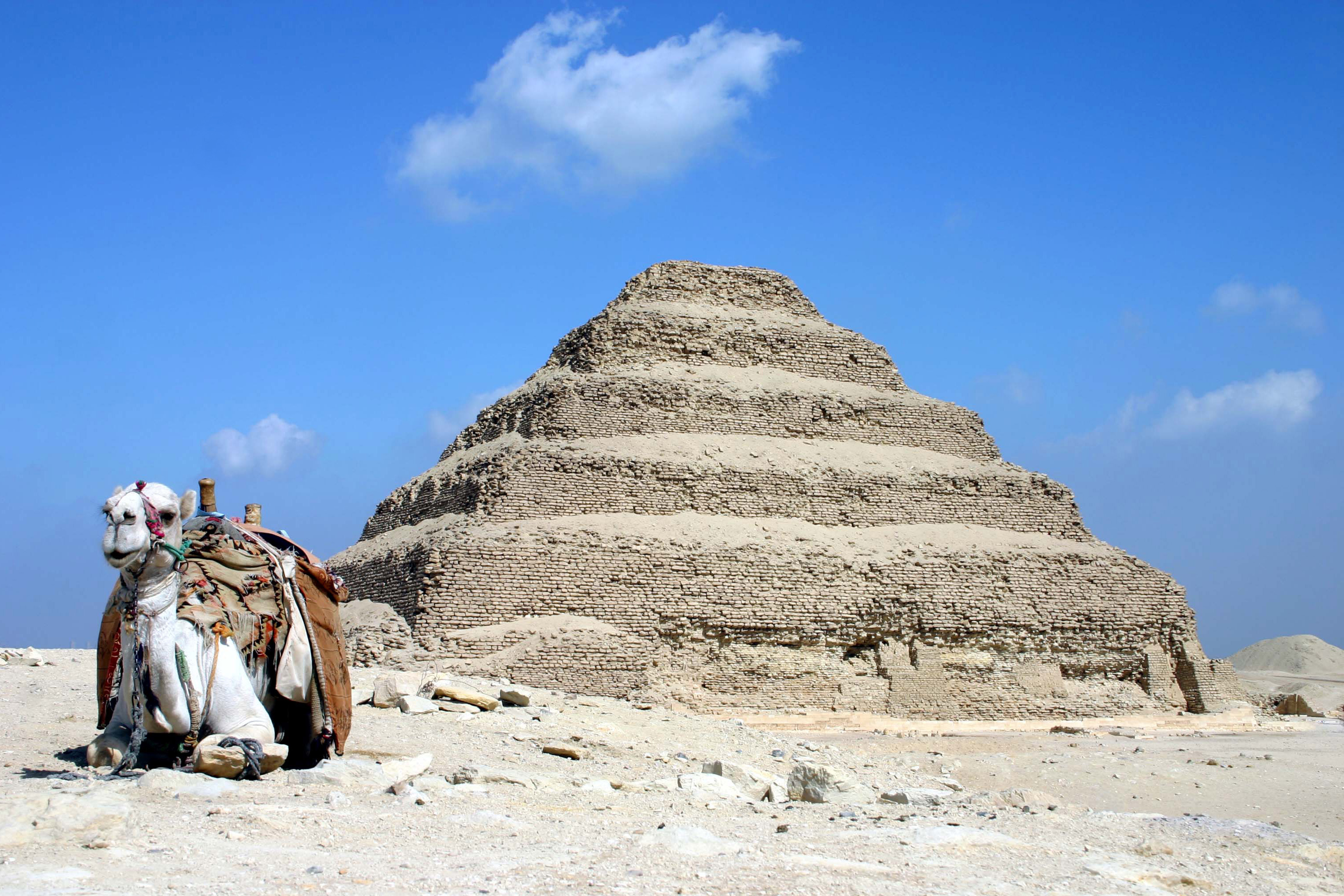
1. The Step Pyramid of Djoser and the Heb-Sed Court
Located two minutes by car from the Serapeum, the Step Pyramid of Djoser (Third Dynasty, c. 2670 BCE) is the oldest monumental cut-stone building in human history. Designed by the royal architect and polymath Imhotep, the six-tiered pyramid rises 60 meters above a vast walled funerary complex that translated earlier reed-and-mudbrick ceremonial architecture into permanent white limestone.
2. The Painted Mastaba Tombs of the Old Kingdom Nobles
Immediately outside the Serapeum parking lot lies the Tomb of Ti (Fifth Dynasty overseer of the sun temples), and near the Pyramid of Teti stands the Mastaba of Mereruka (Sixth Dynasty vizier, containing 32 rooms). Unlike the austere granite interiors of the pyramids or the Serapeum, these noble mastabas preserve vibrant, finely carved limestone reliefs depicting Old Kingdom daily life: hippopotamus hunts in papyrus marshes, bread baking, beer brewing, shipbuilding, and livestock herds crossing Nile canals.
3. The Pyramid of Unas and the Earliest Pyramid Texts
At the southwestern corner of Djoser's enclosure stands the externally modest Pyramid of Unas (last king of the Fifth Dynasty, c. 2345 BCE). Inside its subterranean burial chamber, the limestone walls are carved from floor to ceiling with blue-painted columns of the Pyramid Texts — the oldest surviving corpus of religious funerary literature in the world, which directly shaped the later Osiris-Apis theology of the Serapeum.
4. The Open-Air Museum of Memphis (Mit Rahina) and the Pyramids of Dahshur
Fifteen minutes east in the palm groves of the Nile Valley sits Memphis, where the living Apis bull actually resided. Visitors today can inspect the colossal 10-meter limestone statue of Ramesses II, the Alabaster Sphinx of the Eighteenth Dynasty, and the calcite Apis embalming tables near the ruined enclosure of Ptah. Twenty minutes further south lies Dahshur, home to Pharaoh Sneferu's Bent Pyramid and Red Pyramid (Fourth Dynasty, c. 2600 BCE) — making a combined Saqqara, Memphis, and Dahshur circuit the ultimate companion to our Egypt pyramid tours and the Giza Pyramids and Grand Egyptian Museum tour.
Is the Serapeum of Saqqara Worth Visiting?
For the vast majority of travelers visiting Saqqara, yes — the Serapeum is unequivocally worth the time and the additional ticket cost, provided you know what you are going to see. Standing in a quiet, subterranean bedrock gallery beside 24 polished stone chests that each weigh as much as a commercial airliner delivers a sense of scale and engineering mastery that photographs rarely capture.
Why the Serapeum Stands Out
- Unmatched engineering scale: Nowhere else in Egypt can you view 24 monolithic granite and greywacke sarcophagi of this size lined up in their original underground vaults.
- Cool, uncrowded atmosphere: Even when the Giza Plateau is busy, the Serapeum's wide wooden walkways allow you to explore at an unhurried, contemplative pace out of the direct sun.
- Unique religious perspective: It illustrates Late Period and Ptolemaic Egypt — bridging pharaonic religion, Persian rule, and the Hellenistic world — in a placeotherwise dominated by Old Kingdom pyramids.
When You Might Skip or Adjust
- No colorful wall paintings: Unlike the nearby Tomb of Ti or Mereruka, the Serapeum is an austere rock-cut cavern of bare limestone and dark polished stone; travelers seeking colorful reliefs should prioritize the noble mastabas.
- Requires an extra ticket at the main gate: If you are on a strict budget and purchased only the basic Saqqara entry ticket, you cannot add the Serapeum ticket once you reach the tunnel entrance.
- Severe claustrophobia or mobility limits: While the tunnels are spacious (3 to 5 meters high), visitors uncomfortable underground or unable to negotiate sloped entry ramps may prefer staying above ground.
Frequently Asked Questions About the Serapeum of Saqqara
What is the Serapeum of Saqqara?
The Serapeum of Saqqara is an ancient Egyptian subterranean burial complex carved into the limestone bedrock of the Saqqara necropolis, northwest of the Step Pyramid of Djoser. From the reign of Amenhotep III in the Eighteenth Dynasty until the end of the Ptolemaic Period (c. 1390–30 BCE), it served as the state cemetery for the sacred Apis bulls worshiped at Memphis.
Why were the Apis bulls buried in the Serapeum?
In ancient Egyptian theology, the living Apis bull was revered as the earthly manifestation and herald (ba) of Ptah, the patron creator god of Memphis. When an Apis bull died, it merged with Osiris, Lord of the Underworld, becoming the immortal composite deity Osiris-Apis. Because the bull held divine royal status, its mummified body required a monumental tomb fit for a god-king.
Where is the Serapeum of Saqqara located?
The Serapeum is located in the northwestern sector of the Saqqara archaeological site in Giza Governorate, approximately 800 meters northwest of the Step Pyramid of Djoser, adjacent to the Mastaba of Ti, and roughly 30 kilometers (19 miles) south of central Cairo.
Who discovered the Serapeum of Saqqara?
French archaeologist Auguste Mariette rediscovered the complex between October 1850 and November 1851. After spotting the head of a limestone sphinx emerging from the desert sand and recalling the Roman geographer Strabo's description of a sphinx-lined avenue leading to the Serapeum, Mariette excavated the processional road and entered the subterranean galleries on November 12, 1851.
When was the Serapeum of Saqqara built?
The complex evolved across three architectural phases over 1,350 years. Individual shaft tombs began under Amenhotep III (c. 1390–1352 BCE). Prince Khaemwaset, son of Ramesses II, excavated the first shared underground gallery (the Lesser Vaults) around 1250 BCE, and King Psamtik I inaugurated the monumental Greater Vaults around 612 BCE, which were expanded through the Ptolemaic Period until 30 BCE.
How is the Serapeum related to the god Ptah?
During its lifetime, the sacred Apis bull lived inside a dedicated sanctuary within the Great Temple of Ptah at Memphis and was worshiped as Ptah's living spiritual force on earth. The Serapeum on the Saqqara plateau above functioned as the eternal funerary counterpart to Ptah's valley temple.
What is the relationship between Apis, Osiris, and Serapis?
Upon death and 70-day mummification, the Apis bull assimilated with Osiris to become Osiris-Apis (Wsjr-Ḥp in Egyptian). Under the Greek-speaking Ptolemaic kings, Osiris-Apis was Hellenized into the syncretic deity Serapis, giving rise to the Greek and Roman name Serapeum.
How many sarcophagi remain in the Serapeum of Saqqara?
Twenty-four monolithic stone sarcophagi remain in place inside the underground complex. Although the Greater Vaults feature 28 vaulted side chambers along the main corridor, four of the niches do not contain stone chests.
What materials were used for the Serapeum sarcophagi?
The surviving sarcophagi were carved from single blocks of exceptionally hard stones, primarily red, pink, and black granite quarried in Aswan (nearly 900 kilometers south), as well as greywacke, basalt, diorite, and hard crystalline limestone from the Eastern Desert and northern quarries.
How heavy are the sarcophagi, and how were the large sarcophagi moved?
Most complete sarcophagi in the Serapeum weigh between 60 and 80 metric tons (roughly 40 to 65 tons for the chest and 20 to 30 tons for the lid). Ancient Egyptian workmen shipped the rough-hewn blocks by Nile barge, dragged them up desert ramps on wooden sledges over timber rollers using rope winches anchored into wall sockets, lowered them into sand-filled burial pits by gradually removing the sand beneath them, and polished the stone surfaces in situ.
What is the difference between the Lesser Vaults and the Greater Vaults?
The Lesser Vaults were excavated in Year 30 of Ramesses II (c. 1250 BCE) by Prince Khaemwaset and remained in use until c. 644 BCE, housing Apis bulls primarily in wooden coffins along a 68-meter tunnel. The Greater Vaults were opened in Year 52 of Psamtik I (c. 612 BCE) and feature a wider, 198-meter main corridor with deep sunken crypts designed specifically for colossal monolithic stone sarcophagi.
Can visitors enter the underground galleries of the Serapeum?
Yes. Visitors can walk through the entire Greater Vaults gallery, which reopened in September 2012 with modern steel stabilization arches, level wooden walkways, and LED lighting. You can also walk down a wooden staircase into one crypt to inspect the inscribed sarcophagus of King Amasis up close. The older Lesser Vaults remain closed due to fragile bedrock.
How can travelers visit the Serapeum from Cairo?
The Serapeum is a 45-to-60-minute drive south of central Cairo. Because Saqqara's monuments are spread across several kilometers of desert roads with no internal public transit, visitors should arrange a private car with a driver or join a guided tour rather than taking a one-way taxi or Uber.
Can the Serapeum be combined with the Step Pyramid and Memphis?
Yes. Pairing the Serapeum with the Step Pyramid of Djoser, the Old Kingdom mastaba tombs at Saqqara, the open-air museum of Memphis (where the living Apis bull resided and was embalmed), and the pyramids of Dahshur forms the classic full-day historical circuit from Cairo.
Is the Serapeum worth visiting for travelers interested in ancient Egyptian history?
Yes. For anyone interested in ancient engineering, sacred animal cults, or Late Period and Ptolemaic history, the Serapeum is one of the most memorable monuments in Egypt, offering a dramatic subterranean contrast to the open-air pyramids of Giza and Saqqara.
Why were the Serapeum sarcophagi empty when Auguste Mariette entered the Greater Vaults?
All 24 stone sarcophagi in the Greater Vaults had already been plundered in antiquity; ancient tomb robbers pried the massive stone lids sideways just far enough to remove the mummified bulls and their golden ornaments. However, Mariette discovered an intact, walled-up burial chamber from the reign of Ramesses II inside the older Lesser Vaults.
Conclusion: The Enduring Legacy of the Serapeum
More than a collection of oversized stone chests, the Serapeum of Saqqara stands as physical testimony to the longevity and devotion of ancient Egyptian religion. Across thirteen centuries of political upheaval — from the imperial zenith of Amenhotep III and Prince Khaemwaset to the Saite Renaissance of Psamtik I, the Persian Empire, and the Hellenistic court of the Ptolemies — rulers of every dynasty descended into this limestone plateau to honor the sacred bull of Memphis and bind their reigns to the eternal cycle of Ptah and Osiris.
When you walk down its cool subterranean corridor today and stand beside the polished granite sarcophagus of Amasis, you are experiencing both a triumph of ancient stoneworking and the birthplace of modern chronological Egyptology.
Plan Your Customized Saqqara & Egypt Itinerary
Whether you want a focused private day exploring Saqqara, Memphis, and Dahshur with a dedicated Egyptologist or a multi-day journey connecting Cairo's pyramid fields with Luxor and Aswan, our specialists at Egy Travel Lux have been crafting personalized itineraries since 1983.
Request a Tailor-Made Egypt Tour ItineraryAcademic, Museum & Official Sources
Historical dates, architectural measurements, archaeological findings, and 2026 visitor regulations in this article were verified against the following primary Egyptological and official institutional sources:
- Egyptian Ministry of Tourism and Antiquities — Official Archaeological Site Profile: Saqqara Necropolis and the Serapeum (accessed October 2026).
- UNESCO World Heritage Centre — Memphis and its Necropolis – the Pyramid Fields from Giza to Dahshur (World Heritage List Ref. 86).
- Mariette, Auguste (1857, ed. Gaston Maspero 1882) — Le Sérapéum de Memphis, Paris: Gide / F. Vieweg.
- Dodson, Aidan (2005) — "Bull Cults," in Salima Ikram (ed.), Divine Creatures: Animal Mummies in Ancient Egypt, Cairo: American University in Cairo Press, pp. 72–105.
- Vos, Robert L. (1993) — The Apis Embalming Ritual: P. Vindob. 3873 (Orientalia Lovaniensia Analecta 50), Leuven: Peeters Publishers.
- Thompson, Dorothy J. (2012) — Memphis Under the Ptolemies (Second Edition), Princeton: Princeton University Press.
- Lauer, Jean-Philippe (1976) — Saqqara: The Royal Cemetery of Memphis, Excavations and Discoveries Since 1850, London: Thames & Hudson.
- Musée du Louvre, Department of Egyptian Antiquities — Collection records for the Serapeum of Memphis stelae, jewelry of Prince Khaemwaset, and the limestone statue of the Apis bull.