Ouroboros Symbol: Proven Ancient Egyptian Origins, Meanings & History | Egy Travel Lux 2026
The Ouroboros Symbol: Ancient Egyptian Origins, Meaning, Tutankhamun’s Shrine & History
The Ouroboros Symbol is an ancient visual motif that typically depicts a serpent or dragon biting, swallowing, or holding its own tail in its mouth to form a continuous circle. Known in ancient Egyptian texts as sd-m-r (“tail-in-mouth”) and in later Greek sources as ouroboros (“tail-devourer”), this circular serpent has fascinated historians of religion, archaeologists, and philosophers for more than three millennia. While modern popular culture routinely treats the ring-shaped snake as a universal emblem of mathematical infinity or eternal return, its earliest archaeological history in Egypt reveals a far more specific religious function.
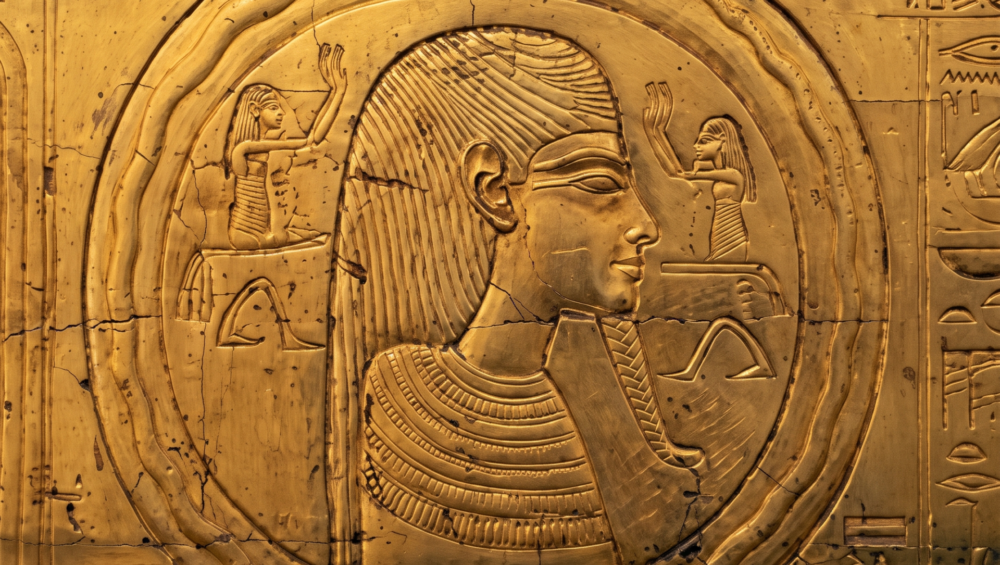
The earliest securely dated visual depiction of a tail-biting serpent appears in Eighteenth Dynasty royal funerary art on the second gilded shrine of Pharaoh Tutankhamun (c. 1332–1323 BCE). Within that sacred chamber in the Valley of the Kings, two tail-biting serpents enclose a monumental mummiform figure uniting the sun god Ra and the underworld ruler Osiris. Rather than serving as a decorative geometric badge, the Egyptian motif functioned within cryptographic netherworld compositions as a protective and regenerative boundary separating ordered creation from the primordial waters of chaos.
Over subsequent centuries, the image traveled from New Kingdom tombs and Third Intermediate Period funerary papyri into Greco-Roman magical fever amulets and Alexandrian alchemical manuscripts—most famously the Chrysopoeia of Cleopatra, where it accompanies the Greek philosophical axiom Hen to Pan (“The All is One”). This historical guide examines the archaeological evidence behind the Ouroboros Symbol, evaluates modern Egyptological scholarship, distinguishes the motif from the protective serpent deity Mehen, and shows where travelers can study these royal funerary traditions across Egypt today.
1. What Is the Ouroboros Symbol and What Does It Mean?
To answer the fundamental question—what is the Ouroboros symbol?—it is necessary to look at both its visual anatomy and its linguistic origins. Visually, the ancient Ouroboros looks like a limbless serpent (or, in later medieval and Renaissance illustrations, a winged or legged dragon) curving its body into a circle or oval with the tip of its tail held firmly inside its jaws. The English term derives from the ancient Greek compound word ouroboros (οὐροβόρος), combining oura (οὐρά, meaning “tail”) and boros (βόρος, meaning “eating” or “devouring”). In Egyptian hieroglyphic and religious texts, the equivalent posture was described literally as sd-m-r, meaning “tail-in-mouth.”
What does the Ouroboros Symbol represent? Across its 3,300-year history, the motif has never possessed a single frozen definition. Instead, its meaning shifted according to the religious, magical, or philosophical system employing it:
- In New Kingdom and Third Intermediate Period Egypt (c. 1332–945 BCE): The tail-biting serpent functioned as a protective, regenerative enclosure surrounding nascent or unified deities (such as Ra-Osiris or the newborn sun god Khepri) within the dark primordial waters of Nu, guarding the process of cosmic and funerary rebirth.
- In Greco-Roman Egyptian Magic (c. 1st–4th centuries CE): Drawn around textual incantations on papyrus amulets and carved onto magical gems, the circular serpent acted as a binding seal that locked protective power inside the charm while keeping demonic illness and fever outside.
- In Alexandrian and Byzantine Alchemy (c. 2nd–11th centuries CE): Paired with the phrase Hen to Pan (“The All is One”), the two-toned tail-biting serpent symbolized the fundamental unity of matter and the circular chemical processes of dissolution, volatilization, and fixation.
- In Modern Philosophy and Popular Culture: The image is widely interpreted as a metaphor for cyclical time, self-reflexivity, eternal return, and psychological wholeness—and is often mistakenly conflated with the mathematical infinity symbol (∞).
| Historical Period / Tradition | Primary Visual Form | Core Documented Meaning | Common Misconception to Avoid |
|---|---|---|---|
| Pharaonic Egypt (18th–21st Dynasties) | One or two serpents with tails in mouths enclosing solar-Osirian figures | Cosmic protection, divine containment, and daily solar/funerary regeneration | Assuming Egyptians used it as a standalone badge for abstract mathematical infinity |
| Greco-Roman Magical Papyri & Amulets | Ring-shaped snake enclosing charakteres, vowels, and healing spells | Apotropaic barrier sealing magical efficacy and warding off fevers or daimones | Treating practical healing charms as purely philosophical treatises |
| Hellenistic & Byzantine Alchemy | Half-dark, half-light serpent or concentric rings with Hen to Pan | Unity of matter, cosmic wholeness, and cyclical transmutation of substances | Attributing alchemical diagrams to Queen Cleopatra VII rather than Cleopatra the Alchemist |
| Modern Esoteric & Popular Reception | Stylized snake or dragon loop, sometimes twisted into a figure-eight | Eternal return, personal renewal, psychological integration, and endless cycles | Projecting 19th- and 20th-century psychological readings backward onto New Kingdom tombs |
Because Egyptian iconography embedded serpents within larger theological narratives, understanding the early motif requires familiarity with the pantheon of ancient Egyptian gods and mythology, where snakes could embody either supreme creative protection or destructive chaos depending on their posture and accompanying inscriptions.
2. Was the Ouroboros Really a Distinct Symbol in Ancient Egypt?
A central question in modern Egyptology is whether the Egyptian Ouroboros was ever conceived as an independent, fixed “symbol” in the same way as the ankh or the wedjat eye. In his landmark 2015 UCLA doctoral dissertation, The Egyptian Ouroboros: An Iconological and Theological Study, Egyptologist Dana Michael Reemes systematically analyzed the surviving Pharaonic evidence and challenged centuries of uncritical assumptions (UCLA eScholarship Repository).
As Reemes demonstrates, post-Renaissance European scholars—starting with Athanasius Kircher and Horapollo’s Hieroglyphica—frequently projected Greco-Roman and alchemical notions of “eternity” and “the cosmos” onto every circular snake in Egyptian art. To evaluate the Egyptian evidence accurately, historians must distinguish between three distinct iconographic postures that are too often lumped together on non-specialist websites:
- A Serpent Biting Its Own Tail (True Tail-in-Mouth / sd-m-r): The serpent’s jaws physically touch or enclose the tip of its tail, creating an unbroken ring. This specific posture appears on Tutankhamun’s second shrine and on Twenty-First Dynasty mythological papyri (such as the Papyrus of Heruben).
- A Coiled or Undulating Serpent: The snake winds in multiple undulating folds or spirals—most famously the guardian deity Mehen coiling around the cabin of the solar barque, or the spiral track of the Predynastic Mehen board game—without placing its tail in its mouth.
- A Serpent Enclosing a Figure or Space: A serpent arches around a deity, corpse, or topographical boundary in the underworld (such as the hours of the night), while its head and tail remain clearly separated or face outward.
Why does this distinction matter? In ancient Egyptian religion, the tail-in-mouth serpent did not have a single proper name or a fixed dictionary definition as “infinity.” Instead, it served as an iconographic device representing a protective, non-existent boundary within the primeval waters (Nu) where disordered potential was held back so that solar and Osirian rebirth could take place inside the circle. Calling every coiled snake in Egypt an “Ouroboros” erases the careful visual distinctions drawn by ancient Egyptian scribes and tomb artists across Egypt's geographical regions and dynastic periods.
3. Inside Tutankhamun's Second Shrine: The Two Serpents Explained
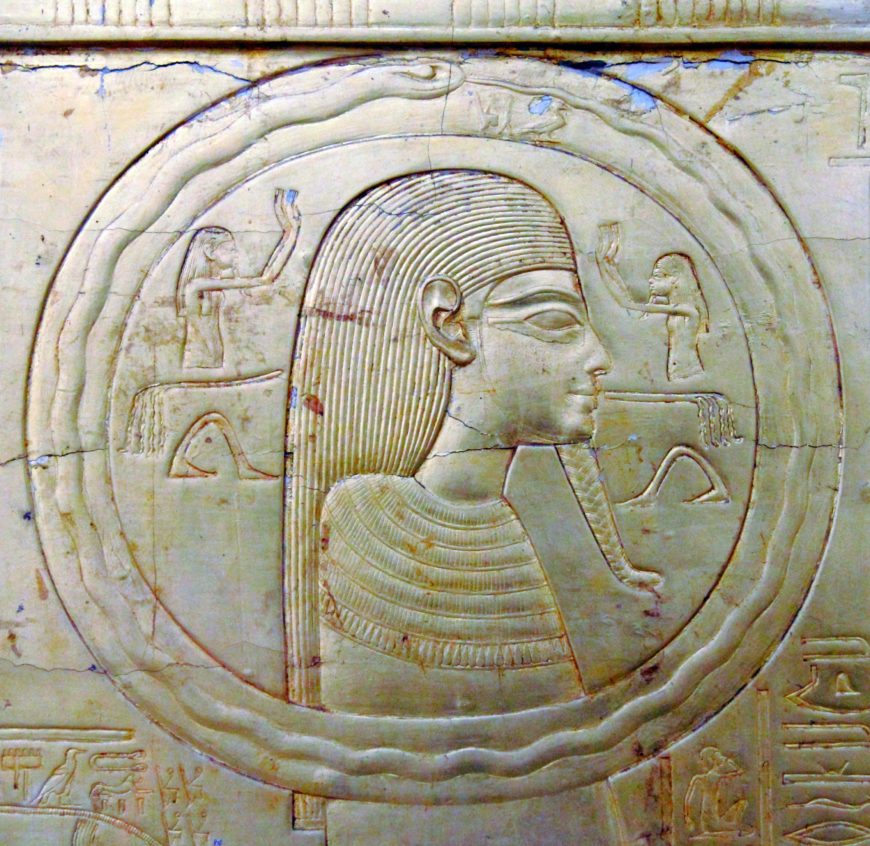
The most famous archaeological search query connected to this topic—Ouroboros Tutankhamun—points directly to Tomb KV62 in the Valley of the Kings. When Howard Carter and his team cleared Tutankhamun’s burial chamber in the 1920s, they documented four nested gilded wooden shrines surrounding the king’s quartzite sarcophagus. The crucial relief appears on the exterior right-hand panel of the Second Sepulchral Shrine, cataloged by the Griffith Institute at the University of Oxford under Carter Object Number 237 (Griffith Institute Tutankhamun Archive).
Archaeological Context and Funerary Purpose
Dating to the late Eighteenth Dynasty (New Kingdom, c. 1332–1323 BCE), Shrine II was constructed of oak and cedar planks covered in gesso and overlaid with sheet gold. Its theological purpose was not merely physical containment; its incised reliefs and cryptographic texts formed a ritual environment designed to assimilate the deceased young pharaoh into the nightly union of the sun god Ra and the underworld ruler Osiris.
Why Are There Two Serpents on Tutankhamun’s Second Shrine?
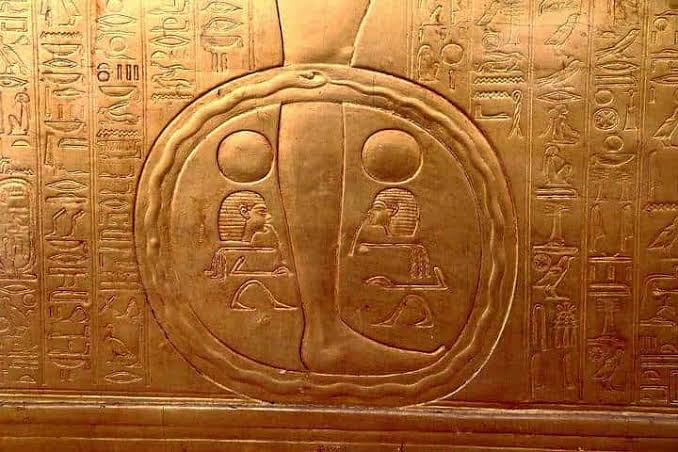
Visitors who only see cropped photographs are often surprised to learn that the relief does not show a single standalone ring, but rather two tail-biting serpents arranged vertically along a colossal mummiform figure:
- The Central Mummiform Figure and Solar Disk: At the center of the composition stands a giant mummiform deity representing the merged Ra-Osiris. A large solar disk rests directly atop the figure’s head, while radiating lines of light and cryptographic signs link the cosmic body to attending deities along the registers.
- The Upper Enclosing Serpent: The first tail-biting serpent curves around the solar disk and the head and shoulders of the giant mummiform figure, protecting the upper, celestial and solar aspect of the unified god.
- The Lower Enclosing Serpent: A second tail-biting serpent coils around the feet and lower legs of the mummiform figure at the base of the scene, anchoring and shielding the chthonic, Osirian foundation in the depths of the underworld.
Scholarly Interpretation vs. Archaeological Evidence
In his authoritative monograph, The Enigmatic Netherworld Books of the Solar-Osirian Unity (2004), Yale Egyptologist John Coleman Darnell analyzed this composition alongside later royal tomb treatises of Ramesses VI and Ramesses IX (Yale University Publications). Archaeologically, the relief is an indisputable visual record of two serpents biting their own tails in fourteenth-century BCE royal art. Interpretively, scholars debate the exact identities of the two snakes: while the upper serpent is frequently associated with the protective deity Mehen surrounding the head of Ra-Osiris, Reemes and Darnell note that the accompanying cryptographic captions require cautious reading and show how the two serpents define the upper and lower cosmic boundaries where solar light revitalizes the inert mummy of Osiris. This theology of burial and resurrection lies at the heart of ancient Egyptian funerary traditions across the Nile Valley.
4. Mehen: The Ancient Egyptian Protective Serpent and Board Game
No investigation of the Egyptian Ouroboros is complete without examining Mehen (mḥn), whose name translates from ancient Egyptian as “the coiled one.” In Egyptian religious iconography, Mehen is a benevolent serpent deity who coils his body around the sun god Ra—or forms a protective canopy over Ra’s cabin—during the hazardous twelve-hour nighttime voyage through the Duat (the underworld). While hostile forces attempt to halt the solar barque, Mehen shields the vulnerable sun god so that dawn can break again.
The Ancient Egyptian Mehen Board Game
Long before New Kingdom royal tombs depicted Mehen guarding the solar barque, the name referred to one of the world’s earliest known board games. Archaeological excavations have recovered circular stone, faience, and ivory game boards carved in the shape of a tightly coiled, segmented serpent whose head rests at the exact center of the spiral and whose tail forms the outer rim. Prominent surviving examples—such as a Predynastic or Early Dynastic stone game board preserved in the Metropolitan Museum of Art (Accession No. 58.125.1, c. 3100–2649 BCE)—were played using small carved lion, lioness, and spherical marble game pieces (The Metropolitan Museum of Art Collection).
While Old Kingdom tomb reliefs (such as the tomb of Hesy-Ra at Saqqara) and Pyramid Texts confirm that the game carried religious associations with cosmic passage and afterlife protection, the exact rules of the Mehen board game do not survive in full certainty. Archaeologists hypothesize that players raced pieces along the spiral segments from tail to head (or vice versa), but modern reconstructions remain informed hypotheses rather than verified ancient rulebooks.
Why Mehen and the Ouroboros Are Not Interchangeable
Many popular articles mistakenly claim that “Mehen is the Egyptian name for the Ouroboros.” Historically and art-historically, this is inaccurate:
| Analytical Category | Mehen (mḥn) | Ouroboros (sd-m-r / Tail-Biter) |
|---|---|---|
| Definition | A specific ancient Egyptian protective serpent deity and a spiral Predynastic/Old Kingdom board game | A descriptive visual posture of a serpent holding or biting its own tail in its jaws |
| Typical Visual Posture | Multi-fold undulating coils, an arch/canopy over Ra’s shrine, or an inward spiral board | A closed single or double circular loop where mouth and tail physically meet |
| Relationship to Ra | Actively defends Ra on the night barque against the chaos serpent Apophis | Encloses the unified Ra-Osiris or newborn sun child within the regenerative waters of Nu |
| Overlap in Evidence | Mehen is sometimes depicted or identified as a tail-biting serpent (e.g., scholarly readings of Tutankhamun’s Shrine II) | Can represent Mehen in specific contexts, but also depicts unnamed cosmic boundary serpents |
Travelers visiting Old Kingdom mastabas on a Giza, Saqqara and Memphis tour can witness the very necropolises where Early Dynastic and Old Kingdom funerary culture—including early references to Mehen—first took monumental shape.
5. The Ouroboros and Book of the Dead Spell 87
To grasp why ancient Egyptians associated serpents so closely with regeneration after death, scholars look to Spell 87 of the Book of the Dead, titled in Egyptian funerary papyri as the “Formula for transforming into a Sata-serpent” (r n irt hprw m s3-t3, literally “son of the earth”). Preserved in major museum holdings—including the illuminated New Kingdom Papyrus of Rames (P. Fitzwilliam E.1.1896) at the Fitzwilliam Museum, University of Cambridge—Spell 87 belongs to a cluster of transformation spells (Spells 76–88) designed to grant the deceased free movement and cosmic renewal in the afterlife (Fitzwilliam Museum, University of Cambridge).
The short liturgical text of Spell 87 reads in substance: “I am the Sata-serpent, extended of years; I die and I am reborn every day. I am the Sata-serpent who dwells in the limits of the earth; I die and I am rejuvenated every day.”
Why is Spell 87 essential context for the Ouroboros Symbol, and what distinction must be maintained? Naturalistic observation of snakes shedding their old skin led Egyptians to view the chthonic serpent (the “son of the earth”) as a living embodiment of sloughing off mortality and emerging renewed each morning with the sun. However, Book of the Dead Spell 87 is not itself a visual depiction of the Ouroboros. The vignettes accompanying Spell 87 on Egyptian papyri consistently illustrate the Sata-serpent as an undulating or upright snake—sometimes sporting human legs or a divine beard—walking forward rather than biting its tail. Spell 87 illuminates the theological mindset behind Egyptian serpent renewal, whereas the tail-biting posture belonged specifically to royal netherworld treatises and cosmological diagrams.
6. The Ouroboros in the Amduat and Book of Gates
In the royal tombs of the Valley of the Kings—which visitors can experience firsthand when they discover Luxor's ancient monuments—the walls of the burial corridors are inscribed with elaborate New Kingdom underworld guides, notably the Amduat (Book of What Is in the Underworld) and the Book of Gates. These royal compositions chart the twelve nocturnal hours as Ra travels from the western horizon to his rebirth in the east.
Across the registers of the Amduat and the Book of Gates, serpents appear in remarkably diverse iconographic roles that must be carefully distinguished:
- Enclosing Protective Serpents (Mehen and the Envelopers): In the First through Twelfth Hours of the Amduat and across the Book of Gates, Mehen wraps around the ram-headed form of the nocturnal sun god (Iuf, meaning “Flesh”). In the Sixth Hour of the Amduat, a multi-headed serpent arches around the corpse of the sun god to guard the mystery of solar-Osirian union.
- Time-Measuring and Rebirth Serpents: In the Twelfth and final Hour of the Amduat, the solar barque is pulled directly through the spine of a colossal serpent named Ankh-Neteru (“Life of the Gods”): the aged sun god enters the serpent’s tail in darkness and emerges from its mouth at dawn rejuvenated as Khepri, the scarab beetle. In the Book of Gates, the giant serpent kheti and time-measuring serpents define the boundaries of hours and duration (Aha).
- Apophis (Apep) — The Antithesis of the Protective Serpent: Is the Ouroboros associated with Apophis? In authentic Egyptian theology, the answer is nuanced. Apophis is the destructive chaos serpent who attempts to swallow the subterranean waters and halt Ra’s barque, and he is usually shown stretched in writhing coils being bound with ropes or pierced with knives. However, because the tail-biting cosmic serpent rests at the border between ordered creation (Ma'at) and the formless outer waters (Nu), some late texts and twenty-first dynasty papyri show how the boundary serpent simultaneously contains regeneration inside its ring while keeping chaotic forces at bay.
By the Twenty-First Dynasty (Third Intermediate Period, c. 1070–945 BCE), the true tail-biting motif moved from royal tomb walls onto the funerary papyri of the Theban priesthood of Amun. On the famous Mythological Papyrus of Heruben (Cairo Museum), a magnificent circular serpent biting its own tail encloses the youthful sun god resting upon the back of two lions, providing a direct visual bridge between New Kingdom royal theology and later Mediterranean esotericism. Travelers exploring Upper Egypt’s monumental temple complexes on a Karnak and Luxor Temples tour can trace the architectural seat of this very priesthood of Amun-Ra.
7. The Ouroboros in Greco-Roman Egypt: The Berlin Fever Amulet
Following the conquests of Alexander the Great and the later incorporation of Egypt into the Roman Empire, Egyptian temple priesthoods interacted closely with Greek language, Hellenistic philosophy, and Mediterranean ritual practices. During the Greco-Roman Period, the tail-biting serpent—now explicitly called the ouroboros drakon in Greek magical instructions—underwent a major functional transformation. In the Greek Magical Papyri (Papyri Graecae Magicae, or PGM), ritual specialists instructed scribes to draw a serpent biting its own tail around magical names (voces magicae), mystical signs (charakteres), and healing prayers.
Case Study: Papyrus Berlin 21165 (P. Berlin 21165)
A compelling archaeological artifact illustrating this everyday protective use is P. Berlin 21165, housed in the Berlin Papyrus Collection (Berliner Papyrusdatenbank) of the Staatliche Museen zu Berlin (Berlin Papyrus Database Record P. 21165). Dating to the third or fourth century CE (Roman Egypt) and excavated in Egypt (associated with the Fayum/Arsinoite region), this small sheet of papyrus was created as a personal medical and magical amulet folded and worn on the body.
What does P. Berlin 21165 show? Inked directly onto the papyrus is a circular Ouroboros serpent biting its own tail. Inside the protective ring formed by the snake’s body, the scribe wrote rows of Greek vowel permutations, magical signs (charakteres), divine names (including Iao and Sabaoth), and a specific healing formula intended to protect and cure its wearer from shivering and recurring fever. In this Greco-Roman Egyptian context, the Ouroboros was not an abstract philosophical puzzle; it functioned as an impenetrable magical fortress sealing curative divine power around the patient while preventing fever-inducing demons from crossing the circle. You can see how Egyptian religious traditions persisted well into the Ptolemaic and Roman eras by visiting southern island sanctuaries on a Philae Temple tour from Aswan.
8. The Chrysopoeia of Cleopatra: Hen to Pan and the Alchemical Ouroboros
How did an Egyptian funerary and magical boundary serpent become the premier emblem of Western alchemy and philosophy? The pivotal link is a celebrated single-page diagram known as the Chrysopoeia of Cleopatra (“Gold-Making of Cleopatra”), preserved in a medieval Greek manuscript in Venice.
Cleopatra the Alchemist vs. Queen Cleopatra VII
First, a critical historical correction is necessary: Cleopatra the Alchemist was not Queen Cleopatra VII Philopator (the last Ptolemaic ruler of Egypt who died in 30 BCE). Cleopatra the Alchemist was a foundational Greek-writing natural philosopher and experimenter active in Roman Alexandria, most likely during the second or third century CE (alongside figures such as Mary the Jewess and Zosimos of Panopolis). Only later medieval and Arab writers occasionally conflated the scientist with the famous royal monarch (Cambridge University Classical & History of Science Resources).
The Marcianus Graecus Manuscript vs. Underlying Historical Material
Historians also distinguish between the date when Cleopatra the Alchemist’s treatise was composed and the date of the surviving physical manuscript. While the alchemical tradition of the Chrysopoeia originated in Roman Alexandria (c. 2nd–3rd century CE), the earliest surviving visual copy appears on folio 188v of Codex Marcianus Graecus 299 (MS Marc. gr. Z. 299), a Byzantine Greek alchemical compendium produced in the tenth or eleventh century CE and preserved today in the Biblioteca Nazionale Marciana in Venice (Biblioteca Nazionale Marciana).
Hen to Pan Meaning: “The All is One”
Among the alembic distillation apparatus and geometric symbols drawn on the Chrysopoeia page are two famous circular motifs:
- The Concentric Rings Inscription: Three concentric circles enclosing the Greek philosophical axiom ἓν τὸ πᾶν (Hen to Pan), which translates literally as “The One is the All” or “The All is One”—accompanied by a longer inscription stating: “One is the Serpent which has its poison according to two compositions, and One is All, and through it is the All, and by it is the All, and if you have not the All, the All is nothing.”
- The Two-Toned Tail-Biting Ouroboros: Immediately adjacent is a serpent biting its own tail, rendered half dark (black) and half light (white/unshaded), enclosing the concise Greek words ἓν τὸ πᾶν (Hen to Pan) at its center.
When searchers ask for the Hen to Pan meaning, this Alexandrian alchemical diagram is the primary historical source. By combining the Egyptian visual form of the tail-biting serpent with Greek monistic philosophy, Cleopatra the Alchemist transformed the Ouroboros into a visual formula for the conservation and unity of matter: base metals and noble gold share one underlying prime substance, cycling continuously through blackening (nigredo/dissolution) and whitening (albedo/purification).
9. Chronological Timeline of the Ouroboros Motif
To prevent anachronism, the timeline below tracks the verified archaeological and manuscript milestones showing how circular serpent imagery evolved from Predynastic Egypt to Byzantine alchemy:
Spiral Mehen Board Games & Pyramid Texts
Stone and faience spiral serpent game boards (Mehen) appear in Early Dynastic burials (e.g., Met Museum 58.125.1) and Old Kingdom tomb reliefs. These boards show an inward-spiraling coiled snake rather than a tail-biting ring, establishing early protective serpent symbolism.
Royal Amduat, Book of Gates & Book of the Dead Spell 87
Royal tombs in the Valley of the Kings depict the coiled serpent deity Mehen shielding Ra on the nocturnal solar barque, while Book of the Dead Spell 87 (“Formula for transforming into a Sata-serpent”) celebrates daily chthonic regeneration without yet showing the tail-in-mouth posture.
Tutankhamun’s Second Gilded Shrine (Carter No. 237)
The earliest securely dated visual depiction of the true tail-biting serpent (sd-m-r). Two tail-biting serpents enclose the head/solar disk and feet of a colossal mummiform Ra-Osiris figure in the enigmatic Book of the Solar-Osirian Unity.
Tombs of Ramesses VI (KV9) and Ramesses IX (KV6)
Royal netherworld compositions in the Valley of the Kings continue the cryptographic solar-Osirian traditions and depict cosmic boundary serpents enclosing divine transformations in the Duat.
Mythological Papyrus of Heruben
Funerary papyri of the Theban priesthood of Amun depict a single circular tail-biting serpent enclosing the newborn sun god within the primeval waters, bridging royal tomb art and portable religious manuscripts.
Greek Magical Papyri (PGM), P. Berlin 21165 & Alexandrian Alchemy
The Greek term ouroboros becomes widespread in ritual texts. P. Berlin 21165 uses a drawn tail-biting serpent as a protective boundary on a fever amulet, while Cleopatra the Alchemist in Alexandria pairs the Ouroboros with Hen to Pan (“The All is One”).
Codex Marcianus Graecus 299 (Venice)
Byzantine scribes copy the Chrysopoeia of Cleopatra onto folio 188v of Marcianus Graecus 299, preserving the iconic half-dark, half-light alchemical Ouroboros that later inspired Renaissance and modern European esotericism.
10. Ouroboros Symbol vs. Other Egyptian Symbols: Ankh, Eye of Horus, Scarab, Djed, and Uraeus
Readers searching for symbols like the Ouroboros often want to know how the tail-biting serpent compares with other iconic motifs of Pharaonic art, as well as the modern mathematical infinity sign. While several Egyptian signs touch upon themes of life, protection, and solar renewal, each possessed a distinct hieroglyphic identity and ritual function.
Ouroboros vs. the Mathematical Infinity Symbol (∞)
Is the Ouroboros connected to infinity, and what is the difference between the Ouroboros and the infinity symbol? Visually and historically, they are entirely distinct. The ancient Ouroboros is a zoomorphic single circle formed by a serpent biting its tail. By contrast, the horizontal figure-eight infinity symbol (∞, the lemniscate) was introduced into European mathematics in 1655 by the English mathematician John Wallis in his treatise De sectionibus conicis. Only in modern graphic design, jewelry, and tattoo art have artists twisted the snake’s body into a figure-eight loop to blend the ancient serpent with Wallis’s seventeenth-century mathematical sign.
Comparison of Major Ancient Egyptian Symbols
To explore the rich visual vocabulary of Pharaonic culture—including our dedicated guide to the Eye of Horus symbol—compare the core attributes of these six motifs:
| Symbol Name | Visual Form | Egyptian Term / Hieroglyph | Primary Religious Meaning | How It Differs from the Ouroboros |
|---|---|---|---|---|
| Ouroboros | Serpent biting or holding its own tail in a closed ring | sd-m-r (“tail-in-mouth”) | Protective cosmic boundary, solar-Osirian containment, and later alchemical unity (Hen to Pan) | Not a standard phonetic hieroglyph; functions as an enclosing cosmological frame |
| Ankh | Looped cross with a teardrop-shaped top handle | ʿnḫ (Biliteral/triliteral sign for “life”) | Breath of life, divine vitality, and eternal living existence gifted by the gods | A standard phonetic hieroglyph held in deities’ hands rather than a protective animal boundary |
| Eye of Horus (Wedjat) | Stylized falcon-human eye with drop and spiral markings | wḏꜣt (“The Whole / Sound One”) | Healing, bodily wholeness, royal protection, and funerary offerings | Rooted in the myth of Horus’s healed eye; widely worn as a daily personal faience amulet |
| Scarab Beetle (Khepri) | Dung beetle pushing a solar disk or emerging with wings | ḫprr / ḫpr (“to come into being”) | Dawn solar rebirth, self-generation, transformation, and protection of the heart in judgment | Represents the morning sun god Khepri himself; often enclosed inside an Ouroboros on late papyri |
| Djed Pillar | Vertical column crossed by four horizontal bars at the top | ḏd (“stability” / “endurance”) | The backbone of Osiris, cosmic stability, and permanent royal endurance | An architectural and Osirian reliquary pillar rather than a living guardian creature |
| Uraeus | Upright rearing Egyptian cobra with flared hood | iꜥrt (“The Risen One” / Goddess Wadjet) | Sovereign royal authority, fiery protection worn on the pharaoh’s brow | Rears outward from the royal crown to spit fire at enemies, never biting its own tail |
Witness Ancient Egyptian Symbolism Firsthand in Giza & Cairo
Reading about Pharaonic iconography is only the beginning. Stand before the royal monuments of the Old and New Kingdoms with a private Egyptologist guide on our Giza Pyramids and Grand Egyptian Museum tour, designed for travelers who want authentic archaeological context.
Book Your Giza & GEM Experience11. Where Can You Explore Tutankhamun's Treasures in Egypt Today?
For international travelers inspired by the history of the Ouroboros Egypt connection, seeing the royal funerary equipment of the Eighteenth Dynasty in person is one of the highlights of visiting the country. Planning your museum and archaeological itinerary carefully ensures you know exactly what is on public view and how the monuments fit together.
The Grand Egyptian Museum (GEM) in Giza
Situated on the desert plateau just two kilometers from the Great Pyramids, the Grand Egyptian Museum (GEM) is the world’s largest archaeological museum dedicated to a single civilization (Grand Egyptian Museum Official Website). When travelers explore Giza and consult our detailed Grand Egyptian Museum visitor guide, they learn how the museum was designed to bring together the more than 5,000 objects excavated by Howard Carter from Tutankhamun’s tomb (KV62)—including the king’s ceremonial chariots, funerary beds, alabaster vessels, shabti figures, jewelry, and royal regalia.
Important Curatorial Note: Related Artifacts vs. the Exact Second Shrine
Because major royal artifacts undergo specialized conservation, phased gallery transitions between the Egyptian Museum in Tahrir Square and the dedicated Tutankhamun Galleries at the Grand Egyptian Museum, and controlled lighting mounts, visitors should always verify current object-display records before their visit. Furthermore, even when viewing the massive nested gilded shrines of Tutankhamun (such as Carter No. 237), museum display cases and protective glass barriers surround the exterior panels, meaning that fine incised details—like the cryptographic solar-Osirian relief and the two tail-biting serpents on the side panel—can be challenging to inspect up close without prior preparation or a knowledgeable Egyptologist guide. Joining a guided GEM Museum Cairo experience helps you connect the wider funerary collection, solar barque imagery, and protective deities directly to the theological world of the shrines.
Combining Cairo, Luxor, and the Nile Valley
To understand the complete story of the Ouroboros Symbol, travelers can pair the museum collections depicted in our Cairo travel guide with the royal tombs of Upper Egypt:
- The Valley of the Kings in Luxor: Descend into Tomb KV62 (where Tutankhamun’s mummy rests in situ) and neighboring Ramesside tombs (such as KV9 of Ramesses VI and KV6 of Ramesses IX) to see full-scale wall paintings of the Amduat, the Book of Gates, and the Book of the Solar-Osirian Unity in their original subterranean architecture.
- Sailing the Nile & Lake Nasser: Experience the landscape that shaped Egypt’s daily solar cycle aboard a classic Nile River cruise in Egypt between Luxor and Aswan, or venture south into Nubia on a Lake Nasser Nile cruise to visit rescue temples rich in New Kingdom solar iconography.
- Practical Trip Planning Resources: Before booking flights, review our complete Egypt travel guide alongside our seasonal breakdown of the best time to visit Egypt (cooler October–April months are ideal for exploring desert valleys). You can also compare budgets using our Egypt trip cost guide for 2026 and map out daily logistics with our Egypt tour planning guide.
12. Historical Summary & Conclusion: The Lasting Legacy of the Ouroboros Symbol
Tracing the Ouroboros Symbol across more than three thousand years of Mediterranean history reveals why careful historical context is far more rewarding than generic dictionary definitions. The motif did not begin as a modern infinity sign or an abstract philosophical riddle. Its earliest documented appearance on the second gilded shrine of Tutankhamun (Carter No. 237) belonged to an intricate Eighteenth Dynasty theology of solar-Osirian unity, where two tail-biting serpents guarded the cosmic boundaries of regeneration around the merged body of Ra and Osiris.
Recognizing the difference between this specific tail-in-mouth posture (sd-m-r), the coiled protective deity and spiral board game Mehen, the daily renewal of the Sata-serpent in Book of the Dead Spell 87, and the hostile chaos serpent Apophis allows us to read Egyptian funerary art on its own terms. Centuries later, when Greco-Roman ritual practitioners drew the circular serpent on healing charms like the Berlin Fever Amulet (P. Berlin 21165) and Cleopatra the Alchemist paired it with the Greek motto Hen to Pan (“The All is One”) in the Chrysopoeia, the ancient Egyptian boundary snake acquired the meanings of cosmic unity and cyclical transmutation that endure today.
Whether you are researching ancient iconography or preparing to walk through the royal tombs of Thebes and the galleries of Giza, experiencing these artifacts in their homeland brings their religious artistry to life. Travelers ready to explore Cairo, Luxor, and Aswan at a comfortable pace can compare our curated 10-day Egypt tour, our comprehensive 12-day Egypt tour package, or an extended 15-day Egypt tour covering the full sweep of Pharaonic and Greco-Roman heritage.
Explore Egypt’s Royal Tombs & Museum Treasures
Turn your passion for ancient Egyptian mythology, royal funerary art, and archaeology into a tailored journey across Cairo, Giza, Luxor, and Aswan. Start with our signature Giza Pyramids and Grand Egyptian Museum tour or customize a multi-day itinerary with our local specialists.
Explore Tailored Egypt Tours13. Frequently Asked Questions About the Ouroboros Symbol
1. The Ouroboros is an ancient symbol that typically depicts a serpent doing what?
The Ouroboros typically depicts a serpent or dragon biting, swallowing, or holding its own tail in its jaws so that its body forms a continuous closed circle. In ancient Egyptian texts, this posture was called sd-m-r (“tail-in-mouth”), while the later Greek name ouroboros translates to “tail-devourer.”
2. What is the Egyptian origin of the Ouroboros?
The earliest securely dated visual depiction of the tail-biting serpent appears in ancient Egypt during the late Eighteenth Dynasty (c. 1332–1323 BCE) on the second gilded wooden shrine of Pharaoh Tutankhamun (Carter No. 237). In that funerary composition, two tail-biting serpents enclose the head and feet of a monumental mummiform figure uniting the sun god Ra and the underworld god Osiris.
3. Why are there two serpents on Tutankhamun’s second shrine?
On the right exterior panel of Tutankhamun’s second shrine, two separate tail-biting serpents frame a colossal mummiform figure of Ra-Osiris: one serpent encircles the solar disk and head at the top, while the second serpent encircles the feet at the base. Together, they form protective upper (solar/celestial) and lower (chthonic/Osirian) boundaries within the primordial waters where divine regeneration takes place.
4. Was the Ouroboros considered a standalone symbol of infinity in ancient Egypt?
No. As Egyptologist Dana Michael Reemes (2015) has demonstrated, ancient Egyptians did not use the tail-biting serpent as an isolated emblem of abstract mathematical infinity. Instead, it functioned within royal and funerary iconography as a protective, regenerative boundary around deities undergoing renewal inside the primeval waters of Nu.
5. Is Mehen the same as the Ouroboros?
No, the two terms are not interchangeable. Mehen (“the coiled one”) is a specific ancient Egyptian protective serpent deity who shields Ra during his nightly voyage through the underworld, as well as the name of a spiral Predynastic and Old Kingdom board game. Ouroboros is the Greek term for the visual motif of a serpent biting its tail. While Mehen is mostly shown in undulating coils without biting his tail, some depictions—such as the upper serpent on Tutankhamun’s second shrine—associate Mehen with the tail-biting posture.
6. What Do We Know About the Ancient Egyptian Mehen Board Game?
Archaeologists have excavated circular stone, faience, and ivory game boards from Predynastic and Old Kingdom Egypt (c. 3100–2300 BCE) carved in the shape of a coiled, segmented serpent with its head at the center. It was played with small lion-shaped and spherical pieces, though the exact rules of gameplay have not survived in ancient texts.
7. How does Book of the Dead Spell 87 relate to Egyptian serpent symbolism?
Book of the Dead Spell 87 is the “Formula for transforming into a Sata-serpent,” in which the speaker declares, “I die and I am reborn every day.” While the spell’s vignette depicts a walking or undulating bearded snake rather than a tail-biting Ouroboros, the text provides vital evidence for how Egyptians connected serpents with daily solar and funerary regeneration.
8. Is the Ouroboros associated with Apophis (Apep)?
In Egyptian mythology, Apophis (Apep) is the hostile serpent of chaos who tries to swallow the subterranean waters and destroy Ra’s solar barque, making him the opposite of protective serpents like Mehen. Whereas Apophis is depicted in writhing coils being speared or hacked into pieces, the tail-biting serpent acts as a protective enclosure shielding divine rebirth from surrounding chaos.
9. What is Hen to Pan’s meaning in the Chrysopoeia of Cleopatra?
Hen to Pan (ἓν τὸ πᾶν) is an ancient Greek philosophical phrase meaning “The All is One” (or “One is the All”). It appears inside a half-dark, half-light Ouroboros and concentric rings in the Chrysopoeia of Cleopatra (attributed to the Alexandrian scientist Cleopatra the Alchemist, c. 2nd–3rd century CE, and preserved in the 10th/11th-century Codex Marcianus Graecus 299), expressing the fundamental unity and cyclical transformation of matter.
10. Was the Chrysopoeia of Cleopatra written by Queen Cleopatra VII?
No. The alchemical diagram and treatise belong to Cleopatra the Alchemist, a Greek-writing experimental philosopher active in Roman Alexandria centuries after the death of the famous Ptolemaic monarch Queen Cleopatra VII (who died in 30 BCE).
11. How was the Ouroboros used on the Berlin Fever Amulet (P. Berlin 21165)?
On Papyrus Berlin 21165, a third- or fourth-century CE Greek magical amulet from Egypt, a drawn tail-biting serpent forms a closed ring around magical signs (charakteres), sacred vowels, and a healing prayer. In Greco-Roman Egypt, the Ouroboros functioned as a protective seal that locked the healing charm inside and warded off shivering and fever from the wearer.
12. What is the difference between the Ouroboros and the infinity symbol (∞)?
The ancient Ouroboros is a circular serpent biting its own tail, attested since the fourteenth century BCE. The horizontal figure-eight infinity symbol (∞) was invented in 1655 CE by English mathematician John Wallis. Modern jewelry and tattoo designs sometimes twist the snake into a figure-eight, blending the two historically separate designs.
13. What other Egyptian symbols are similar to the Ouroboros in theme?
While visually distinct, several ancient Egyptian symbols share themes of renewal, protection, and eternal life: the Scarab (Khepri) represents morning solar rebirth, the Ankh signifies eternal life, the Djed pillar embodies Osirian stability, the Eye of Horus provides healing and restoration, and the rearing Uraeus cobra guards royal sovereignty.
14. Where can visitors explore Tutankhamun’s funerary objects in Egypt today?
Visitors can explore the world’s premier collection of Tutankhamun’s funerary treasures at the Grand Egyptian Museum (GEM) in Giza, and visit his original subterranean burial chamber (KV62)—alongside Ramesside tombs featuring underworld serpent books—in the Valley of the Kings in Luxor. Because specific shrines and delicate reliefs are subject to conservation and gallery display protocols, travelers should verify current exhibition listings prior to visiting.
14. Further Reading and Academic References
- Reemes, Dana Michael (2015): The Egyptian Ouroboros: An Iconological and Theological Study. PhD Dissertation, University of California, Los Angeles (UCLA). UCLA eScholarship Open Access Repository.
- Darnell, John Coleman (2004): The Enigmatic Netherworld Books of the Solar-Osirian Unity: Cryptographic Compositions in the Tombs of Tutankhamun, Ramesses VI and Ramesses IX (Orbis Biblicus et Orientalis 198). Academic Press Fribourg / Vandenhoeck & Ruprecht. Yale University Near Eastern Languages & Civilizations Record.
- The Griffith Institute, University of Oxford: Tutankhamun: Anatomy of an Excavation — The Second Sepulchral Shrine (Carter No. 237 / TAA i.3.25). University of Oxford Tutankhamun Spatial Archive.
- The Metropolitan Museum of Art: Game Board in the Form of a Coiled Serpent (Mehen), Early Dynastic Period (Accession No. 58.125.1). The Met Museum Online Collection.
- Fitzwilliam Museum, University of Cambridge: Book of the Dead of Rames (Spell 87 Transformation Vignettes & Egyptian Funerary Papyri Collection). Fitzwilliam Museum Official Portal.
- Berlin Papyrus Database (Berliner Papyrusdatenbank): P. Berlin 21165 — Greek Magical Fever Amulet with Ouroboros (3rd–4th Century CE), Staatliche Museen zu Berlin. Berliner Papyrusdatenbank Object Record P. 21165.
- Biblioteca Nazionale Marciana (Venice): Codex Marcianus Graecus 299 (MS Marc. gr. Z. 299, fol. 188v) — Chrysopoeia of Cleopatra. Biblioteca Nazionale Marciana Official Archive.
- Cambridge University Press / History of Greco-Egyptian Alchemy: Studies on Cleopatra the Alchemist and Alexandrian Chrysopoeia. Cambridge University Academic Portal.
- Grand Egyptian Museum (GEM): Official Visitor Information, Galleries, and Collections Guide in Giza. Official Grand Egyptian Museum Website.
Editorial & Archaeological Note: All historical dates and interpretations in this guide distinguish verified archaeological artifacts (such as Carter No. 237 and P. Berlin 21165) from scholarly hypotheses and later esoteric traditions. Exhibition displays in Egyptian museums are subject to curatorial updates.