Eye of Horus: Meaning, Mythology & Symbolism | Egy Travel Lux
Eye of Horus: Meaning, Mythology, and Ancient Egyptian Symbolism
The Eye of Horus — known to the ancient Egyptians as the Wedjat (wḏꜣt, meaning "the Whole One" or "the Restored One") — is one of the most enduring religious emblems of the ancient Mediterranean world. Combining a stylized human eye and eyebrow with the dark facial markings of a falcon, the symbol originated in the mythological struggle between the sky god Horus and his rival Set. Because Horus's injured left eye was healed and restored through divine intervention, the Wedjat came to embody physical healing, bodily completeness, royal legitimacy, ritual offerings, and unbreakable protection for both the living and the dead across more than three millennia of pharaonic history.
Yet the popularity of the Eye of Horus in modern jewelry, design, and esoteric writing has also surrounded it with misconceptions. Many online summaries confuse the Egyptian words Wedjat ("the sound eye") and Wadjet (the cobra goddess of Lower Egypt), conflate the lunar Eye of Horus with the fierce solar Eye of Ra, or present twentieth-century theories about human senses and grain fractions as undisputed ancient dogma. Prepared by the Egyptology editorial team at Egy Travel Lux, this guide examines what surviving Egyptian texts, temple reliefs, and museum artifacts actually reveal about the Eye of Horus — helping history enthusiasts and travelers researching the best things to do in Cairo and along the Nile read Egypt's monuments with genuine historical clarity.
Key Takeaways: The Eye of Horus at a Glance
- Origin and Ancient Name: In ancient Egyptian, the symbol was called the Wedjat (or Udjat), meaning "that which is whole, sound, or restored," referring to the left eye of the falcon god Horus after it was injured by Set and healed by Thoth (or Hathor).
- Core Religious Meaning: Rather than serving as a generic good-luck charm, the Eye of Horus represented cosmic and physical restoration — making what was broken whole again, sustaining the dead through ritual offerings, and warding off chaos and disease.
- Wedjat vs. Wadjet Terminology: While English writers often use "Wadjet" for the Eye of Horus, Egyptologists distinguish wḏꜣt ("the whole eye") from Wꜣḏyt ("the Green One"), the cobra tutelary goddess of Lower Egypt, which comes from a different Egyptian root.
- Eye of Horus vs. Eye of Ra: The Eye of Horus is predominantly linked to the moon, healing, and restoration (usually the left eye), whereas the Eye of Ra represents the fierce, protective solar disk and its feminine manifestations (usually the right eye), though the two frequently paired in temple art.
- The 63/64 Fraction System: In New Kingdom and Late Period mathematical traditions, parts of the Wedjat eye were linked to the binary unit fractions (1/2, 1/4, 1/8, 1/16, 1/32, and 1/64, totaling 63/64) used to measure grain and medicine by the heqat, though paleographers note these cursive numerals originally developed independently in Old and Middle Kingdom bookkeeping.
1. What Is the Eye of Horus?
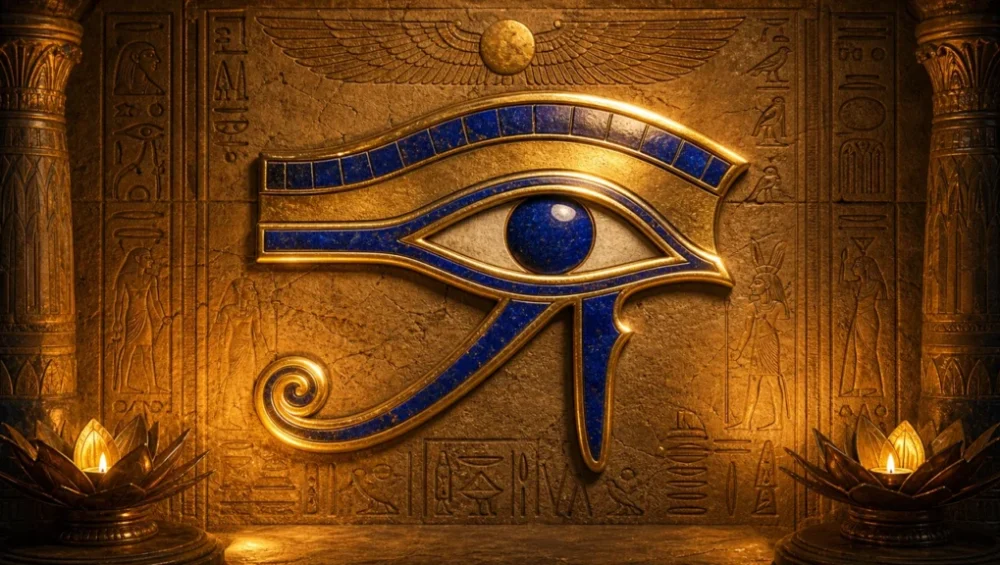
The Eye of Horus (or Wedjat eye) is a composite hieroglyphic sign and protective religious emblem from ancient Egypt that depicts a frontal human eye rimmed with cosmetic kohl, surmounted by an arched eyebrow, and accented below by two distinctive markings drawn from the plumage of a falcon: a vertical teardrop-shaped stripe and a backward-curling spiral. In the standard classification of Egyptian hieroglyphs compiled by Sir Alan Gardiner, the symbol is cataloged as sign D10.

What makes the symbol immediately recognizable is its hybrid anatomy. Ancient Egyptian artists observed the wild lanner falcon (Falco biarmicus) and peregrine falcon (Falco peregrinus) hovering high above the Nile Valley. Both birds of prey possess dark malar stripes ("tear marks") beneath their eyes that reduce sun glare while hunting. By fusing the human organ of sight with the markings of the sacred sky falcon — an artistic synthesis visitors can admire up close during a Giza Pyramids and Grand Egyptian Museum tour — Egyptian craftsmen created a visual metaphor for all-seeing divine vigilance.
Clarifying the Terminology: Wedjat, Udjat, and Wadjet
One of the most frequent points of confusion in popular histories is the spelling and meaning of the eye's Egyptian name. In academic Egyptology, you will encounter three closely spelled terms that must be carefully distinguished:
- Wedjat / Udjat / Oudjat (wḏꜣt): These are simply English, German, and French transliteration variants of the exact same ancient Egyptian feminine noun, wḏꜣt. Derived from the verb wḏꜣ ("to be whole, uninjured, prosperous, or healthy"), Wedjat literally translates as "The Whole One" or "The Sound Eye." It refers specifically to the eye of Horus after it had been healed from damage.
- Wadjet (Wꜣḏyt): By contrast, Wadjet is the name of the ancient cobra goddess of Lower Egypt, whose cult center stood at Buto (Per-Wadjet) in the northwestern Nile Delta. Her name derives from a different Egyptian root, wꜣḏ ("papyrus-colored," "green," or "flourishing"). Because the rearing cobra (uraeus) of Wadjet was worn on the pharaoh's brow to protect the king and was frequently associated with the fiery solar Eye of Ra, later Egyptian religious texts sometimes intertwined the cobra goddess with divine eye imagery. Nevertheless, calling the Eye of Horus "the Wadjet" without qualification blurs two distinct linguistic roots: wḏꜣt (the restored eye) and Wꜣḏyt (the cobra goddess).
2. The Myth Behind the Eye of Horus
In ancient Egypt, there was no single canonical scripture equivalent to a modern Bible. Instead, the myth of the Eye of Horus developed across more than two thousand years through ritual allusions in the Old Kingdom Pyramid Texts (first inscribed inside the Pyramid of Unas at Saqqara around 2345 BCE), the Middle Kingdom Coffin Texts, the New Kingdom Book of the Dead, the satirical literary tale The Contendings of Horus and Seth (preserved on Papyrus Chester Beatty I from the Twentieth Dynasty), and the first-century CE Greek treatise On Isis and Osiris by Plutarch. To understand how these narratives fit into the broader pantheon, you can explore our comprehensive guide to the gods of ancient Egyptian civilization.
Osiris, Isis, Set, and the Struggle for Egypt's Throne
The mythological foundation of the Eye of Horus lies in the royal succession drama of the Heliopolitan Ennead (the nine primordial deities descended from the creator sun god Atum-Ra). According to the Osirian cycle, Osiris ruled Egypt as a benevolent civilizing king alongside his sister-consort Isis, the mistress of magic and wisdom. Driven by ambition and chaotic aggression, their brother Set (Seth, lord of the red desert, storms, and disorder) murdered Osiris, dismembered his body, and usurped the kingship of Egypt.
Through tireless devotion and ritual magic, Isis and her sister Nephthys located the scattered pieces of Osiris's corpse, bound them together to create the first mummy, and revived Osiris long enough for Isis to conceive a son and rightful heir: Horus. While Osiris descended to rule the Duat (the underworld) as judge of the dead, Isis raised the young Horus in secret among the papyrus marshes of Khemmis in the Nile Delta until he grew strong enough to challenge his uncle Set before the tribunal of the gods.
How Horus Lost His Eye — and How It Was Restored
For eighty years, according to New Kingdom literary accounts, Horus and Set competed in both legal debates before the Ennead and violent physical duels for the throne of Egypt. During their fiercest combat, Set attacked Horus's eye. Ancient Egyptian texts preserve several distinct versions of both the injury and the healing:
- The Tearing and Trampling of the Left Eye (Funerary & Lunar Tradition): In the dominant theological tradition recorded in the Pyramid Texts and Coffin Texts, Set tore out Horus's left eye — associated with the moon — and either swallowed it, flung it beyond the edge of the sky, or trampled it into pieces. Thoth, the ibis-headed god of wisdom, reckoning, and sacred words, retrieved the scattered fragments, reassembled them, and spat upon the wound to restore the eye to complete health (transforming the injured eye into the Wedjat).
- Hathor and the Milk of the Gazelle (Papyrus Chester Beatty I): In the New Kingdom narrative The Contendings of Horus and Seth, Set gouges out both of Horus's eyes and buries them on a mountainside to illuminate the earth, where the eyeballs sprout into two lotus blossoms. The goddess Hathor (Lady of the Southern Sycamore) finds Horus weeping in the desert, catches a wild gazelle, milks it, and pours the soothing milk into Horus's empty eye sockets — instantly restoring both his right and left eyes.
- Horus Presents the Healed Eye to Revive Osiris: Once Horus finally triumphed over Set and was crowned legitimate ruler of Egypt, he did not keep the restored eye solely for himself. In the pivotal act of filial piety described in the Pyramid Texts (Utterances 35–40 and 587) — carved onto subterranean tomb walls that travelers can still visit on a guided journey through Giza, Saqqara, and Memphis — Horus traveled to the underworld and offered his healed Wedjat eye to his murdered father Osiris. By placing the living eye against Osiris's lips, Horus restored his father's vital energy (ka) and spiritual faculties in the afterlife.
This final act explains why, across every temple wall in Egypt, every ritual offering of bread, beer, wine, incense, linen, or ointment made by a pharaoh to a god was formally pronounced with the liturgy: "Take to yourself the Eye of Horus." The restored eye had become the ultimate prototype for every life-giving gift.
Experience the Myths of Horus and Osiris Where They Were Carved
Reading about the conflict of Horus and Set is only the beginning; standing before the monumental sandstone reliefs of Edfu, Abydos, and Saqqara with a private Egyptologist brings three thousand years of sacred storytelling to life. Let our specialists help you plan a tailor-made Egypt journey designed around your historical interests.
Design Your Private Cultural Itinerary3. Who Was Horus in Ancient Egyptian Religion?
To appreciate the prestige of the Eye of Horus, one must understand that "Horus" (Egyptian Ḥr, meaning "The Distant One" or "He Who Is Above") was not a single, static figure, but an overarching falcon deity whose worship predated the unification of Egypt around 3100 BCE and encompassed several distinct regional and theological forms.

The Two Principal Traditions: Horus the Elder vs. Horus Son of Isis
Egyptologists distinguish two primary streams of theology that gradually merged over the course of Egyptian history:
- Horus the Elder (Heru-ur / Greek Haroeris): One of the oldest cosmic sky gods of Egypt, revered at Nekhen (Hierakonpolis) and Letopolis from the Late Predynastic Period. In this celestial aspect, Horus was envisioned as an immense cosmic falcon whose outstretched wings spanned the vault of heaven: his right eye was the sun and his left eye was the moon. When the moon waned each month or passed through a lunar eclipse, Egyptians saw the periodic injury of Horus's left eye; when the full moon returned, the eye was once again wedjat — whole and sound.
- Horus the Son of Isis and Osiris (Harsiese and Harpocrates): As the Osirian funerary cult rose to prominence during the late Old Kingdom, Horus was integrated into the family drama of Osiris and Isis. Depicted either as a vulnerable child nursing on Isis's lap (Horpakhered / Harpocrates, protector against scorpion stings and snakebites) or as the adult avenger of his father (Harendotes), this Horus represented rightful dynastic succession and filial devotion.
Above all, Horus was the patron deity of Egyptian kingship. From the First Dynasty onward, the first and oldest of a pharaoh's five royal titles was the Horus Name, written inside a rectangular palace-facade frame (serekh) surmounted by the perching Horus falcon. Every builder of the great Old Kingdom monuments — which travelers explore on our Egypt pyramid tours and can easily reach once they know how far the pyramids sit from modern Cairo — ruled Egypt as the living embodiment of Horus on earth, and upon death united with Osiris while his successor ascended the throne as the new Horus.
4. What Does the Eye of Horus Mean?
In ancient Egyptian thought, symbols were not passive illustrations; through the principle of heka (divine creative and magical energy), an image actively generated the reality it depicted. Based on surviving inscriptions, medical papyri, and funerary texts, the Eye of Horus carried five interconnected meanings:
- Healing and Physical Restoration: Because Horus's mutilated eye was reassembled and healed by Thoth, the Wedjat became the supreme emblem of medical recovery. Physicians invoked the myth of the injured eye in curative spells (such as those preserved in the Ebers Papyrus and the London Medical Papyrus), comparing a patient's illness or wound to the damaged eye of Horus and commanding Thoth and Isis to make the patient's body whole again.
- Apotropaic Protection (Warding Off Evil): As an unblinking falcon eye, the Wedjat watched over vulnerable spaces and thresholds. Painted on the prows of Nile riverboats and Mediterranean cargo ships, carved above temple doorways, or worn on the chest, the eye deflected the "evil eye," hostile spirits, venomous creatures, and unseen malice.
- Wholeness, Perfection, and Cosmic Order (Ma'at): The word wedjat literally signified a state of unimpaired completeness — whether applied to a healthy human body, a full lunar disk, an intact storehouse of grain, or a prosperous kingdom governed according to ma'at (truth, balance, and cosmic harmony).
- The Archetype of Sacred Offerings: Following Horus's gift of his eye to revive Osiris, every ritual offering placed on a temple altar or tomb offering table — including the royal funerary dedications carved inside underground monuments such as the Serapeum of Saqqara — was mystically identified as "the Eye of Horus," capable of nourishing gods and deceased ancestors alike.
- Lunar Cyclical Renewal: Tied to the 29.5-day lunar cycle, the waning and waxing of the left eye assured Egyptians that loss, darkness, and death were never permanent, but always followed by regeneration.
5. Eye of Horus Symbolism and Its Visual Elements
Look closely at a finely carved ancient Wedjat amulet and you will see six distinct graphic strokes. How did ancient Egyptians understand these parts, and how do those beliefs differ from modern claims?
Documented Ancient Iconography vs. Modern Popular Claims
In documented Egyptology — a subject that a licensed female Egyptologist tour guide in Cairo or museum specialist frequently decodes for visitors — the visual elements of the Wedjat are understood primarily through natural observation and royal art:
- The Arched Eyebrow: Modeled on the heavy supraorbital ridge of the falcon and rendered in royal art with lapis lazuli inlays, framing the eye from above.
- The Central Pupil and Iris: The dark focal point of vision and life force, often inlaid with obsidian or black glass in royal jewelry.
- The Inner and Outer Corners of the Sclera (White of the Eye): Outlined in heavy dark lines representing green malachite (wadju) and black galena (mesdemet) eye paint — cosmetics that ancient Egyptians wore not only for beauty, but also to reduce desert sun glare and ward off bacterial eye infections.
- The Vertical Teardrop Line: Representing the dark sub-ocular malar stripe of the falcon, sometimes interpreted in funerary texts as the tear shed by Horus or Isis during the mourning of Osiris.
- The Curved Spiral Line: Sweeping backward beneath the eye, this stroke mimics the feathered cheek markings of the lanner falcon while echoing the stylized curl of the Red Crown of Lower Egypt and the regenerative coil of cosmic energy.
Important Historical Caveat — The "Six Human Senses" Theory: Many modern websites assert as an established historical fact that the six parts of the Eye of Horus stood for the "six human senses": smell (right side of the sclera), sight (pupil), thought/mind (eyebrow), hearing (left side of the sclera), taste (curved spiral), and touch (vertical teardrop). While ancient Egyptians certainly associated the faculties of sight, hearing, taste, and breath with bodily vitality (and placed thought inside the ib, or heart, rather than the brain), the rigid one-to-one mapping of the six strokes of the Wedjat to six sensory faculties is a twentieth-century philosophical synthesis popularized by esoteric writers such as R. A. Schwaller de Lubicz rather than an explicit table translated from an ancient Egyptian papyrus. Similarly, popular claims comparing the cross-section of the human brain's thalamus and pineal gland to the outline of the Eye of Horus have no basis in ancient Egyptian medical anatomy, which removed and discarded the brain during mummification while venerating the heart as the seat of intelligence.
6. The Eye of Horus and the Ancient Egyptian Fraction System
One of the most fascinating intersections between Egyptian religion and practical administration is the connection between the components of the Eye of Horus and the binary fraction series known as the Horus-Eye Fractions. In daily economic and medical life, Egyptian scribes measured dry commodities — especially barley, emmer wheat, incense, and pharmacological pigments — using a volume unit called the heqat (ḥqꜣt, equivalent to approximately 4.8 liters, or slightly more than one U.S. dry gallon), using wooden and stone measuring vessels of the kind displayed on guided Cairo cultural day tours.
To measure smaller portions of a heqat, scribes did not use decimal notation. Instead, they divided the heqat repeatedly in half using a geometric progression of six binary fractions: 1/2, 1/4, 1/8, 1/16, 1/32, and 1/64. The smallest of these fractions, 1/64 of a heqat, was equal to 5 ro (roughly 75 milliliters, or about five tablespoons — a standard dose in ancient Egyptian medical prescriptions).
Verifying the 63/64 Mathematical Calculation
When you add all six binary fractions together by converting each term to a common denominator of 64, the arithmetic works out as follows:
- 1/2 = 32/64
- 1/4 = 16/64
- 1/8 = 8/64
- 1/16 = 4/64
- 1/32 = 2/64
- 1/64 = 1/64
- Total Sum: (32 + 16 + 8 + 4 + 2 + 1) / 64 = 63/64
| Visual Component of the Wedjat Eye | Gardiner Hieroglyph Sign | Attributed Heqat Fraction | Equivalent in 64ths & Ro (1 Heqat = 320 Ro) | Historical Context & Scholarly Caveat |
|---|---|---|---|---|
| Inner Corner of Sclera (Side nearest the nose) | D11 | 1/2 | 32/64 heqat (160 ro / ~2.4 liters) | Used in grain rations and bakery accounts; linked to the inner white of the eye in Late Period and Ptolemaic temple lists. |
| Central Pupil / Iris | D12 | 1/4 | 16/64 heqat (80 ro / ~1.2 liters) | Represented by a circular disc; used widely in administrative grain records and temple offering tallies. |
| Arched Eyebrow | D13 | 1/8 | 8/64 heqat (40 ro / ~600 ml) | Curved stroke above the eye; standard quarter-subdivision in grain and flour accounting. |
| Outer Corner of Sclera (Side nearest the temple) | D14 | 1/16 | 4/64 heqat (20 ro / ~300 ml) | Triangular outer eye corner; frequent measure for brewing and medical ingredients. |
| Curved Sub-Ocular Spiral (Lower sweeping tail) | D15 | 1/32 | 2/64 heqat (10 ro / ~150 ml) | Diagonal/curved lower line; used for smaller dry quantities of resins, seeds, and ointments. |
| Vertical Teardrop Marking (Falcon malar stripe) | D16 | 1/64 | 1/64 heqat (5 ro / ~75 ml) | Smallest standard binary heqat fraction; smaller volumes were written using the mouth sign (ro, 1/320 of a heqat). |
What Does the Missing 1/64 Really Mean?
Because the six fractions sum to 63/64 rather than a full 64/64 (1 whole), a popular story states that when Thoth reassembled the fragments of Horus's torn eye, one sixty-fourth was missing, and Thoth supplied the final 1/64 through his magic — symbolizing that no human measurement is ever completely exact without divine aid. While this is a poetic explanation, historians of ancient mathematics point out two essential scholarly nuances:
- Paleographic Origin of the Signs: In 1911, the German Egyptologist Georg Möller suggested that the cursive hieratic signs for the six heqat fractions had evolved directly from the parts of the Wedjat eye, based on Late Period and Graeco-Roman temple diagrams (such as those at Edfu) that explicitly group the six signs into the Eye of Horus. However, subsequent research by historian of science Jim Ritter (2002) demonstrated that in third-millennium BCE Old Kingdom archives (such as the Abusir Papyri), the cursive fraction signs looked quite different from the parts of the eye; it was only during the New Kingdom and Late Period, as the cursive numerals came to resemble the strokes of the Wedjat, that Egyptian scribes and priests wove the mathematical signs into the myth of Horus's fragmented eye.
- Practical Accounting Reality: In everyday bookkeeping (as shown in the Rhind Mathematical Papyrus), scribes handled remainders below 1/64 of a heqat using a precise secondary unit called the ro (equal to 1/320 of a heqat, where 1/64 heqat = 5 ro), rather than leaving a mystical gap in their grain ledgers.
7. Eye of Horus vs. Eye of Ra: Understanding the Differences and Overlaps
Walk through an Egyptian museum gallery or sail between Upper Egypt's temples on a Cairo and Nile cruise package and you will notice two identical-looking eyes — one facing left and one facing right — often painted side by side on wooden coffins or carved above temple lintels. Are they both the Eye of Horus, or is one the Eye of Ra? In Egyptian theology, the two symbols were closely related twins representing the two great lights of the sky, yet they carried distinct mythological personalities.
While the Eye of Horus was primarily identified with the left (lunar) eye — injured in battle, healed by Thoth, and associated with restoration, healing, and funerary offerings — the Eye of Ra was primarily identified with the right (solar) eye of the sun creator god Ra. Unlike Horus's eye, the Eye of Ra functioned as an independent, fierce feminine force (personified as a daughter of Ra) that could detach from the sun god to punish rebels, incinerate enemies of cosmic order (ma'at), and guard the pharaoh. In myth, the Eye of Ra manifested as powerful goddesses including Hathor, Sekhmet (the lioness of plague and fiery destruction), Tefnut, Bastet, Mut, and the cobra goddess Wadjet.
| Feature / Dimension | The Eye of Horus (Lunar Wedjat) | The Eye of Ra (Solar Eye) |
|---|---|---|
| Primary Celestial Association | The Moon (waxing and waning lunar disk) and the left eye of the cosmic sky falcon. | The Sun (blazing solar disk) and the right eye of the sun god Ra (or Horus the Elder). |
| Usual Anatomical Orientation | Typically depicted as the left eye (from the viewer's perspective, looking at a face, the eye on the right side; in profile, facing right). | Typically depicted as the right eye (though orientation varied by artistic symmetry on temple walls and coffins). |
| Core Mythological Narrative | Torn out or injured by Set during the struggle for the throne; healed by Thoth (or Hathor) and offered by Horus to revive Osiris. | Sent out by Ra as an autonomous feminine avenger (Sekhmet/Hathor/Tefnut) to subdue rebellious humanity or return from the Distant Desert. |
| Associated Deities | Horus, Thoth (healer of the eye), Osiris (recipient of the eye), and Isis. | Ra, Hathor, Sekhmet, Bastet, Tefnut, Mut, and the royal cobra goddess Wadjet. |
| Distinctive Iconographic Variations | Standard falcon-marked Wedjat; in funerary amulets, sometimes shown with a falcon wing or human arm holding an offering or ankh. | Frequently depicted either as a right Wedjat eye OR as a solar disk encircled by one or two rearing cobras (uraei). |
| Primary Religious Function | Healing, bodily restoration, funerary offerings, sensory awakening of the mummy, and protective wholeness. | Active defense of the king and solar bark, aggressive destruction of chaos (isfet) and enemies, and royal authority. |
Why You Cannot Reduce Them to "Left vs. Right" Alone: Although left-for-Horus and right-for-Ra is a helpful rule of thumb, ancient Egyptian iconography valued visual symmetry above rigid checklists. When Egyptian artisans painted a pair of Wedjat eyes on the eastern exterior panel of a Middle Kingdom coffin or at the top arch of a limestone stela, the two eyes worked together as the "Two Eyes" of heaven — sun and moon, day and night, defensive fire and restorative healing — ensuring continuous 24-hour protection.
8. The Eye of Horus in Ancient Egyptian Religion
Beyond its mythological origin, the Eye of Horus permeated daily temple liturgy, maritime navigation, and royal ideology across Egypt. Central to its religious power was the concept of ma'at — the divinely ordained harmony, truth, justice, and cosmic balance established at creation and constantly threatened by isfet (chaos, violence, illness, and decay).
- Sustaining Cosmic Order in Temple Rituals: Every morning in major temples from Memphis to Thebes and Edfu, the officiating high priest (acting on behalf of the pharaoh) broke the clay seal on the inner sanctuary shrine and presented food, incense, linen, eye paint, and wine to the cult statue of the deity. Each offering was consecrated as "the Eye of Horus," because just as Set's mutilation of the eye represented an assault on cosmic order, returning the healed eye to its rightful owner restored ma'at throughout the universe.
- Protection on the Water (Ship Prows and Sacred Barks): Navigating the Nile — with its shifting sandbars, hippopotamuses, and crocodiles — as well as sailing into the Red Sea or the Mediterranean ports highlighted on our Cairo and Alexandria cultural tour packages required divine sight. From the Old Kingdom through the Ptolemaic era, Egyptian shipwrights painted large pairs of Wedjat eyes on the wooden bows of funerary barges, royal riverboats, and seafaring cargo vessels so the ship could "see" its course safely through treacherous waters — a maritime heritage that travelers can trace from the Nile Valley to the Mediterranean coast during a six-day Cairo and Alexandria itinerary.
- Festival of the Full Moon (Book of the Dead Spell 140): Religious calendars celebrated the "filling of the Wedjat" on the fifteenth day of the lunar month (when the moon reached full brightness) and on the winter solstice, accompanied by the crafting of glazed steatite and lapis lazuli eye amulets over which priests recited Chapter 140 of the Book of the Dead.
9. Eye of Horus Amulets: Materials, Uses, and Archaeological Evidence
Archaeological excavations across Egypt show that the Wedjat was the single most common protective amulet (meket or sa) produced in pharaonic history. When pioneer archaeologist Sir William Matthew Flinders Petrie cataloged thousands of Egyptian amulets in his foundational 1914 study Amulets (now documented online through University College London's Digital Egypt amulet archive), he recorded hundreds of distinct variations of the Wedjat spanning from the late Old Kingdom (Sixth Dynasty, c. 2300 BCE) all the way to the Roman Period.
Why Materials and Colors Mattered
In ancient Egyptian craftsmanship, the material chosen for an amulet was never merely decorative; the stone or glaze imparted specific symbolic properties to the eye:
- Egyptian Faience (Blue and Turquoise Glaze): By far the most widespread material. Made from sintered crushed quartz coated in a copper-based alkaline glaze, its vibrant blue-green color (wadj) evoked the sky, the life-giving waters of the Nile inundation, and ceaseless rebirth.
- Lapis Lazuli and Dark Blue Glass: Associated with the night sky and the hair of the gods; the rubric to Chapter 140 of the Book of the Dead specifically prescribes making a Wedjat amulet of genuine lapis lazuli or jasper plated with gold.
- Carnelian and Red Jasper: Deep red stones connected the eye with solar vitality, blood, and fierce protective energy against hostile demons.
- Gold, Electrum, and Silver: Because gold did not tarnish, Egyptians called it "the flesh of the gods," while silver was "the bones of the gods" (associated with lunar light). Royal exemplars — such as the famous pectoral and bracelet worn by Pharaoh Tutankhamun (Eighteenth Dynasty), which visitors can admire during a guided visit to the Grand Egyptian Museum, and the golden Wedjat plaques of King Shoshenq II found at Tanis — inlaid a solid gold chassis with carnelian, turquoise, lapis lazuli, and black obsidian.
As documented in the Metropolitan Museum of Art's Department of Egyptian Art collection and displayed in Cairo on a dedicated GEM museum tour in Cairo, Wedjat amulets were worn by the living strung on linen cords around the neck, wrist, or ankle (especially by pregnant women, infants, soldiers, and sailors), while elaborate openwork plural Wedjat plaques — combining four, eight, or dozens of miniature eyes into a single amulet — were mass-produced during the Third Intermediate and Late Periods to multiply protective power.
10. The Eye of Horus in Funerary Beliefs
Nowhere was the restorative power of the Eye of Horus more vital than in the tomb. Because death represented the ultimate fragmentation of the individual — mirroring Osiris's dismemberment and Horus's injured eye — funerary rituals relied on the Wedjat at every stage of mummification and burial.

How the Wedjat Protected and Revived the Deceased
- Sealing the Embalmer's Incision: During mummification, embalmers made a vertical cut in the lower left flank of the abdomen to remove the internal organs (lungs, liver, stomach, and intestines) for placement in the four canopic jars. Because this surgical cut left a physical breach in the body's defenses, embalmers covered the stitched or resin-packed incision with a flat plaque of gold foil, bronze, beeswax, or faience embossed with the Eye of Horus. Located on the left side — matching Horus's left eye — the plaque magically healed the wound and prevented malevolent spirits from entering the corpse.
- Amulets Woven into Mummy Wrappings: As confirmed by CT scans and historical unwrappings cataloged in the British Museum's Egyptian Death and Afterlife galleries, priests placed multiple Wedjat amulets on the chest, throat, forehead, and wrists between specific layers of linen bandages while reciting Chapter 167 of the Book of the Dead ("Spell for Bringing the Wedjat Eye").
- Painted Eyes on Middle Kingdom Rectangular Coffins: During the First Intermediate Period and Middle Kingdom (c. 2150–1650 BCE), wooden coffins were routinely painted on their exterior left (eastern) wall with a prominent pair of Wedjat eyes positioned directly in front of the mummy's face, which rested on its left side looking east toward the rising sun. Above an ornate "false door" panel, these painted eyes acted as a magical window enabling the deceased's spirit to look out into the world of the living and receive funerary offerings — part of Egypt's deep cultural reverence for maintaining bonds between the living and the dead, a tradition whose later medieval expressions can also be understood through the historic City of the Dead in Cairo or an architectural walking tour of Cairo's historic necropolis.
11. Eye of Horus vs. Other Ancient Egyptian Symbols
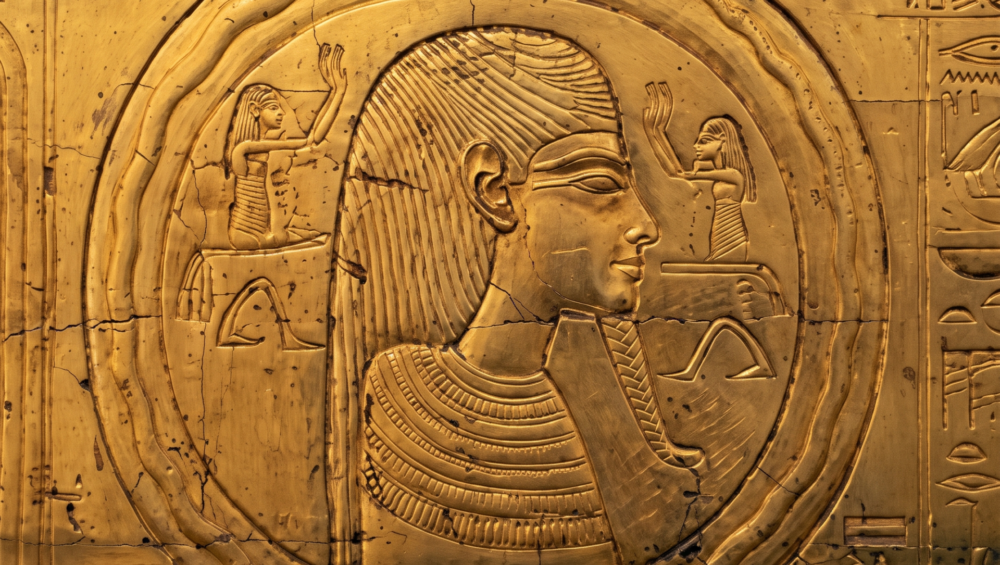
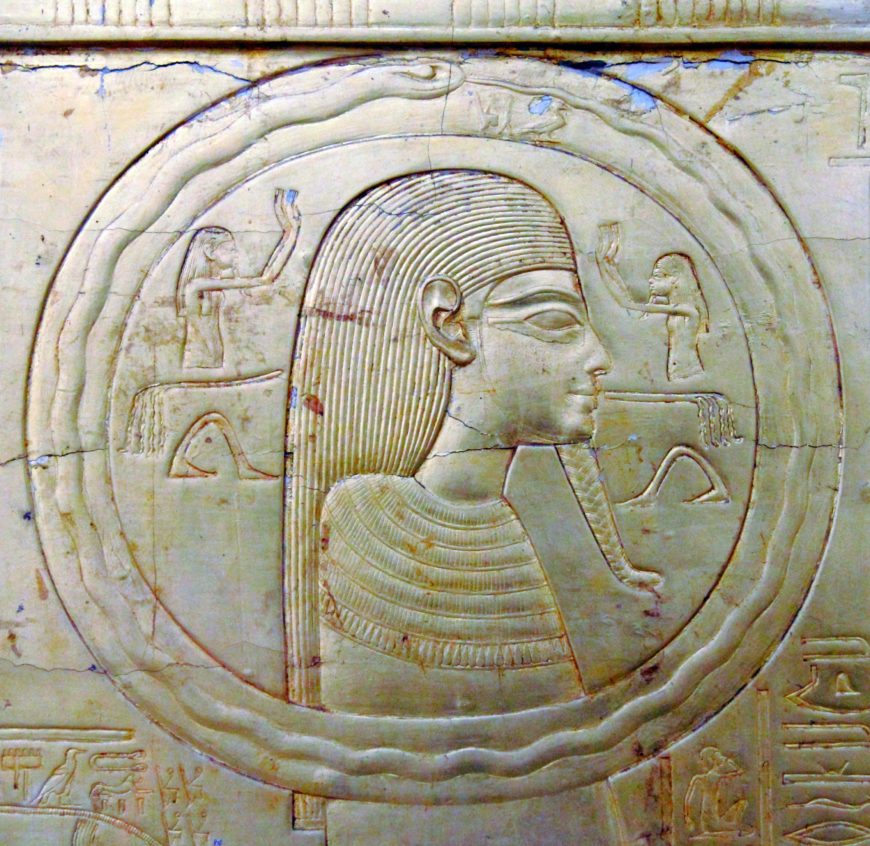
Ancient Egyptian artisans rarely used the Eye of Horus in isolation. On temple friezes, royal pectorals, and coffin lids, the Wedjat frequently appeared in deliberate combinations alongside other sacred hieroglyphs — each contributing a distinct aspect of divine blessing. For instance, while the Eye of Horus represents linear restoration and the healing of what was damaged, the Ouroboros symbol in ancient Egyptian history (the tail-devouring serpent that first appeared in New Kingdom royal underworld books such as the Enigmatic Book of the Netherworld on Tutankhamun's golden shrine) symbolizes the boundless, cyclical regeneration of time and the cosmos around the sun god.
| Symbol Name & Hieroglyph | Visual Form | Core Meaning & Religious Role | How It Relates to or Differs from the Eye of Horus |
|---|---|---|---|
| Eye of Horus (Wedjat) Gardiner D10 | Stylized human eye and eyebrow with falcon cheek markings. | Healing, restoration, wholeness, ritual offerings, and apotropaic protection. | Focuses specifically on repairing damage, restoring physical/cosmic integrity, and guarding against unseen harm. |
| Ankh (ꜥnḫ) Gardiner S34 | Looped cross (teardrop loop above a T-shaped crossbar). | Eternal life, vital breath, and divine animation given by the gods to the king. | Whereas the Ankh bestows the spark of life itself, the Wedjat protects and heals that life from injury; the two are often held together by winged eyes. |
| Djed Pillar (ḏd) Gardiner R11 | Flanged vertical column with four horizontal crossbars at the top. | Endurance, stability, permanence, and the reconstructed backbone of Osiris. | Both stem from the Osirian myth: the Djed represents Osiris's upright spine and permanence, while the Wedjat represents Horus's gift that revived him. |
| Was Scepter (wꜣs) Gardiner S40 | Long staff with a stylized canine/Set-animal head and forked base. | Dominion, royal power, and sovereign control over chaotic forces. | Frequently grouped with the Ankh and Djed beneath a Wedjat eye on temple walls to wish the king "All life, stability, dominion, and health." |
| Scarab Beetle (Kheper) Gardiner L1 | Sacred dung beetle (Scarabaeus sacer) rolling a sphere. | Dawn creation, self-generation, transformation ("coming into being"), and heart protection. | The scarab embodies solar morning rebirth (Khepri) and guarded the heart in the Weighing of the Heart, whereas the Wedjat guarded the embalming incision and outer body. |
| Ouroboros (Shed / Mehen) | Serpent curving in a circle with its tail inside its mouth. | Cosmic boundary between order and non-existence; eternal cyclical renewal of time. | Unlike the Wedjat (which heals a specific wound and serves as a wearable protective amulet), the Ouroboros originated as a cosmological boundary guardian in royal tomb theology. |
12. The Eye of Horus in Modern Culture
More than two thousand years after the last hieroglyphic inscription was carved at Philae, the Eye of Horus remains instantly recognizable around the globe. Its clean geometric lines have made it a favorite motif in contemporary silver and gold jewelry — still crafted by hand by silversmiths in Khan el-Khalili, which visitors often browse while exploring Cairo by night or attending traditional cultural performances at Wekalet El Ghouri — as well as in architectural art deco revivals, tattoo art, and modern brand iconography. Even in the history of Western medicine, medical historians have long debated whether the modern pharmacological prescription symbol Rx — while directly abbreviated from the medieval Latin imperative Recipe ("Take thou") and the astrological sign of Jupiter — also absorbed visual and conceptual echoes from the Roman-era invocation of the healing Eye of Horus.
At the same time, it is helpful to separate ancient Egyptian history from modern conspiracy theories and occult folklore. Because Renaissance hermeticism, eighteenth-century Freemasonry, and early twentieth-century esoteric movements (such as Aleister Crowley's Thelema) borrowed Egyptian motifs alongside the Christian/Deist "Eye of Providence" (the eye inside a triangle seen on the Great Seal of the United States), internet videos occasionally label the Eye of Horus an "Illuminati" or "Satanic" symbol. From an historical and archaeological standpoint, that claim is completely anachronistic: the concept of the biblical Satan did not exist in pharaonic Egyptian religion, and for ancient Egyptians the Wedjat was doing the exact opposite of promoting evil — it was a sacred emblem of divine healing, filial devotion, and the defense of cosmic justice (ma'at) against chaos.
13. Where Can You Learn More About the Eye of Horus in Egypt?
For travelers fascinated by ancient Egyptian symbolism, seeing the Eye of Horus in its original archaeological context — inlaid in royal gold, painted on cedar coffins, or carved twenty feet high across a Ptolemaic temple pylon — transforms an abstract drawing into living history. When organizing your itinerary with a practical guide to planning an Egypt trip, four destinations in Egypt offer extraordinary encounters with the mythology and artifacts of Horus:
- The Grand Egyptian Museum (Giza) and the Egyptian Museum (Tahrir, Cairo): Cairo's major museums house the world's richest collections of royal and private Wedjat amulets, funerary papyri, and painted coffins. Examining the royal jewelry from the tomb of Tutankhamun reveals winged Wedjat eyes crafted from gold, lapis lazuli, carnelian, and turquoise forming the centerpieces of the young king's funerary pectorals and bracelets, alongside thousands of New Kingdom and Late Period protective amulets.
- The Saqqara Necropolis and Giza Plateau: Inside the Fifth and Sixth Dynasty pyramids at Saqqara (such as the Pyramid of Unas and the Pyramid of Teti), the subterranean limestone walls preserve the earliest carved Pyramid Texts recounting how Horus presented his healed eye to Osiris. Travelers comparing day excursion options can review our Cairo and Giza day trip price breakdown as well as affordable pyramid tour options to match their schedule.
- The Temple of Horus at Edfu (Upper Egypt): Located on the west bank of the Nile between Luxor and Aswan — a highlight of any 7-day Egypt cultural itinerary or fully guided 7-day Egypt tour — the Ptolemaic Temple of Edfu (constructed between 237 and 57 BCE) is the best-preserved cult temple in Egypt and the supreme monument dedicated to Horus of Behdet. Its outer ambulatory wall preserves the complete carved drama of the Triumph of Horus over Set, while its inner offering chambers feature dozens of pristine reliefs showing the king presenting the Wedjat eye to Horus and Hathor.
- The Temple of Kom Ombo and Its Ancient Medical Reliefs: Situated south of Edfu and shared by Sobek and Haroeris (Horus the Elder, "the Good Doctor"), the Temple of Kom Ombo acted as an ancient center of healing where pilgrims sought cures under the watchful gaze of Horus. On the rear outer corridor wall, a famous Roman-period relief depicts surgical and medical instruments alongside two sacred Wedjat eyes and seated healing goddesses.
To make the most of your museum and temple visits across Upper and Lower Egypt, check our guides on the best time of year to visit Egypt, our transparent 2026 Egypt trip cost breakdown, and our practical advice on getting around Egypt between Cairo, Luxor, and Aswan — including the option of booking a private car with a dedicated driver in Egypt or joining a specialized women-only Cairo cultural tour.
Explore Egypt's Museums and Temples with a Private Egyptologist
Standing before a wall of hieroglyphs at the Grand Egyptian Museum or the Temple of Horus at Edfu is infinitely more rewarding when a qualified Egyptologist can read the royal cartouches, point out the offering formulas of the Wedjat eye, and connect the artifacts to the myths behind them. Discover how our private tours bring Egypt's heritage to life.
Explore Our Private Grand Egyptian Museum Tour14. Frequently Asked Questions About the Eye of Horus
What does the Eye of Horus mean?
In ancient Egyptian religion, the Eye of Horus — called the Wedjat ("the Whole One") — meant physical and spiritual healing, restoration to completeness, royal protection, and the triumph of cosmic order (ma'at) over chaos. It also served as the supreme symbol for every sacred offering presented to the gods and the dead.
Why did Horus lose his eye?
According to Egyptian mythology, Horus lost his left eye during a fierce battle against his uncle Set (Seth) to avenge the murder of Horus's father, Osiris, and reclaim the rightful throne of Egypt. During the combat, Set tore out, trampled, or gouged Horus's eye.
Who restored the Eye of Horus?
In the majority of funerary and religious texts (such as the Pyramid Texts and Book of the Dead), the ibis-headed god of wisdom and magic, Thoth, reassembled and healed Horus's injured left eye. In another literary version preserved in the New Kingdom tale The Contendings of Horus and Seth, the goddess Hathor restored Horus's eyes using the milk of a wild gazelle.
Is the Eye of Horus the same as the Eye of Ra?
No, though they are closely related counterparts. The Eye of Horus is predominantly associated with the left (lunar) eye, healing, restoration, and funerary offerings, whereas the Eye of Ra represents the right (solar) eye of the sun god Ra and acts as a fierce feminine defender (manifesting as Sekhmet, Hathor, or Wadjet) who destroys the sun god's enemies.
What is the Wedjat eye?
Wedjat (also spelled Udjat or Oudjat, from the Egyptian wḏꜣt) is the authentic ancient Egyptian name for the Eye of Horus. Derived from the verb wḏꜣ ("to be sound, intact, or healthy"), it literally translates as "The Whole One" or "The Uninjured/Restored Eye."
What does the Eye of Horus protect against in ancient Egyptian beliefs?
Ancient Egyptians believed the Eye of Horus protected against disease, physical wounds, venomous snakebites and scorpion stings, the envious "evil eye," shipwreck on the Nile or sea, and hostile underworld demons seeking to harm a deceased person's mummy.
Why was the Eye of Horus used in amulets?
Because the Wedjat represented an injured organ that had been miraculously made whole again by divine magic, wearing it as an amulet (crafted from faience, lapis lazuli, carnelian, or gold) transferred that same guarantee of bodily integrity and divine vigilance to the wearer, both in daily life and inside the tomb.
What do the six parts of the Eye of Horus represent?
Anatomically, the six strokes depict the eyebrow, pupil, inner and outer sclera corners, vertical falcon malar stripe, and curved cheek spiral. In Late Period and Ptolemaic temple traditions, these six strokes were equated with the six binary fractions of the heqat grain measure (1/2, 1/4, 1/8, 1/16, 1/32, and 1/64). The popular idea that the six parts also represent the "six human senses" is a modern twentieth-century interpretation rather than an explicit ancient Egyptian text.
Do the Eye of Horus fractions really add up to 63/64?
Yes. Adding the six binary fractions — 1/2 (32/64) + 1/4 (16/64) + 1/8 (8/64) + 1/16 (4/64) + 1/32 (2/64) + 1/64 (1/64) — equals exactly 63/64. In practical Egyptian grain accounting, quantities smaller than 1/64 of a heqat were measured in a smaller unit called the ro (1/320 of a heqat), while popular commentary often poetically links the missing 1/64 to Thoth's restorative magic.
Is the Eye of Horus connected to the moon?
Yes. In Egyptian cosmology, the sky god Horus's right eye was the sun and his left eye was the moon. The monthly waning of the moon and lunar eclipses were explained mythologically as Set injuring Horus's left eye, while the return of the full moon on the fifteenth day of the lunar month celebrated Thoth healing the eye back to full wholeness.
What is the difference between the Eye of Horus and the Eye of Ra?
The primary difference lies in their mythological roles and celestial associations: the Eye of Horus is the left, lunar eye of healing, restoration, and funerary offerings, while the Eye of Ra is the right, solar eye of fierce royal defense and destructive solar heat. Visually, the Eye of Ra is also frequently depicted as a sun disk encircled by a rearing cobra (uraeus).
Did ancient Egyptians wear the Eye of Horus in daily life?
Yes. Archaeological excavations of residential towns (such as Amarna, Deir el-Medina, and Lahun) confirm that living men, women, and children wore glazed faience, stone, and metal Wedjat amulets strung as necklaces, bracelets, and finger rings to guard their health.
Was the Eye of Horus used in burial practices?
Extensively. Embalmers placed a gold, wax, or faience Eye of Horus incision plate directly over the abdominal cut made to remove the internal organs, wove Wedjat amulets into the mummy's linen bandages, and painted pairs of Wedjat eyes on the outsides of coffins so the deceased could look out into the world and receive offerings.
Is the Eye of Horus a religious or magical symbol?
In ancient Egypt, it was both simultaneously. Egyptians did not separate religion from magic (heka); they viewed heka as a sacred divine force created by the gods to sustain the universe, heal the sick, and protect the dead through temple liturgy and amulets.
Can visitors see Eye of Horus artifacts in Egyptian museums?
Yes. Visitors to Egypt can view exquisite gold and semi-precious stone Wedjat pectorals, bracelets, and amulets (including those from the tomb of Tutankhamun) at the Grand Egyptian Museum in Giza, as well as hundreds of funerary amulets, painted Middle Kingdom coffins, and stelae at the Egyptian Museum in Tahrir Square and the Luxor Museum. Before booking your museum and plateau visits, you can check current Cairo and Giza pyramid tour prices and review our Egypt entry and visa requirements guide.
Is the Eye of Horus associated with Satan or the occult?
No. The Eye of Horus originated thousands of years before the Christian era in a polytheistic civilization that had no concept of the biblical Satan. In ancient Egyptian belief, the Wedjat was a deeply positive emblem of healing, filial devotion, and protection against evil and chaos; associations with the occult stem entirely from modern pop-culture misconceptions.
What is the difference between Horus and Wadjet?
Horus is the falcon-headed male deity of the sky and kingship whose healed eye is called the Wedjat (wḏꜣt, "the Whole One"). Wadjet (Wꜣḏyt, "the Green One") is the ancient cobra tutelary goddess of Lower Egypt, depicted as the rearing uraeus serpent on the pharaoh's crown. Although their names sound similar in English, they are two distinct deities with different Egyptian linguistic roots.
15. Conclusion: Why the Eye of Horus Still Captivates the World
Across more than three thousand years of human history, few symbols have carried as much emotional and theological weight as the Eye of Horus. Born from a myth of loss, family loyalty, and miraculous healing, the Wedjat spoke to one of humanity's deepest hopes: that what has been broken by violence, illness, or death can be made whole again. Whether carved in miniature turquoise faience for an ordinary villager along the Nile, inlaid in solid gold and lapis lazuli on the chest of Tutankhamun, or chiselled into the towering sandstone walls of the Temple of Edfu, the Eye of Horus united royal power, medical science, mathematics, and eternal afterlife beliefs into a single, unmistakable silhouette.
When you understand the real history behind the Wedjat — distinguishing its ancient roots from modern myths — every museum gallery and temple relief in Egypt begins to speak in a clearer voice. If reading about Egypt's sacred symbols inspires you to see these masterpieces in person, our team can help you customize your Egypt cultural itinerary with private Egyptologist guides who bring every inscription to life.
Turn Your Fascination with Ancient Egypt into a Personalized Journey
From the royal jewelry galleries of the Grand Egyptian Museum and the Old Kingdom Pyramid Texts of Saqqara to the magnificent Sanctuary of Horus at Edfu, our private Egyptologists craft seamless itineraries tailored to your pace and curiosity.
Customize Your Tailor-Made Egypt TourAcademic, Museum & Egyptological Sources
Mythological narratives, linguistic transliterations, mathematical analyses, and artifact descriptions in this article were verified against the following authoritative museum and academic Egyptology sources:
- Encyclopaedia Britannica — Eye of Horus (Wedjat): Ancient Egyptian Symbol and Mythology.
- University College London (UCL) — Digital Egypt for Universities: Amulets in Ancient Egypt (Petrie Museum Classification).
- The Metropolitan Museum of Art — Department of Egyptian Art Collection & Heilbrunn Timeline of Art History.
- The British Museum — Egyptian Death and Afterlife: Mummies, Book of the Dead of Hunefer (EA 9901), and Funerary Amulets.
- Andrews, Carol (1994) — Amulets of Ancient Egypt, London: British Museum Press, pp. 43–44 ("The Wedjat-eye").
- Pinch, Geraldine (2002) — Handbook of Egyptian Mythology, Santa Barbara: ABC-CLIO, pp. 131–132, 143–146.
- Wilkinson, Richard H. (1992) — Reading Egyptian Art: A Hieroglyphic Guide to Ancient Egyptian Painting and Sculpture, London: Thames & Hudson, pp. 42–43 ("The Eye of Horus").
- Ritter, Jim (2002) — "Closing the Eye of Horus: The Rise and Fall of 'Horus-Eye' Fractions," in J. M. Steele and A. Imhausen (eds.), Under One Sky: Astronomy and Mathematics in the Ancient Near East, Münster: Ugarit-Verlag, pp. 297–323.